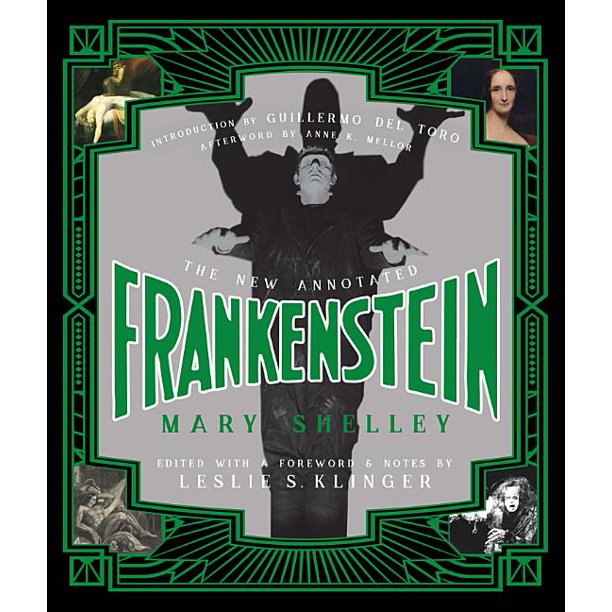
In an earlier piece on Mary Shelley, I discussed Brian Aldiss's suggestion that she should be regarded as the founder of the modern genre of Science Fiction. The appearance of this new film by horror maestro Guillermo del Toro offers a chance to reexamine the question from a rather different angle.
What exactly is Frankenstein?

Well, on the surface, it's clearly a Gothic novel written in the mode pioneered by William Beckford (Vathek, 1786); Ann Radcliffe (The Mysteries of Udolpho, 1794); Matthew "Monk" Lewis (The Monk, 1796), and many, many others - including Mary Shelley's own husband Percy, who'd published two such romances as a schoolboy: Zastrozzi (1810) and St. Irvyne; or, The Rosicrucian (1811).
But if that were all it is, then Frankenstein would presumably have long since achieved honourable oblivion along with most of the other specimens of the genus: except, of course, for Jane Austen's lively satire Northanger Abbey - written in 1799, but not published (posthumously) until 1817.
Guillermo del Toro's own work is (according to Wikipedia):
characterized by a strong connection to fairy tales, gothicism and horror, often blending the genres, with an effort to infuse visual or poetic beauty in the grotesque.That list of influences - fairy tales, gothicism and horror - is certainly vital when it comes to defining his approach to Frankenstein.

As far as Horror goes, Shelley's monster certainly has a far worse temper than del Toro's. He kills Victor Frankenstein's young brother William, his friend Henry Clerval, and Victor's bride Elizabeth Lavenza on their wedding night. Worse than that, he contrives to frame a faithful family servant for the murder of little William. Despite his suspicions, Victor doesn't try to prevent her execution for the crime.

Del Toro's monster, by contrast, is a gentle pastoralist and an innocent victim of circumstances. He's constantly being blamed for murders he didn't commit, and even when Victor tries to kill him with a pistol - and instead ends up shooting his brother's bride in the stomach - Victor still manages to read this as somehow the monster's fault.
There's an inordinate amount of shooting in del Toro's film, in fact. Hunters, villagers, sailors - all seem to have loaded muskets ready to fire at the drop of a hat. Shelley herself is more sparing with the special effects, so the one significant exception - when the monster is shot by the father of a young girl he's just saved from drowning - has far more resonance.


When it comes to Gothic, it's important to remember that despite our associations with clanking chains and gloomy old castles, it's a far more varied genre than one might have expected.
Yes, it's a repository for dream imagery and extreme emotions: the repressed unconscious of the Age of Reason. But it's also associated with hidden knowledge and forbidden lore. One of Percy Shelley's novellas was about a Rosicrucian. Mary Shelley's own introduction to the 1831 revised edition of her novel (the first to include her name as its author) sums up perfectly the fusion of these ideas:
I saw - with shut eyes, but acute mental vision - I saw the pale student of unhallowed arts kneeling beside the thing he had put together. I saw the hideous phantasm of a man stretched out, and then, on the working of some powerful engine, show signs of life, and stir with an uneasy, half vital motion. Frightful must it be; for supremely frightful would be the effect of any human endeavour to mock the stupendous mechanism of the Creator of the world.It's phrases such as "unhallowed arts" and "mocking the stupendous mechanism of the Creator of the world" which stand out here, rather than the scientific trappings with which she also adorns her story: for instance, "the experiments of Dr. Darwin, ... who preserved a piece of vermicelli in a glass case, till by some extraordinary means it began to move with voluntary motion."
Perhaps a corpse would be re-animated; galvanism had given token of such things: perhaps the component parts of a creature might be manufactured, brought together, and endued with vital warmth.It's worth noting that the word "scientist" was not yet in common use. "Natural Philosopher" was the only description readily to hand. Mary herself appears to prefer the term "artist":
His success would terrify the artist; he would rush away from his odious handywork, horror-stricken. He would hope that, left to itself, the slight spark of life which he had communicated would fade; that this thing, which had received such imperfect animation, would subside into dead matter; and he might sleep in the belief that the silence of the grave would quench for ever the transient existence of the hideous corpse which he had looked upon as the cradle of life. He sleeps; but he is awakened; he opens his eyes; behold the horrid thing stands at his bedside, opening his curtains, and looking on him with yellow, watery, but speculative eyes.Brrr! That Mary Shelley certainly could write. I love that description of the thing's "yellow, watery, but speculative eyes" ... Not only was her story conceived in a dream, but her intention here - and in other passages - seems to be to recall the atmosphere of a nightmare.

So don't be too misled by the affectionate parody behind Jane Austen's famous list of "horrid novels" in chapter six of Northanger Abbey:
"... Castle of Wolfenbach, Clermont, Mysterious Warnings, Necromancer of the Black Forest, Midnight Bell, Orphan of the Rhine, and Horrid Mysteries. Those will last us some time.”Not only are they "horrid", but they're also quite real. The Folio Society published a box-set of all seven in 1968, and followed it up a few years later with an edition of Ann Radcliffe's six novels in the same vein.
“Yes, pretty well; but are they all horrid, are you sure they are all horrid?”


Which brings us to fairy tales. There was a time when this term would have led us to visualise dew-sipping flower-fairies with diaphanous wings - the Cottingley Fairy photographs, for instance, along with the literature which inspired them.
Ever since the appearance of J. R. R. Tolkien's influential essay "On Fairy-stories" in 1947, however - reprinted in Tree and Leaf in 1964 - the concept of Faerie as a destination, rather than simply a species of diminutive, supernatural creatures, has transformed our approach to the subject.

The statement in Wikipedia's Guillermo del Toro article that:
He has had a lifelong fascination with monsters, which he considers symbols of great powerapplies, then, just as much to his interest in fairy-stories as it does to his taste for Gothic horror.
Fairy-stories, after all (whether traditional or literary) generally embody some kind of quest, and thus have a tendency to reenact Vladimir Propp's classic breakdown of the narrative structure of a folktale:

Frankenstein's Monster is far from a conventional Fairy-tale hero, but he certainly has his avatars in the folktale tradition. He's a kind of holy innocent (or, if you prefer, Rousseau-istic noble savage). Both Boris Karloff (in James Whale's classic Frankenstein of 1931) and Jacob Elordi (in del Toro's film) play him as a creature whose innate good nature is gradually corrupted by the brutality and suspicion which surround him - not to mention Victor's primal act of abandonment of his own, self-created child.


It's this aspect of the monster which transforms Mary Shelley's gothic novel into a more potent myth of despair and redemption. Anticipating Stevenson's Dr Jekyll and Mr Hyde by almost a century, she reverses the positions of Monster and Creator. It's Victor who's the real monster, in virtually every version of the story.

It's for this reason that, in Víctor Erice's Spanish Civil War film El espíritu de la colmena [Spirit of the Beehive] - a masterpiece which del Toro constantly references in his own work (either directly, as in Pan's Labyrinth, or indirectly, as in the elven scenes of The Golden Army) - it's the Spirit embodied in Frankenstein's Monster who inspires the little girl to try to help a wounded Republican soldier.
Another avatar exerting a strong influence over del Toro's film is David Lynch's Elephant Man - in particular the scene where John Hurt, playing the monster, is cornered in a public lavatory by a crowd of angry townies, and quells them with a speech which Jacob Elordi seems, at times, on the verge of uttering in propria persona.


Does all of this help? This labyrinth of references, this visual library of clues, this invocation of the great symbolic performances of the past?
I'm inclined, much against my will, to conclude not. Jacob Elordi's performance as the monster is flawless and intuitive. He stands with any of the other greats who've inhabited the role. The sublime Mia Goth, too, brings an unexpected breath of fresh air to an otherwise emotionally claustrophobic film.

There's so much to admire in Guillermo del Toro's film! And yet it's not, in the end, particularly likeable. It dissolves into a series of amazing set and character designs. Unlike James Whale's twin masterpieces, Frankenstein (1931) and Bride of Frankenstein (1935), del Toro's version lacks the humorous exuberance of his own two almost criminally entrancing Hellboy movies.
And yet I'm sure that I'll watch it again - if only to savour Elordi and Goth at work - and, more importantly, I feel that it's helped to enhance my appreciation of Mary Shelley's genius. That her novel can still be such a source of inspiration two hundred years after it was first written is in itself astonishing.
Under the circumstances, it's hardly surprising that the most potent image left to us by all this plethora of Frankensteins large and small is that of a hastily married, recently bereaved young woman scratching away with a quill-pen in a villa by Lake Geneva, halfway through the notorious year without a summer, 1816.


-
Film:
- Doña Lupe [short film] (1985)
- Geometría [short film] (1987)
- Cronos (1992)
- Mimic (1997)
- El espinazo del diablo [The Devil's Backbone] (2001)
- Hellboy (2004)
- Hellboy, dir. & writ. Guillermo del Toro – with Ron Perlman, Selma Blair, Karel Roden, Rupert Evans, Jeffrey Tambor, John Hurt – (USA, 2004)
- El laberinto del fauno [Pan's Labyrinth] (2006)
- Pan’s Labyrinth, writ. & dir. Guillermo del Toro – with Sergi López, Maribel Verdú, Ivana Baquero – (Spain / Mexico, 2006)
- Hellboy II: The Golden Army (2008)
- Hellboy II: The Golden Army, dir. & writ. Guillermo del Toro – with Ron Perlman, Selma Blair, Doug Jones, Jeffrey Tambor, John Hurt – (USA, 2008)
- Pacific Rim (2013)
- Crimson Peak (2015)
- The Shape of Water (2017)
- Nightmare Alley (2021)
- [with Mark Gustafson] Pinocchio (2022)
- Frankenstein (2026)
- Blade II (2002)
- Don't Be Afraid of the Dark (2010)
- [co-written] The Hobbit: An Unexpected Journey (2012)
- The Hobbit: An Unexpected Journey (Extended DVD Edition), dir. Peter Jackson, writ. Fran Walsh, Philippa Boyens, Peter Jackson, Guillermo del Toro (based on the novel by J. R. R. Tolkien) – with Ian McKellen, Martin Freeman, Richard Armitage, James Nesbitt, Ken Stott, Sylvester McCoy, Cate Blanchett, Ian Holm, Christopher Lee, Hugo Weaving, Elijah Wood, Andy Serkis – (NZ/USA, 2012)
- [co-written] The Hobbit: The Desolation of Smaug (2013)
- The Hobbit: The Desolation of Smaug (Extended DVD Edition), dir. Peter Jackson, writ. Fran Walsh, Philippa Boyens, Peter Jackson, Guillermo del Toro (based on the novel by J. R. R. Tolkien) – with Ian McKellen, Martin Freeman, Richard Armitage, James Nesbitt, Ken Stott, Sylvester McCoy, Cate Blanchett, Ian Holm, Christopher Lee, Hugo Weaving, Elijah Wood, Andy Serkis – (NZ/USA, 2013)
- [co-written] The Hobbit: The Battle of the Five Armies (2014)
- The Hobbit: The Battle of the Five Armies (Extended DVD Edition), dir. Peter Jackson, writ. Fran Walsh, Philippa Boyens, Peter Jackson, Guillermo del Toro (based on the novel by J. R. R. Tolkien) – with Ian McKellen, Martin Freeman, Richard Armitage, James Nesbitt, Ken Stott, Sylvester McCoy, Cate Blanchett, Ian Holm, Christopher Lee, Hugo Weaving, Elijah Wood, Andy Serkis – (NZ/USA, 2014)
- [story] Scary Stories to Tell in the Dark (2019)
- The Witches (2020)
- Trollhunters: Rise of the Titans (2021)
- Un embrujo (1998)
- Crónicas (2004)
- Insignificant Things (2008)
- Rudo y Cursi (2008)
- Rabia (2009)
- Julia's Eyes (2010)
- The Book of Life (2014)
- Pacific Rim Uprising (2018)
- Antlers (2021)
- The Boy in the Iron Box (TBA)
- Dona Herlinda and Her Son (1985)
- The Orphanage (2007)
- While She Was Out (2008)
- Splice (2009)
- Puss in Boots (2011)
- The Captured Bird [short film] (2012)
- Rise of the Guardians (2012)
- Mama (2013)
- Kung Fu Panda 3 (2016)
- La hora marcada (1986–1989)
Wrote & directed episodes "Hamburguesas", "Caminos de ayer", "Con todo para llevar" & "Invasión"; directed "Les gourmets"
- The Simpsons (2013)
Opening sequence of episode "Treehouse of Horror XXIV"
- The Strain (2014–2017)
Wrote & directed episode "Night Zero"; directed prologue of episode "BK, NY"; directed Luchador sequence in episode "The Silver Angel"
- Trollhunters: Tales of Arcadia (2016–2018)
Wrote & directed episodes "Becoming: Part 1 & 2"; directed episodes "The Eternal Knight: Part 1 & 2"
- 3Below: Tales of Arcadia (2018–2019)
Wrote & directed episodes "Terra Incognita: Part 1 & 2"
- Carnival Row (2019)
Original story
- Wizards: Tales of Arcadia (2020)
Wrote episodes "Spellbound" & "History in the Making"
- Guillermo del Toro's Cabinet of Curiosities (2022)
Showrunner; wrote episode "Lot 36"; wrote story of episode "The Murmuring"
- [writer & voiceover director] Hellboy: The Science of Evil (2008)
- [director] P.T. (2014)
- [character likeness]] Death Stranding (2019)
- [writer & producer] Trollhunters: Defenders of Arcadia (2020)
- [character likeness] Death Stranding 2: On the Beach (2025)
- Alfred Hitchcock (1990)
- La invención de Cronos (1992)
- Hellboy: The Golden Army Comic (2008)
- Hellboy II: The Art of the Movie (2008)
- The Monsters of Hellboy II (2008)
- The Strain [novel] (2009)
- The Fall [novel] (2010)
- Don't Be Afraid of the Dark: Blackwood's Guide to Dangerous Fairies (2011)
- The Night Eternal [novel] (2011)
- Cabinet of Curiosities: My Notebooks, Collections, and Other Obsessions (2013)
- Cabinet of Curiosities: My Notebooks, Collections, and Other Obsessions. Ed. Marc Scott Zicree. Foreword by James Cameron. Contributions by Tom Cruise, Alfonso Cuaron, Cornelia Funke, Neil Gaiman, John Landis, Mike Mignola, Ron Perlman & Adam Savage. An Insight Editions Book. Harper Design. New York: HarperCollins Publishers, 2013.
- [with Daniel Kraus] Trollhunters (2015)
- The Shape of Water (2018)
- At Home With Monsters (2019)
- Pan's Labyrinth: The Labyrinth of the Faun (2019)
- The Hollow Ones (2020)
- The Boy in the Iron Box Series (2024)
Director & Writer:
Director:
Writer:
Producer:
Executive producer:
Television:
Video games:
Books:

•