I thought I'd start off by quoting a poem by New Zealand writer - and WWII soldier - Kendrick Smithyman (1922-1995):
Reading Quasimodo


            remembering (thinking I remembered?)
(I’d been reading Quasimodo) reading about
night, when bombers came.
Gunfire downriver announced:
     noise, in what folk formerly called
"the Heavens", as though it were all
an oldfashioned playhouse, open to
elements. We waited moonrise, the moon rose
flowering past cross stations, beyond simile.
It was the moon. It did not flower.
     The bombers came. They were bombers
not monotone birds. They’d no fine feathers.
They let fall neither eggs nor untimely dung.
They were searching the river, they found
the river. They looked for docks, ware
houses, power plants. In their foreign language
they droned, tediously debating.
     We burned angrily. That was the night
the sugar refinery flared, and ran.
Tenders, men with hoses, trapped
in floods of toffee, baked. Charred,
glazed, innocent of carnival.
Incendiaries fell in course.
Some wasted among park trees, some in roosts
on storage depots, factories, wharf sheds,
fragmented. Flocks shocked by noise dazed
by lights caught fire, rose and flew.
Sparks did not fly like birds, they were birds.
Truly, we did this, we saw that? Truly, we did.

20.7.85

I've talked about this poem before, in an 2003 essay entitled "Smithyman / Quasimodo". What I said about it then seems worth repeating now:
The poem is a maze of contradictions, of memories cancelling each other out. “the moon rose / flowering past cross stations, beyond simile. / It was the moon. It did not flower.” Did the moon rise flowering? No, of course it didn’t. It was the moon. Moons don’t “flower.” “The bombers came. They were bombers / not monotone birds.” They weren’t birds, they had no feathers, they didn’t lay eggs or “untimely dung” – they were bombers. They dropped bombs.It is (presumably) a dream poem - or at least a false memory poem. Smithyman never had to endure a bombing. As a World War II serviceman he was (briefly) posted to Norfolk Island, but he had no combat experience. He served first as a bombadier in the New Zealand Army artillery (1941–1942), then as a quartermaster in the Royal New Zealand Air Force (1942-1945).
“Beyond simile” is the key phrase here. When experience becomes ungraspable, unbelievable, it becomes pointless to look for analogies. How can one define the indefinable? How can one believe that such things happened? “Truly, we did this, we saw that?” They did. “Truly, we did.” They do.
The sparks “did not fly like birds,” they were birds.
There's much more to it than vicarious war envy, though, I think. I concluded my essay by saying:
Kipling once said that when you knew how to do something, it was time to do something you couldn’t. In some ways, late Smithyman was in his most experimental phase, most anxious to attempt the peaks he’d never managed before. Quasimodo, then, can be seen as one of the vehicles he employed to express the hitherto inexpressible: moral indignation, rage against pain and injustice – those things we want so desperately to say but which tend to choke us the moment we begin.

Smithyman's book of translations from most of the major modern Italian poets took him roughly ten years to compile. It was substantially complete by 1993, when he first submitted it for publication. However, it didn't actually appear until 2004, a decade after his death, in an edition edited by me. It was subsequently reprinted, in slightly enlarged form, with an introduction by Italian scholar Marco Sonzogni.
Salvatore Quasimodo is (by far) the most comprehensively represented writer. Smithyman included substantial selections from all of his major books of poems, to the point where it almost became a collected edition. So what was it about the older poet that appealed to him so much?
I listed the resemblances between the two poets in the essay mentioned above:
Some similarities at once stand out. Both came from the backblocks (Modica, Sicily; Te Kopuru, Northland) to the metropolis, and for both this remained a dominant theme. Both had rather muted war service, apparently preferring the role of spokesperson to Byronic (d’Annunzio-esque) man-of-action. Despite some striking successes in that genre, both found the role of love poet difficult to sustain. The differences, though, are even more striking:I think that translating Quasimodo enabled Smithyman not only to try on a new hat - that of poète engagé - but even to create an entire alternate self. He couldn't quite see himself as Montale, though some of his versions of the latter's poems are (in my opinion) among the best ever made. Quasimodo, though - that shift from hermetic impenetrability to resonant self-identification with the sufferings of his people offered a parallel to Smithyman's own progress from daunting intellectualism to an increasingly relaxed anecdotal interest in the places and folk he knew so well.
Quasimodo is a poet apotheosised by crisis. His early work, collected in Ed è subito sera [Suddenly, Evening] (1942), was fierce enough. The indignation of these poems at the fact of death: death of love, destruction of the natural world, immediately distinguished him from his more urbane contemporaries. However, it was the Second World War which really defined him. The editor of his complete poems remarks: “While remaining antifascist, he [didn’t] take an active part in the resistance.” All that changed in 1946-47, with the issue of his collection of war poems Giorno dopo giorno [Day after day], welcomed for its assertion of a “reclaimed human dignity.” It won him a Nobel Prize in 1959.
Smithyman, on the other hand, is a poet bound up by landscape (particularly the Northland he grew up in and continually revisited), and language (the convolutions and ambiguities of English syntax) – a writer intensely suspicious of grand attitudes and romantic self-aggrandisement.
Whatever the reasons, Smithyman the Italian poet manqué opened up a fascinating new door to me when I first read a typescript of these translations in the late 1990s. Quasimodo was not much more than an amusingly incongruous name to me at the time - though I did know that he came from Sicily, like prominent anti-fascist Elio Vittorini (who married his sister), and the aristocratic Giuseppe Tomasi di Lampedusa (author of The Leopard). That was about it. I've tried to make up for that ignorance since.


Il mio paese è l'Italia Più i giorni s'allontanano dispersi e più ritornano nel cuore dei poeti. Là i campi di Polonia, la piana dì Kutno con le colline di cadaveri che bruciano in nuvole di nafta, là i reticolati per la quarantena d'Israele, il sangue tra i rifiuti, l'esantema torrido, le catene di poveri già morti da gran tempo e fulminati sulle fosse aperte dalle loro mani, là Buchenwald, la mite selva di faggi, i suoi forni maledetti; là Stalingrado, e Minsk sugli acquitrini e la neve putrefatta. I poeti non dimenticano. Oh la folla dei vili, dei vinti, dei perdonati dalla misericordia! Tutto si travolge, ma i morti non si vendono. Il mio paese è l'Italia, o nemico più straniero, e io canto il suo popolo, e anche il pianto coperto dal rumore del suo mare, il limpido lutto delle madri, canto la sua vita. - Salvatore Quasimodo (1946)• The more days move off into distance scattering themselves, the more they return to hearts of the poets. There fields of Poland, the Kutno plain with hill of corpses burning in clouds of naphtha, there barbed wire fences quarantining Israel, refuse soaked with blood, the fever-pitch uprising, the chains of wretches dead long ago, struck down in their trenches dug by their own hands, Buchenwald is there that mild-mannered beech wood with its accursed ovens: Stalingrad and Minsk with its marshes and rotten snow. Poets do not forget. Oh hordes of the lowly, the conquered, those forgiven out of pity! All things may pass, but the dead do not sell themselves. My country is Italy, felt to be alien more than estranged. I sing the people, also their grief muffled by sound of the sea, the mothers’ crystal-clear mourning: I sing the life of my country.
- trans. Kendrick Smithyman (1993)

Like so many of the other poets included in this series, Quasimodo was himself a translator. As you can see from the bibliography below, he took it much further than most. It was his major source of income for many years - until, in fact, he won the Nobel Prize for Literature in 1959. I myself own a copy of his delightful early book of Ancient Greek lyrics, a bestseller which helped to keep him solvent for many years.

The works he translated ranged from classics such as Catullus, Virgil, Homer and the Greek dramatists, to moderns such as Conrad Aiken, e. e. cummings, and Pablo Neruda. His languages included Greek, Latin, English, French, Spanish - even Romanian.
As for his own work, it's hard to improve on the brief summary appended to his Wikipedia biography:
Traditional literary critique divides Quasimodo's work into two major periods: the hermetic period until World War II and the post-hermetic era until his death. Although these periods are distinct, they can be seen as a single poetical quest. This quest or exploration for a unique language took him through various stages and various modalities of expression.The poem above, "Italy is my country", with its resonant claim that "Poets do not forget", is - I suppose - an example of this "bitterness". It's certainly full of disgust and shame at the massacres and death-camps which need now to be tabulated in order to prevent their repetition. We've done a great job of that!
... Quasimodo used a hermetical, "closed" language to sketch recurring motifs like Sicily, religion and death. Subsequently, the translation of authors from Roman and Greek Antiquity enabled him to extend his linguistic toolkit. The disgust and sense of absurdity of World War II also had an impact on the poet's language. This bitterness, however, faded in his late writings and was replaced by the mature voice of an old poet reflecting upon his world.
"The mature voice of an old poet reflecting upon his world" sounds a little less thrilling, but as you can see from the poem below, Quasimodo had no intention of going gentle into that good night ...

Ho fiori e di notte invito i pioppi (Ospedale di Sesto S.Giovanni, novembre 1965) La mia ombra è su un altro muro d’ospedale. Ho fiori e di notte invito i pioppi e i platani del parco, alberi di foglie cadute, non gialle, quasi bianche. Le monache irlandesi non parlano mai di morte, sembrano mosse dal vento, non si meravigliano di essere giovani e gentili: un voto che si libera nelle preghiere aspre. Mi sembra di essere un emigrante che veglia chiuso nelle sue coperte, tranquillo, per terra. Forse muoio sempre. Ma ascolto volentieri le parolle della vita che non ho mai inteso, mi fermo su lunghe ipotesi. Certo non potró sfuggire; sarò fedele a la vita e a la morte nel corpo e nello spirito in ogni direzione prevista, visibile. A intervalli qualcosa mi supera leggero, un tempo paziente, l’assurda differenza che corre tra la morte e l’illusione del battere del cuore - Salvatore Quasimodo• My shadow’s on the other wall of the hospital there are flowers here At night I ask in poppies and plane trees from the park skeleton boughs with leaves bled white The Irish nuns never mention death as they waft about the wards so casual at being young and kind (unanswered prayer) I feel like an Ellis Island immigrant lying swaddled on the ground Perhaps I’ll be dying for good overhearing rumours which I’ve never understood at the end of theory I can’t run away stuck with being faithful to my visible means of decay I can see the absurdity of choosing between death and this illusion boom-boom the heart
- trans. Jack Ross (7/9/99-18/2/2000)

Quasimodo moved north to Rome from his native Sicily in 1919 to complete his engineering studies. Unable to find work in his field, he worked as a draughtsman and continued to write in a desultory fashion. Finally, in 1930, he took a job with Italy's Civil Engineering Corps in Reggio Calabria, at the foot of Italy. That was also the year he published his first collection, Acque e terre ["Waters and Lands"].
In 1934 he moved to Milan, where he made his home for the rest of his life. He became a full-time writer and translator in 1938.
The poem reprinted below, "Antico inverno", comes from that first 1930 collection. It's a good example of his earliest, most "hermetic" mode, and should provide a good contrast with his more humanist, post-1946 style. It's been extensively translated:

-
Antico inverno
- Ancient Winter
- Ancient Winter
- Winter in the Old Days
- Old Winter
- Old Winter
- Ancient Winter [1]
- Old Winter
- Salvatore Quasimodo (1930)
Desiderio delle tue mani chiari
nella penombra della fiamma:
sapevano di rovere e di rose;
di morte. Antico inverno.

Cercavano il miglio gli uccelli
ed erano sùbito di neve;
così le parole:
un po’ di sole, una raggiera d’angelo,
e poi la nebbia; e gli alberi,
e noi fatti d’aria al mattino.

- trans. George Kay (1958)
Desire of your clear hands
in the half light of the flame;
they smelt of oakwood and roses;
of death. Ancient winter.

The birds looked for their grain
and were suddenly of snow;
similarly words;
a little sun, an angel’s glory,
and then the mist; and the trees,
and us made of air in the morning.

- trans. Jack Bevan (1965)
Desire of your bright
hands in the flame’s half-light;
flavour of oak, roses
and death.

Ancient winter.

The birds seeking the grain
were suddenly snow.

So words:
a little sun; a haloed glory,
then mist; and the trees
and us, air, in the morning.

- trans. Kendrick Smithyman (1993)
Desire of your clear hands
in the half-light of the flame:
they smelt of oak and of roses;
of death. Ancient winter.

The birds searched for millet
and were all in a moment snow;
likewise with words:
a little sun, an angel’s splendour,
then the mist, and the trees,
ourselves made of air in the morning.

- trans. Jack Ross (2010)
Desire for your clear hands
in the half-light of the flame:
They smelt of oak and of roses;
Of death. Old winter.

The birds looked for millet
and were suddenly of snow;
the same with words:
a little sun, an angelic halo,
and then the fog; and the trees,
and us made of air in the morning.

- trans. Anna & Ben (2010)
will clear your hands
in the shadow of the flame
knew oak and roses
death    Ancient winter

The birds tried
& suddenly the snow
if the words
one a little sunshine    my angel
then the fog and trees
& we in the morning air

- trans. Andy Fleck (2012)
Desire of your hands white
in the penumbra of the flame:
they had the fragrance of oakwood and roses;
of death. Ancient Winter.
The birds looked for their grain
and were suddenly of snow;
similarly words;
a little sun, an angel’s glory,[2]
and then the mist, and the trees
and us made of air in the morning.
Notes:
1. From The Penguin Book of Italian Verse, Ed. George Kay, Penguin 1958. The above translation is an adaptation of his prose translation.
2. Luciano Rebay (Introduction to Italian Poetry, Dover, 1991) translates this as ‘an angel’s halo’.

- trans. Claire Roberts (2015)
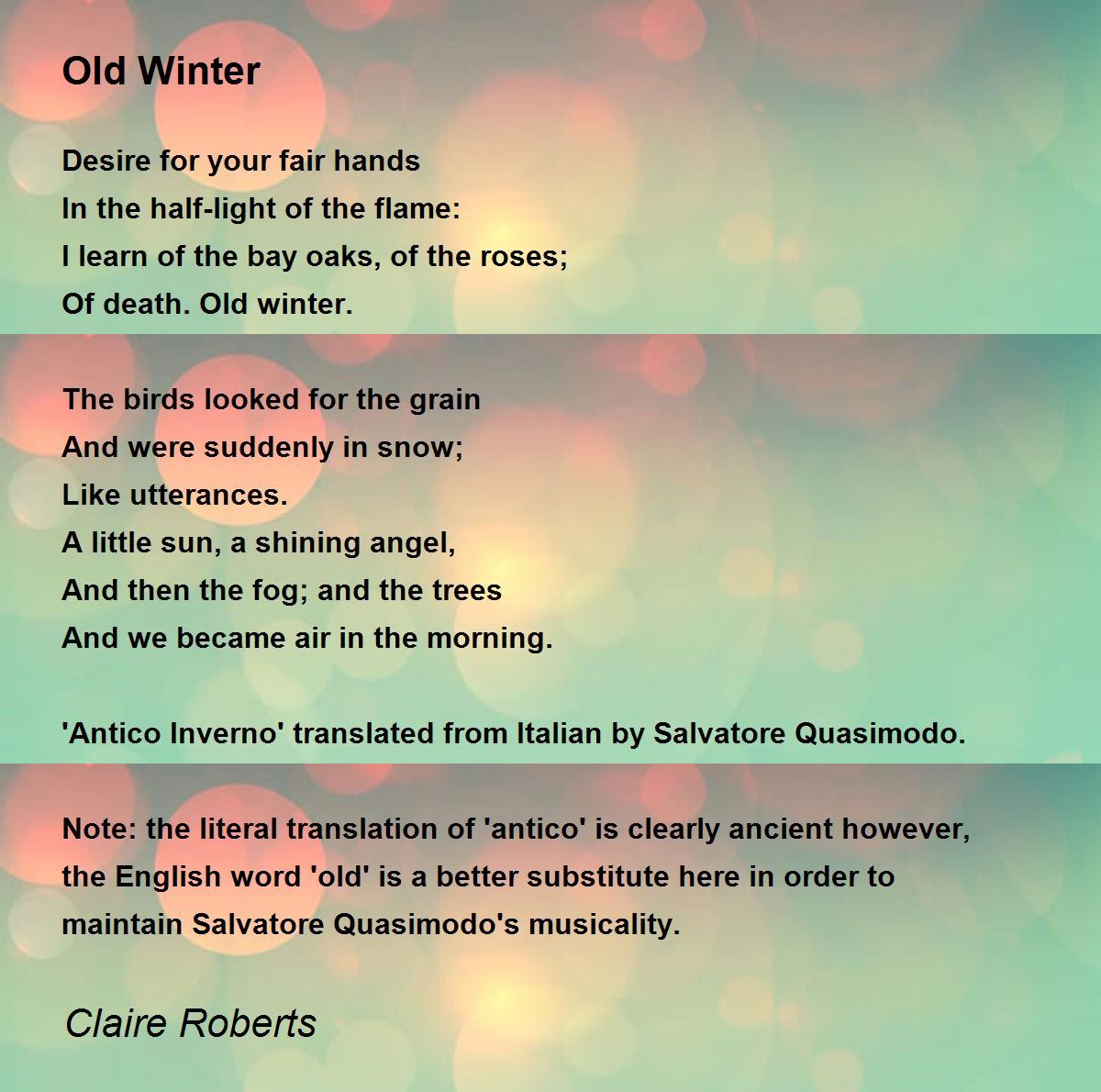
Desire for your fair hands
In the half-light of the flame:
I learn of the bay oaks, of the roses;
Of death. Old winter.

The birds looked for the grain
And were suddenly in snow;
Like utterances.
A little sun, a shining angel,
And then the fog; and the trees
And we became air in the morning.

Why exactly does Quasimodo describe the winter as "antico" [old / antique / ancient]? Clearly it's in the past - his own past, presumably, given the references to the poet's "desire" for the woman's hands lit up by the fire. But is it perhaps an old picture rather than a personal memory? No, it seems too circumstantial for that.
Why do her hands smell of "death" as well as "oakwood and roses"? Is it a dead lover he's addressing? One might guess as much, given the elegiac tone of the memories he's invoking.
It's a classic example of Quasimodo's early hermeticism: much is evoked and gestured towards, but nothing is really spelt out. In subject matter it resembles Montale's "Casa dei Doganieri", but the stylistic contrast between the two poems - both written at much the same time, around 1930 - tells you a great deal about the two poets. Montale's is full of complex conceits and muscular reasoning around the basic concept of memory. Quasimodo's is all air and evanescence: an attempt to recreate an impression without the "irritable reaching after fact and reason" which John Keats defined as the signature characteristic of Negative Capability.
As far as the seven translations go, there's little disagreement on the meanings of the words. It's not an obscure poem in that respect. But interpretations of the precise implications of Quasimodo's phrases are surprisingly varied. George Kay's "Desire of your clear hands" seems like curious English to me. Surely it would be more idiomatic to say "desire for your clear hands"? Unless, that is, he means to imply that the hands themselves are experiencing desire.
The only two translators who substitute "for" for "of" in this opening line are myself and Claire Roberts, however.
Jack Bevan, the translator of Quasimodo's Complete Poems (1983), has given us a very fine version. He's relineated it to bring out the meaning more clearly, and subtly condensed the wording of Kay's more literal translation. If you want to understand the poem while still feeling that it is a poem, his is surely the one to go for.
Kendrick Smithyman's is little more than a tidied up version of George Kay's. It reads better, but otherwise offers no significant new readings.
The same could be said of mine, too, mind you. I should explain that I once did a class exercise which consisted of getting pairs of students to rewrite a set of poems in foreign languages. Quasimodo's "Antico inverno" was one of the poems selected. The rules for the exercise were as follows:
- You'll be put into pairs, then given a copy of a poem in a foreign language.
- The text will be accompanied by a literal translation.
- I want you to write me your own poem using these two components.
- It can be a translation (as free, or literal, as you like) of the text you were given.
- Or it can be more obviously your own poem (though it should incorporate some ideas, words, lines or concepts from the original you were given).
Andy Fleck, by contrast, makes no secret of his dependence on George Kay's Penguin Book of Italian Verse. Which leaves us with Claire Roberts' interesting reinvention of the first stanza:
What most others have been content to English as "They [i.e. your hands] smelt of ..." has been switched by Roberts to "I learn of ..." Is this a possible - let alone a plausible - reading of "sapevano", from the verb "sapere" [to know]? At first sight it seems a reasonable conjecture. However:Desire for your fair hands In the half-light of the flame: I learn of the bay oaks, of the roses; Of death. Old winter.
When used in the phrase sapevano di + [noun], the verb sapere means to smell of, taste of, or have a scent of, rather than to know.Italian, as anyone who's ever tried to learn it is well aware, is a language of phrases and (in particular) phrasal verbs. If you try to translate the words in an Italian sentence individually, you often end up with the opposite of the intended meaning, as a particular grouping of words can mean something quite different from each of the words on their own.
So, strictly speaking, George Kay and his successors are right, and Claire Roberts is wrong, about the meaning of this line. It is, however, a rare usage of sapere (the example cited in many Italian grammars is this very phrase of Quasimodo's) so the contention that Italian readers might still subliminally hear the "knowing" behind the "smelling" when they read the line is a possible one.
Anyway, whether or not that's the case, Roberts has come up with a very interesting variant on the meaning of the various things that succeed the verb, and which are "known" - or scented - as a result of it. In particular, the notion that through learning about oak trees, roses - and death, the significance of "old winter" has become clearer to the speaker significantly recasts the emphasis on those words in context.
I'd therefore prefer to see it as a daring poetic move, playing on both senses of sapere, which ignores correct grammar in favour of a daring and intuitive leap of lexical double focus. It's not easy to come up with a new twist on a poem such as this, some 60 years after George Kay first translated it. Claire Roberts has managed it, though, and the poem seems the richer for it.

The Wikipedia pundits quoted above contend that:
Quasimodo used a hermetical, "closed" language to sketch recurring motifs like Sicily, religion and death. Subsequently, the translation of authors from Roman and Greek Antiquity enabled him to extend his linguistic toolkit.This is a useful distinction to bear in mind when reading his earlier poems. In this particular case, though, it's hard not to hear already the influence of the Greek lyric poets in his pithy invocation of strong emotion. combined with subtle evocation of nature.
I've included, below, my own literal version of Quasimodo's recasting of a lyric from the Ancient Greek Tebtunis Papyri to give you an idea of what I mean.


Canto Mattutino Dorati uccelli dall'acuta voce, liberi per il bosco solitario in cima ai rami di pino confusamente si lamentano; e chi comincia, chi indugia, chi lancia il suo richiamo verso i monti: e l'eco che non tace, amica dei deserti, lo ripete dal fondo delle valli. - trans. Salvatore Quasimodo (1940)• Bright birds with their sweet voices freely through the lonely forest on pine branches sing their sorrows one starts off another takes it up some cry to the hills until the burbling echo friend of emptiness replays them in the hidden valley
- trans. Jack Ross (23-25/4/2026)
 Salvatore Quasimodo: Lirici Greci (1940)
[photograph: Bronwyn Lloyd]

Books I own are marked in bold:
-
Poetry:
- Acque e terre (1930)
- Oboe sommerso (1932)
- Odore di eucalyptus ed altri versi (1932)
- Erato e Apòllìon (1936)
- Poesie (1938)
- Ed è subito sera (1942)
- Giorno dopo giorno (1947)
- La vita non è sogno (1949)
- Il falso e vero verde (1954)
- La terra impareggiabile (1958)
- Poesie scelte di Quasimodo. Ed. Roberto Sanesi (1959)
- Tutte le poesie (1960)
- Dare e avere (1966)
- Poesie e Discorsi sulla poesia. Ed. Gilberto Finzi. Preface by Carlo Bo (1971)
- Bacia la soglia della tua casa. Ed. Alessandro Quasimodo. Preface by Elio Filippo Accrocca Finzi (1981)
- Notturni del re silenzioso. Preface by Gesualdo Bufalino. Critical Essay by Giovannna Musolino (1989)
- Dalla Sicilia - quattro poesie e manoscritti inediti. Introduction by Gilberto Finzi. Illustrations by Pietro Roccasalva (1989)
- Tutte le Poesie. Ed. Gilberto Finzi (1995)
- Tutte le Poesie. Ed. Gilberto Finzi. Grandi Classici. 1995. Milano: Arnoldo Mondadori Editore, 2001.
- Lirici greci (1940)
- Lirici Greci: Testo Greco a fronte. 1940. Saggio di Luciano Anceschi. 1944. Biblioteca Moderna Mondadori clxxxix. Verona: Arnoldo Mondadori Editore, 1951.
- Virgilio: Il Fiore delle Georgiche (1942)
- Catulli Veronensis Carmina [aka "Canti di Catullo", 1955] (1945)
- Omero: Dall'Odissea (1945)
- Sofocle: Edipo re (1946)
- Il Vangelo secondo Giovanni (1946)
- John Ruskin: La Bibbia di Amiens (1946)
- William Shakespeare: Romeo e Giulietta (1948)
- Eschilo: Le Coefore (1949)
- William Shakespeare: Riccardo III (1950)
- Pablo Neruda: Poesie (1952)
- William Shakespeare: Macbeth (1952)
- Sofocle: Elettra (1954)
- William Shakespeare: La Tempesta (1956)
- Molière: Il Tartufo (1958)
- Fiore dell'Antologia Palatina [aka "Dall'Antologia Palatina", 1968] (1958)
- Edward Estlin Cummings: Poesie scelte (1958)
- Dalle Metamorfosi di Ovidio (1959)
- William Shakespeare: Otello, (1959)
- Euripide: Ecuba (1962)
- Conrad Aiken: Mutevoli pensieri (1963)
- Euripide: Eracle (1964)
- William Shakespeare: Antonio e Cleopatra (1966)
- Tudor Arghezi: Poesie (1966)
- Yves Lecomte: Il gioco degli astragali (1968)
- Omero: Iliade - episodi scelti. Illustrations by Giorgio di Chirico (1968)
- Donner à voir di Éluard (1970)
- Billy Budd. Music by Giorgio Federico Ghedini (1949)
- Orfeo - Anno Domini MCMXLVII. Music by Gianni Ramous (1960)
- L'amore di Galateo. Music by Michele Lizzi (1964)
- Petrarca e il sentimento della solitudine (1945)
- Il poeta e il politico e altri saggi (1960)
- Scritti sul teatro [aka "Il poeta a teatro", ed. Alessandro Quasimodo. Introduction by Roberto de Monticelli, 1984] (1961)
- Leonida di Taranto (1968)
- Renato Giorgi, Marzabotto parla. Con scritti di Salvatore Quasimodo (1970)
- "A colpo omicida" e altri scritti. Ed. Gilberto Finzi (1977)
- Autobiografia per immagini. Ed. Giovanna Musolino (2001)
- [with Luciano Anceschi] Lirici minori del XIII e XIV secolo (1941)
- Lirica d'amore italiana, dalle origini ai nostri giorni (1957)
- Poesia italiana del dopoguerra (1958)
- Introduzione a Luigi Berti (1965)
- Le Lettere d'amore di Quasimodo [aka "Lettere d'amore a Maria Cumani (1936-1959)", 1973] (1969)
- [with G. La Pira] Carteggio. Ed. Alessandro Quasimodo (1980)
- A Sibilla. Preface by Giancarlo Vigorelli (1983)
- [with S. Pugliatti] Carteggio (1929-1966). Ed. Alessandro Quasimodo (1988)
- Selected Writings. Trans Allen Mandelbaum (1960)
- Poems. Trans. G. H. McWilliam et al. (1963)
- The Poet and the Politician, and Other Essays. Trans. Thomas G. Bergin & Sergio Pacifici (1964)
- Selected Poems. Trans. Jack Bevan (1965)
- Selected Poems. Trans. Jack Bevan. 1965. Penguin Modern European Poets. Harmondsworth: Penguin, 1970.
- To Give and to Have, and Other Poems. Trans. Edith Farnsworth (1969)
- Debit and Credit. Trans. Jack Bevan (1972)
- Complete Poems. Trans. Jack Bevan (1983)
- Campana to Montale: Versions from Italian. Trans. Kendrick Smithyman (2004)
- Campana to Montale: Versions from Italian. Trans. Kendrick Smithyman. Edited by Jack Ross. Auckland: The Writers Group, 2004.
- Campana to Montale: Versions from Italian. Trans. Kendrick Smithyman. 2004. Edited by Jack Ross & Marco Sonzogni. Introduction by Marco Sonzogni. Essay by Jack Ross. Transference Series. Ed Erminia Passannanti. Novi Ligure: Edizioni Joker, 2010.
- The Night Fountain: Selected Early Poems. Trans. Gerald Dawe & Marco Sonzogni (2008)
- Barbaro, Patrizio. Salvatore Quasimodo. Biografia per immagini (1995)
- Salvatore Quasimodo [Passerino Editore] (2018)
Translated:
Libretti:
Prose:
Edited:
Letters:
Translations:
Secondary:

•
 William Roberts: The Vorticists at the Restaurant de la Tour Eiffel (1961-62)
Modern Poets in English
- C. P. Cavafy (1863-1933)
- Anna Akhmatova (1889-1966)
- Osip Mandelstam (1891-1938)
- Arthur Rimbaud (1854-1891)
- Guillaume Apollinaire (1880-1918)
- Rainer Maria Rilke (1875-1926)
- Paul Celan (1920-1970)
- Eugenio Montale (1896-1981)
- Salvatore Quasimodo (1901-1968)
- Federico García Lorca (1898-1936)
- Pablo Neruda (1904-1973)
- Fernando Pessoa (1888-1935)