Showing posts with label Frank Herbert. Show all posts

Wednesday, January 07, 2026

Some Problems with The Rings of Power


The Rings of Power (2022-24)

The Lord of the Rings: The Rings of Power
Developed by J. D. Payne & Patrick McKay
Season 1: 8 episodes (September 1-October 14, 2022)
Season 2: 8 episodes (August 29-October 3, 2024)


Quite apart from its dramatic failures (and successes), which have already been thoroughly analysed by a number of commentators, The Rings of Power also purports to be "based on" the material in the appendices to J. R. R. Tolkien's Lord of the Rings, along with sundry other writings by him about the early stages of the struggle with Sauron.

Now that two series of the show have appeared, and everyone who watched them has at least had the chance to consider them as a whole, it might be a good time to revisit that claim.


J. R. R. Tolkien: The Lord of the Rings. 3 vols (1954-55, rev. ed. 1966)


Tolkien's work on the appendices to his novel took so long that the publication of the third volume, The Return of the King, had to be delayed for almost a year. Even then Tolkien wasn't satisfied. He thoroughly overhauled them for the 1966 revised edition, as well as adding a new index.

Here's what they look like in situ:


J. R. R. Tolkien: Appendix A to The Lord of the Rings (1954, rev. 1966)


A bit on the dry-as-dust side, you might think, but then that's always been part of the book's appeal: the sense of reality imparted by all of these scholarly chronologies and other details. Most readers probably skip them, but real fanatics - such as myself - tend to pore over them tirelessly as the culmination of each rereading.

The trouble is, there's not enough of them. Tolkien could only hint at the immense body of lore he'd been creating - or 'discovering', as he preferred to describe it - since before the First World War.


J. R. R. Tolkien: The Silmarillion. Ed. Christopher Tolkien (1977)


In particular, the complexities of reducing to order his account of the Elves of the First Age, The Silmarillion, and trying to make it consistent with his other published writings, were so intractable that Tolkien was unable to manage it before his death in 1973. The book only appeared posthumously, in a drastically shortened and rationalised version created by his son Christopher (with the help of future fantasy novelist Guy Gavriel Kay).


J. R. R. Tolkien: Unfinished Tales of Numenor and Middle-earth. Ed. Christopher Tolkien (1981)


Inspired, presumably, by the unexpected success of this very demanding book, Tolkien's son followed it up with another collection of scraps and fragments called Unfinished Tales. By now it was clear that the appetite for stories set in Tolkien's world had not died with him. If anything, it's only grown greater over the years.

Nothing if not scrupulous about his sources - and piqued at the suggestion that he was in fact the real author of The Silmarillion and these other posthumous works - Christopher Tolkien decided to publish a history of the composition of his father's legendarium in the form of a scholarly edition of the bulk of the surviving manuscripts.


J. R. R. Tolkien: The History of Middle-earth. Ed. Christopher Tolkien (1983-96)


Christopher was well qualified to do so, having trained as a linguist and scholar in his father's footsteps. But his daring decision to retire from his job as an Oxford lecturer in English language in 1975, at the early age of 51, proved an excellent bet. He was able to spend the rest of his life working on his father's legacy in comfortable ease, in the South of France. He died a few years ago, at 95.

The History of Middle-earth, the keystone in his arch, took him some thirteen years and twelve volumes to complete (13, if you count the index). It includes a blow-by-blow account of the composition of both The Silmarillion and The Lord of the Rings, from their earliest beginnings to the radical rethinking of the original Elvish legends Tolkien was still engaged in at the time of his death.


Jared Lobdell, ed.: A Tolkien Compass (1975)


The important thing to stress about all these publications, early and late, is that they lean most heavily on the first and third ages of Tolkien's imaginary history:
  • The First Age, the period of the war with Morgoth, up to the drowning of Beleriand, is described (mostly from the point of view of the Elves) in The Silmarillion.
  • The Third Age, from the fall of Sauron at the hands of the Last Alliance, to his rise and eventual defeat in the War of the Ring, is the subject matter of The Lord of the Rings - though only the last part of that story is recounted in Tolkien's novel.
There is, however, comparatively little in all this material about the Second Age, the least chronicled period in Tolkien's corpus. True, Christopher Tolkien's version of The Silmarillion does include the Akallabêth, the story of the rise and fall of the island kingdom of Númenor, which might be seen as the central event of that age.

Akallabêth, it should be noted, means "downfall" - in the Adûnaic language native to Númenor. The Quenya (High Elvish) translation of this word is Atalantë. Hence, it would seem, our own word "Atlantis."

An enlarged version of the Akallabêth is included in the Unfinished Tales. More recently all of Tolkien's writings on the subject have been gathered and re-edited by Middle-earth enthusiast Brian Sibley.


J. R. R. Tolkien: The Fall of Númenor. Ed. Brian Sibley (2024)


Pauline Baynes: A Map of Middle-earth (1969)

Three Rings for the Elven-kings under the sky,
Seven for the Dwarf-lords in their halls of stone,
Nine for Mortal Men doomed to die,
One for the Dark Lord on his dark throne;
In the Land of Mordor where the Shadows lie.
One Ring to rule them all, one Ring to find them,
One Ring to bring them all, and in the darkness bind them;
In the Land of Mordor where the Shadows lie.
The other great event of the Second Age was the creation of the Rings of Power. Tolkien's short essay on the subject, "Of the Rings of Power and the Third Age", is also included in The Silmarillion. His account hinges on Sauron's ability to disguise himself as "Annatar, Lord of Gifts," and to try and persuade the Elves of Middle-earth to try to emulate the glory of Valinor, beyond the sea:
It was in Eregion that the counsels of Sauron were most gladly received, for in that land the Noldor desired ever to increase the skill and subtlety of their works. Moreover they were not at peace in their hearts, since they had refused to return into the West, and they desired both to stay in Middle-earth, which indeed they loved, and yet to enjoy the bliss of those that had departed. Therefore they hearkened to Sauron, and they learned of him many things, for his knowledge was great. In those days the smiths ... surpassed all that they had contrived before; and they took thought, and they made Rings of Power. But Sauron guided their labors, and he was aware of all that they did; for his desire was to set a bond upon the Elves and to bring them under his vigilance.
- J.R.R. Tolkien, “Of the Rings of Power and the Third Age”
[quoted from Tolkien Essays]
The Lord of the Rings also has some interesting things to say about the creation of these "Rings of Power." Gandalf informs Frodo that:
The lesser rings were only essays in the craft before it was full-grown, and to the Elven-smiths they were but trifles – yet still to my mind dangerous for mortals. But the Great Rings, the Rings of Power, they were perilous.
Of the 20 "Great Rings", only Celebrimbor's final three were made without the direct involvement and supervision of Sauron. The Tolkien Gateway article on the subject specifies that:
When Annatar departed from Eregion, Celebrimbor went on to forge the Three Rings using the knowledge he had gained from him, but without his involvement, and finished them around [Second Age] 1590.
Sauron went on to create the One Ring around S.A. 1600, on his own, in the heart of Mount Doom.
As soon as Sauron put on the One, the bearers of the Three [Galadriel, Círdan, & Gil-galad] became aware of him and took them off in fear and anger. They defied Sauron and refused to use the Rings.


Mairon66: The Five Wizards
l-to-r: Saruman / Alatar / Gandalf / Radagast / Pallando

  1. Saruman the White - Curumo - Curunír
  2. Alatar the Blue - Morinehtar - Haimenar
  3. Gandalf the Grey - Olórin - Mithrandir
  4. Radagast the Brown - Aiwendil - Hrávandil
  5. Pallando the Blue - Rómestámo - Palacendo

So far so good, one might say. The Rings of Power series hinges on both of these plotlines: the growing estrangement of the inhabitants of Númenor from the Elves of Valinor, their friends and mentors in previous times; and the machinations of Sauron in suborning Celebrimbor and the Elven smiths of Eregion.

But what of the wizards - or Istari - another principal theme of the TV show? When did the five wizards (pictured above) first appear in Middle-earth? In the chapter about them included in Unfinished Tales, Tolkien mainly gives etymological details about their various names in different languages. It is, however, clear that none of their activities can be reliably dated before early in the Third Age.

Mind you, there is a hint in one of Tolkien's very last writings, "The Five Wizards" - included in The History of Middle-Earth, vol. XII: The Peoples of Middle-earth [384-85] - that:
The 'other two' came much earlier ... when matters became very dangerous in the Second Age. ... Their task was to circumvent Sauron: to bring help to the few tribes of men that had rebelled from Melkor-worship, to stir up rebellion.
This reads to me more like a note-to-self, a reminder to tidy up the matter of the five wizards, than a settled historical fact. It's notable that Tolkien uses the two names Morinehtar and Rómestámo - "Darkness-slayer and East-helper" - here and only here. Elsewhere, in the account of the "Blue Wizards" in Unfinished Tales, he refers to these two as Alatar and Pallando. In another scribbled note, reproduced in the same section of The Peoples of Middle-Earth, he states:
No names are recorded for the two wizards. They were never seen or known in lands west of Mordor. The wizards did not come at the same time [my emphasis]. Possibly Saruman, Gandalf, Radagast did, but more likely Saruman the chief (and already over mindful of this) came first and alone.
So, yes, when it comes to the wizards, there is some - tenuous - justification for including them in The Rings of Power. They were never a very settled part of Tolkien's mythology, unfortunately, despite the huge importance of Gandalf and Saruman in the latter stages of the story.


The Rings of Power: Harfoots


As for the "Harfoots" included in The Rings of Power, Tolkien's essay "Concerning Hobbits," at the beginning of The Lord of the Rings, specifies Stoors, Fallohides, and Harfoots as the three main types of Hobbit:
The Stoors grew facial hair and had an affinity for water, boats and swimming and wore boots; the Fallohides were fair, tall and slim, an adventurous people, friendlier and more open to outsiders. Finally, the Harfoots were the most numerous and instituted the living in burrows.
Tolkien Gateway: Hobbits
The Tolkien Gateway goes on to specify that they come into the records "not earlier than the early Third Age where they were living in the Vales of Anduin in Wilderland, between Mirkwood and the Misty Mountains".
Some time near the beginning of the Third Age ... uneasy because of the growing numbers of alien men from the East who passed the Greenwood and ... the rising Shadow of Dol Guldur ... They took the arduous task of crossing the Misty Mountains, beginning thus their Wandering Days. Some of the Stoors, however, returned ... and it is from these people that Gollum would come many years later.


J. R. R. Tolkien: The Nature of Middle-earth. Ed. Carl F Hostetter (2021)


By now it should be apparent that one of the main problems with the TV series is:

CHRONOLOGY

Ptolemy, and the other astronomers who succeeded him (up to the age of Copernicus), concerned themselves mainly with "saving the appearances." It didn't matter how many conplex cycles and epicycles they included in their description of the structure of the universe as long as they preserved the Platonic principle of perfect circles moving at uniform motion with (of course) the Earth at the centre. The result was some very harebrained schemes indeed.

The problem of reconciling the plot of The Rings of Power with Tolkien's own writings on the prehistory of Middle-earth requires similar feats of legerdemain. Among other things, it involves accepting huge leaps - literally of thousands of years - between the chronology of the Second Age and that of the Third Age.


One can certainly understand the temptation to include the story of Númenor in a series of this sort. And the Númenorean scenes are some of the most impressive in the whole show. Sauron did indeed visit the island, and successfully suborn its people, thus leading to the catastrophe of the inundation. But all that happened during the last days of the Second Age, between S.A. 3255, when Ar-Pharazôn usurped the sceptre from Tar-Míriel, and S.A. 3319, when the world was changed, the island sank, and Sauron was forced to return to Middle-earth as a disembodied spectre.

The forging of the Rings of Power, however, took place roughly between S.A. 1500 and 1600, a millennium and a half earlier.


Emil Johansson.: Visual Timeline of the One Ring (2013)


If we agree with conventional Tolkienian chronology, and set the advent of the wizards (or at least the three featured in The Lord of the Rings) around c. Third Age 1000, you'll appreciate that it's a bit difficult to pull them into the story as well - rather like including King Nebuchadnezzar of Babylon as one of the combatants in the Second World War:

S.A. 1600 - S.A. 3300 - T.A. 1000 = c.2,700 years.

It's not that I'd accuse the makers of the show of ignorance of the finer details of Tolkien's chronology. They have access to the same printed - and, increasingly, online - resources as the rest of us. And they have, it would appear from the credits, Christopher Tolkien's son Simon as their principal consultant. I'm forced to conclude that they know exactly what they're doing, which (I'm afraid) makes it far worse.

Does it matter? Is concocting a kind of atemporal Tolkien soup an acceptable approach to the carefully designed historical framework of his works? Well, I guess it depends on your point of view. Simon Tolkien disagreed with his father on the question of whether or not the Tolkien estate should cooperate with the Lord of the Rings: "It was my view that we take a much more positive line on the film and that was overruled by my father." It led to a long estrangement between the two.

Certainly some liberties were taken in the films - some swapping around of characters, some condensing of storylines - but they remained remarkably faithful to the original, considering the concomitant need to reach an entire new audience. I don't myself feel that the same is true of The Rings of Power, but then I do have the disadvantage of having read all of the materials they're drawing on to make their soup.


\The Cast of the Rings of Power (Season 2: 2024)


Whhich brings us to another, perhaps less cut-and-dried matter:

CHARACTERISATION

I'd accept that many of Tolkien's protagonists are a little underdeveloped in narrative terms. This is not really the case in novels such as The Hobbit and The Lord of the Rings, where the characterisation may be secondary to the action, but is still perfectly adequate for its purpose. They were, as a result, comparatively easy to translate to film.

In his more mythic or historical writings, though - such as those collected in The Silmarillion - little scrutiny of the inner psychology of his epic heroes and heroines is supplied. And this, again, can be seen as appropriate to their genre.


The Rings of Power: Morfydd Clark as Galadriel (2022-24)


It's a natural enough, even necessary desire to fill in the gaps of many these characters - Galadriel, Elrond, Celebrimbor, even Sauron - for the purposes of drama. The trouble is, given the urgent desire of the producers and writers to create a follow-up series for the hugely successful Game of Thrones, the characters in The Rings of Power seem in many cases to have been reduced to stereotypes of a type familiar in the Age of the Reality Show.

Far from the courtly aristocrat of the Lord of the Rings and Hobbit films, for instance, this Galadriel more closely resembles a gung-ho action queen from Survivor. I myself find the new-look Galadriel far more entertaining, but she's a little hard to reconcile with Tolkien's original vision. Galadriel is, after all, one of the major characters in The Silmarillion, and has a complex back-history which is largely ignored here.


The Rings of Power: Charlie Vickers as Sauron (2024)


There've been two Saurons so far in this production. The first, Jack Lowden, played him as a hotheaded brawler; the second, Charlie Vickers, more like a backstabbing game-player from The Traitors. The true Sauron was, admittedly, a bit of shapeshifter, but the endless intrigues with rival Orc-captains, and vain attempts to disguise his identity do stretch credulity - and genre - a little.


The Rings of Power: Robert Aramayo as Elrond (2022-24)


I suppose the haircut doesn't help - there were some unintentionally amusing scenes during the siege of Eregion where Elrond tried unsuccessfully to fit a helmet over his carefully coiffed locks. I find that I just can't warm to this new Elrond. I understand that he's meant to be a politician, and that he's already a bit on the back foot as a mere half-elven immortal, but does he have to be quite so mean to his old pal Galadriel all the time? She is, after all, invariably right, so it's a bit odd that Elrond's constant weird changes of tack haven't yet managed to undermine anyone else's faith in his judgement.

A Big Brother contestant, perhaps?


The Rings of Power: Charles Edwards as Celebrimbor (2022-24)


As for Celebrimbor ... well, what can I say? He just never seemed remotely like the heir to the great First Age craftsman Fëanor he's presumably intended to be. Again, there's the terrible haircut (or is it a wig?), and the fact that he always looks half-stunned. Maybe an unsuccessful suppliant from The Shark Tank or The Dragon's Den? He certainly comes across as a vainglorious, credulous buffoon.

But then, none of them seem the sort to inspire much respect among others - let alone faith in their leadership skills. There are no Ian McKellen Gandalfs or Viggo Mortensen Aragorns here.

I could go on, but I accept that such reactions are bound to be subjective. Some viewers may admire the aspects of the production I find most disconcerting - the Scots-accented dwarves, for instance - not to mention the supremely irritating Ewok-y antics of the Irish-accented Harfoots, whose smug motto:
Nobody goes off-trail and nobody walks alone
seems somewhat belied by their tendency to abandon anyone, injured or simply careless, who falls behind, and then to recite antiphonally the names of such lost ones before each new migration.

It is, after all, a fantasy world - but my point is that it only tangentially resembles Tolkien's fantasy world. Tolkien's characters may be somewhat over-decorous and dignified at times, but The Rings of Power turns the dial far too far in the opposite direction. It's all kitchen-sink melodrama, with a complete lack of gravitas or restraint.

Mind you, given the material they have to work with, many of these actors do exceptionally well. My favourite, as I mentioned above, is Morfydd Clark's Galadriel, but both versions of Sauron - Charlie Vickers in season 2, and Jack Lowden in series 1 - are very much on point. He's so slimy, and plausible, and loathsome: hats off to the pair of them.

But really, where's Roland Barthes when you really need him? His amusing analysis of the excesses of Hollywood hairdos in the essay "The Romans in Films" from Mythologies might well have been written with The Rings of Power in mind.


Wayne G. Hammond & Christina Scull: The J.R.R. Tolkien Companion and Guide (2007)


My final category is a little more difficult to define. I'd like to refer to it as:

FIDELITY TO THE KNOWN FACTS

if it weren't that those "facts" have had to be deduced from decades of painful cogitation and self-correction by Tolkien himself, multiplied by a legion of commentators - starting with Christopher Tolkien, but now carried on by successors such as Douglas A. Anderson, Carl F. Hostetter, Tom Shippey, and the husband-and-wife team of Wayne G. Hammond and Christina Scull.

I guess that it seems to me that the creators of The Rings of Power have looked at the details of Tolkien's world and asked themselves "what extra stuff can I squeeze in here?" rather than "how can we best reproduce this on screen?" I can't help feeling that this is the direct opposite of Peter Jackson and his collaborators' approach to the movie trilogy. It's true that they had a more fully formed narrative arc to follow, but they treated Tolkien's creations - and, by extension, his fans - with a certain respect.

Cate Blanchett may have been a little too statuesque in her interpretation of Galadriel, but at least she's recognisable as the character from the book. Morfydd Clark, by contrast, plays her more like Lara Croft. There's hardly a moment when she isn't fighting, arguing, sneering, or generally busting up the scenery. Not that I dislike that, exactly. Her super-abundant energy is actually one of the best aspects of the whole production. It's just that she seems a bit too - what exactly? - adolescent to be one of the major players of the First Age, an Elven leader from Valinor, immensely more learned and respected than virtually any other Elf left in Middle-earth.

Did the producers choose the Second Age because there was so little about it (comparatively) in Tolkien's literary remains? It was open season on the rise of Sauron because Tolkien had always concentrated more on the vexed tale of the Silmarils than on the earlier history of the Rings of Ppwer.

That'd be fine if they'd done much with it - but did they have to include a scene where Sauron is killed by his own orcs, then forced to reconstitute himself as chopped mince, and crawl about eating rats until he finds a human or two to provide him with a new backbone? It's the stuff of B-grade horror movies, not the kind of epic particularity which fleshed out even the longueurs of Game of Thrones.

There are certainly plenty of good things about it: the set designs, some of the action sequences. But the title credits are accompanied by music so similar to that of The Lord of the Rings that they set up an unfortunate scale of comparison. The Rings of Power ends up making even The Hobbit trilogy look good!

As for the credits themselves, they're so obviously meant to remind us of the intricate clockwork of Game of Thrones that, again, they end up checkmating themselves. I'm sorry. It's just not an appropriate level of emulation for this production.

The Rings of Power is, after all, still pretty good when weighed against farragoes such as The Witcher or House of the Dragon. But then again, it should be, given it's supposed to be one of the most expensive productions in television history.


Frank Herbert: The Original Dune Novels


Frank Herbert's son Brian had a vexed relationship with his father, whom he felt never took him seriously as a writer or a man. It's hard not to read the decision to create - in collaboration with Kevin J. Anderson - a series of prequels and sequels to the Dune series which now greatly outnumber the original six novels as some kind of act of Oedipal revenge:
"As of 2024, 23 Dune books by Herbert and Anderson have been published."
- Wikipedia: Dune (Franchise)

Herbert / Anderson: Sequels to the Dune Novels


Might the same be postulated of Simon Tolkien? His own father Christopher did, after all, essentially disown him over the question of faithfulness to his father's Lord of the Rings. What better revenge than to 'consult' on a deliberately anachronistic and discordant series of adaptations such as this?

Whatever the reasons for it, I wish the end result had turned out better than this.


Priscilla Tolkien: The Tolkien Family Album (1992)


Sunday, December 12, 2021

SF Luminaries: Frank Herbert


Denis Villeneuve, dir.: Dune: Part One (2021)

Dunes

"These memories, which are my life"
- Evelyn Waugh, Brideshead Revisited (1945)


I see that my old paperback copy of Dune is dated 1973. I think that I must have got it for my birthday in 1975, when I was just turning 13. It didn't disappoint. In fact, I think that next to The Lord of the Rings, it probably had the biggest influence on me of anything I'd read up to then.


Frank Herbert: Dune (1965)


Not that I found it flawless, even at the time. I found the italicised internal monologues by the main characters unnecessarily intrusive on the action, and I also found tedious the 'sayings' by each of these characters enshrined in quote marks at the opening of each chapter.

But, hey, those were small things beside the sheer fascination of Herbert's vision of planetary ecologies, his portrayal of the Fremen, and the tantalising glimpses he provided of an immensely complex galaxy-wide economy.


Frank Herbert: Dune Messiah (1969)


Dune Messiah was an unexpectedly depressing cold shower-bath of a sequel to the lush vistas of Dune - though it's definitely grown on me over the years - but Frank Herbert seemed to be back on planet-spanning form in its follow-up, Children of Dune.


Frank Herbert: Children of Dune (1976)


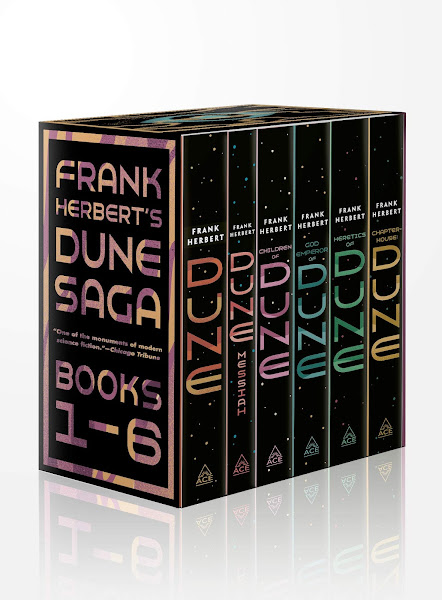
I dutifully followed the saga through all its twists and turns in the next three sequels, until the ridiculously titled (though actually rather good) Chapter House Dune in 1985. Herbert died the year after it was published.


David Lynch, dir.: Dune (1984)
Dune, dir. & writ. David Lynch (based on the novel by Frank Herbert) - with Francesca Annis, Linda Hunt, Kyle MacLachlan, Everett McGill, Kenneth McMillan, Siân Phillips, Jürgen Prochnow, Patrick Stewart, Sting, Max von Sydow, Sean Young - (USA, 1984).
By then, however, we'd entered the world of the movies. There were many rumours about the first Dune film before it came out. I think Sci-fi fans in general were most excited by the prospect of a Ridley Scott version, building on the artistry of his Alien and (in particular) Blade Runner triumphs.

I don't think anyone - or anyone in my circle, at any rate - knew about the Jodorowsky concept designs, or any of the other details of the rocky road that led to David Lynch's eventual De Laurentis-produced spectacular.

I wouldn't say that it was love at first sight. The movie was too campy and over-the-top for an SF-cinematic sensibility formed by Kubrick's 2001 and Scott's Blade Runner. Over time, however, I began to see that Lynch was a horse of a different colour. He saw Dune as a huge Italian melodrama, with a lush operatic score, and a massive cast of picturesque characters.


The wonderful visual inventiveness of his guild navigators and planet-dwarfing space-ships remains impressive. And, once I had learned to recalibrate my expectations, I found his relish for teaasingly gnomic lines ("A beginning is a very delicate time" - Princess Irulan; "We have worm-sign such as God has never seen" - Stilgar; "The sleeper must awaken" - Duke Leto; "Tell me of your homeworld, Usul" - Chani; "The Spice must flow!" - passim) a source of rich entertainment at each of many reviewings over the years.


Francesca Annis was a spectacularly beautiful Lady Jessica, Sean Young played Chani as a kind of slinky cat-woman, and Patrick Stewart as Gurney Halleck looked super-cool, as always. Kyle MacLachlan - well, what can you say? He seemed to be in training for Agent Cooper in Twin Peaks already, but then one doesn't go to Grand Opera for gritty realism.


John Harrison, dir.: Frank Herbert's Dune: TV Miniseries (2000)
Frank Herbert’s Dune, dir. & writ. John Harrison (based on the novel by Frank Herbert) – with William Hurt, Alec Newman, Saskia Reeves, Susan Sarandon, Daniela Amavia – (USA, 2000)
There were, of course, omissions. Putting so large a plot into one movie required some fairly violent surgery, but these were interestingly reexamined in John Harrison's 3-part miniseries, some fifteen years later.

Alec Newman made a far more plausible Paul than MacLachlan had. He looked streetwise and desert-hardened from the very beginning, and only Saskia Reeves seemed to have blundered in from some BBC kitchen sink drama by mistake. The fact that it was largely filmed in the Czech Republic also guaranteed some strikingly imaginative costume and set designs. All in all, it was a thoroughly creditable effort, which complemented rather than superseding Lynch's pioneering film.

Frank Herbert’s Children of Dune, dir. & writ. John Harrison (based on the novels Dune Messiah and Children of Dune by Frank Herbert)– with James McAvoy, Alec Newman, Alice Krige, Susan Sarandon – (USA, 2003)
It was in the sequel that John Harrison's vision really started to pay off, though. The addition of Herbert's two sequels to the original Dune plotline helped greatly in fleshing out the true richness of the Dune universe. James McAvoy made a great Duke Leto, Paul Muad'Dib's son and heir - the future God Emperor of Dune of the fourth novel - and the complex intrigues and machinations surrounding the new Fremen imperium were spectacularly embodied on screen.

Alice Krige made a far better Lady Jessica than Saskia Reeves ever had, and most of the other casting decisions were similarly shrewd.


Denis Villeneuve, dir.: Dune: Part One (2021)
Dune: Part One, dir. Denis Villeneuve, writ. Denis Villeneuve, Jon Spaihts, & Eric Roth (based on the novel by Frank Herbert) – with Timothée Chalamet, Rebecca Ferguson, Oscar Isaac, Josh Brolin, Stellan Skarsgård, Dave Bautista, Zendaya, Charlotte Rampling, Jason Momoa, Javier Bardem – (USA, 2021)
All of which brings us, I guess, to the $64,000 question: what do you think of Denis Villeneuve's new film? I should begin by saying that for a Dune-ophile such as myself, any new movie based on Herbert's work is big news.


Denis Villeneuve, dir. Arrival (2016)


Having said that, I guess that I have to make a couple of provisos. First of all, I do find some of the adulation heaped on Villeneuve's sci-fi movies to date a bit misplaced. Arrival was, I thought, very good - mainly because of the ingenious plot of Ted Chiang's original short story.

I did my level best to like Blade Runner 2049, and - once again - found some points of interest in its approach to the tried-and-true android theme, but already a certain visual blankness seemed to be standing in for the seedy baroque magnificence of Ridley Scott's imagination.


Denis Villeneuve, dir. Blade Runner 2049 (2017)


Dune, too, looked frustratingly blank to me. The city of Arrakeen looked like an old concrete gun emplacement beefed up with a bit of CGI. The spaceships were larger and emptier than David Lynch's, but otherwise they lacked distinction - or any particular role beyond spectacle. Any cinema-goer these days has seen a few too many such space-scapes already.

What, then, of the performances? Some pretty impressive actors had been recruited to fill these oh-so-familiar roles, but they had - in almost every case - little to work with in the minimalist script. For all the richness of the plot material to get through in the first half of Herbert's book, this Dune (Part One) (as it's coyly labelled) seems to devote an inordinate amount of time to its characters' apparent desire to stare out to sea, or into space, or into the desert, without much to say.

It's not that I don't concede that internal monologues were somewhat overused as a device by Lynch, but that was a true reflection of Frank Herbert's own practice, and without them there's seldom enough in the dialogue to explain what's going on.

Who, then, stands out? Not, I'm afraid, Timothée Chalamet, who does a good enough job of playing the callow, young heir of a noble house, but shows few signs of his coming metamorphosis into Paul Muad'Dib, Messiah of Arrakis and Galactic Kwisatz Haderach. His puzzlement at the welcome he receives on arrival at the desert planet Arrrakis is, I fear, echoed by much of the cinema audience. There's just not a lot to him - at this point, at any rate.


Rebecca Ferguson as Jessica? Wonderful, I'm glad to say. It's true that I was already a bit of a fan, but she is, to me, the only actor on screen who seems actually to be there, on a strange, forbidding planet, caught in the toils of her Bene Gesserit sisterhood's plans.

Oscar Isaac - meh; Josh Brolin - God knows what movie he thought he was in; Stellan Skarsgård - a very disappointing Baron Harkonnen: a Halloween mask could have performed with more distinction; Dave Bautista - another massively talented comic actor, reduced to playing a thuggish sidekick; Zendaya - reduced mainly to wandering around in dream sequences; Chang Chen - when one thinks of what the late lamented Dean Stockwell made of his Doctor Yueh, this one seems pretty close to nothing; Sharon Duncan-Brewster - actually this seemed rather a nice notion: Max von Sydow (needless to say) was great in the role of Doctor Liet-Kynes, the imperial planetary ecologist, in the 1984 movie, but changing the character's gender and ethnicity made her far more believable, as well as the fact that she seemed more interested than most of the other in doing some actual acting; Charlotte Rampling - if you insist on hiding one of the best-known faces in cinema behind a rope net, little can be expected, and little was accordingly achieved: both of the previous cinematic Reverend Mothers were far superior; Jason Momoa - another interesting casting idea, but his obvious desire to be doing something all the time made him seem a bit out of step with the passivity of the production as a whole; and (last and unfortunately least) Javier Bardem - a dreadfully ill-judged casting decision; was he worse than the equally out-of-place Everett McGill's Stilgar in the original movie? He was certainly no better, that's for sure.


A lot of the problems here come down to a single factor. Denis Villeneuve seems entirely to lack a sense of humour. In the case of very intense, confined dramas, this can lead to highly effective results: in his early film Incendies (2010), for instance, or even his first Hollywood film Prisoners (2013).

But when the action portrayed is a bit over-the-top (which is a good description of Herbert's work in general), he seems to lack the tonal sense of how to shift registers, make it somehow less unbelievable with a well-timed joke or the adoption of a slightly less ponderous approach to things. Hence the strange trainwreck that was the film Sicario: a lot of nonsense about a very serious subject - a theme treated far more adroitly in Breaking Bad. Hence, too, the nasty and irrelevant psychopath subplot in his Blade Runner sequel: a tiresome intrusion on a film whose legitimate interests lay elsewhere.


To do the director credit, there's no character in Dune as irritating as Jared Leto in Blade Runner 2049, but Villeneuve still doesn't seem to understand that if you take out virtually all the background trimmings and subtleties from Frank Herbert's universe, you're left not with austerity but boredom. Cracking a joke or two, always David Lynch's first instinct to relieve the tension, seems to be quite off the agenda. There's not even any room in all these hours of cinema for a character so gleefully anarchic as Julie Cox's Princess Irulan in the John Harrison version.


Vague disappointment - that, I'm afraid, was the emotion I was left with. There was indeed much there on screen to enjoy (I particularly liked the dragonfly-like thopters).


Shai-Hulud (2021)


As I said before, any Dune movie is cause for celebration among the faithful (the ones who intone "the Spice must flow" at regular intervals, and make a peculiar hand gesture at each appearance of the great sandworm, Shai-Hulud: "May His passage cleanse the world"). But Denis Villeneuve is no Ridley Scott, and there's little point in having such inflated expectations of him.


Shai-Hulud (2000)


Naturally I'll be trotting off to see Part Two when it's released - if only to admire the Garbo-esque Rebecca Ferguson once again - and (who knows?) maybe this time Villeneuve'll pull out the stops a bit further. He's promised as much, after all.


Shai-Hulud (1984)


But don't go dissing David Lynch in my presence anytime soon. A myth has grown up that his 1984 Dune movie was a disaster when it was, in fact, an eccentric masterpiece, one which gave fair warning of many transgressive cinematic excesses to come!


Floyd Snyder: The Dunes (2015)


Frank Herbert (1984)

Franklin Patrick Herbert Jr. [Frank Herbert]
(1920-1986)


    The Dune Series:

  1. Dune. [Part I, "Dune World": Analog (Dec 1963 – Feb 1964); Parts II and III, "The Prophet of Dune": Analog (Jan – May 1965)]. 1965. Times Mirror. London: New English Library, 1973.
  2. Dune Messiah. 1969. Times Mirror. London: New English Library, 1973.
  3. Children of Dune. 1976. Times Mirror. London: New English Library, 1977.
  4. God Emperor of Dune. 1981. London: New English Library, 1982.
  5. Heretics of Dune. 1984. London: New English Library, 1985.
  6. Chapter House Dune. 1985. London: New English Library, 1986.

  7. The Pandora Sequence [aka the WorShip series]:

  8. Destination: Void. 1966. Rev. ed. 1978. Penguin Science Fiction. Harmondsworth: Penguin, 1985.
  9. [with Bill Ransom]: The Jesus Incident. 1979. An Orbit Book. London: Futura Publications Limited, 1980.
  10. [with Bill Ransom]: The Lazarus Effect. 1983. An Orbit Book. London: Futura Publications Limited, 1984.
  11. [with Bill Ransom]: The Ascension Factor. London: Victor Gollancz Ltd., 1988.

  12. The ConSentiency Series:

  13. Whipping Star. 1970. Times Mirror. London: New English Library, 1978.
  14. The Dosadi Experiment. 1977. A Futura Book. London: Futura Publications Limited, 1979.

  15. Other Novels:

  16. The Dragon in the Sea. 1956. [aka 'Under Pressure' and '21st Century Sub']. Penguin Science Fiction. Harmondsworth: Penguin, 1963.
  17. The Green Brain. 1966. Times Mirror. London: New English Library, 1979.
  18. The Eyes of Heisenberg. 1966. Times Mirror. London: New English Library, 1976.
  19. The Heaven Makers. 1968. London: New English Library, 1982.
  20. The Santaroga Barrier. New York: Berkeley, 1968.
  21. Soul Catcher. New York: G.P. Putnam's Sons, 1972.
  22. The Godmakers. ["You Take the High Road", Astounding (May 1958); "Missing Link", Astounding (Feb 1959); "Operation Haystack", Astounding (May 1959); "The Priests of Psi", Fantastic (Feb 1960)]. 1972. London: New English Library, 1984.
  23. Hellstrom's Hive. New York: Doubleday, 1973.
  24. Direct Descent. New York: Ace Books, 1980.
  25. The White Plague. New York: G.P. Putnam's Sons, 1982.
  26. [with Brian Herbert] Man of Two Worlds (with Brian Herbert), New York: G.P. Putnam's Sons, 1986.
  27. High-Opp. WordFire Press, 2012.
  28. Angels' Fall. WordFire Press, 2013.
  29. A Game of Authors. WordFire Press, 2013.
  30. A Thorn in the Bush. WordFire Press, 2014.

  31. Short Story Collections:

  32. The Worlds of Frank Herbert. 1970. Times Mirror. London: New English Library, 1975.
  33. The Book of Frank Herbert. New York: DAW Books, 1973.
  34. The Best of Frank Herbert. London: Sidgwick & Jackson, 1975.
  35. The Priests of Psi. London: Gollancz Ltd, 1980.
  36. Eye. Illustrated by Jim Burns. 1985. New English Library. London: Hodder & Stoughton, 1988.
  37. [with Brian Herbert & Kevin J. Anderson]. The Road to Dune. Foreword by Bill Ransom. London: Hodder & Stoughton Ltd., 2005.
  38. The Collected Stories of Frank Herbert. New York: Tor Books, 2014.

  39. Secondary:

  40. Brian Herbert. Dreamer of Dune: The Biography of Frank Herbert. New York: Tor Books, 2003


The Dune Saga (1965-1986)


Saturday, October 05, 2019

Millennials (1): Harry from the Agency (1997)


Philip Gluckman: Harry from the Agency (1997)


I don't know why he saved my life. Maybe in those last moments he loved life more than he ever had before. Not just his life... anybody's life... my life. All he'd wanted was the same answers the rest of us want. Where do I come from? Where am I going? How long have I got? All I could do is sit there and watch him die.


Hampton Fancher & David Peoples: Blade Runner (1982)


Most purists can’t stand the original theatrical release version of Blade Runner, with the intrusive voice-over and the soldered-on happy ending. If that’s the first version of the movie you saw, though (as it was for me), things can seem a bit different.

Some bits of it work pretty well – like the one above, for instance.

I guess that the point of these NZSF essays of mine is somewhat similar – Where did we come from? Where are we going? How long have we got? Does it really matter if New Zealand can claim its own independent SF tradition? Well, I guess that to a dedicated fan, everything matters.

If it gives you a kick - as it does me - to read about a long grey space ship descending over Remuera Rd in Philip Gluckman's Harry from the Agency, then you'll understand what I'm getting at. If not, well:
Breathes there the man, with soul so dead,
Who never to himself hath said,
This is my own, my native land!
- Sir Walter Scott, 'The Lay of the Last Minstrel' (1805)


I felt it in Scotland, first, when reading James Hogg's strange, mad Gothic novel The Confessions of a Justified Sinner (1824). The streets his hero trod, the fields on top of Salisbury Crags where he saw his vision of the devil, were familiar to me from my everyday wanderings through Edinburgh.

It's a city that stays, for the most part, the same: the same street layout, the same landmarks. It's definitely strange to be able to retrace someone's steps like that when you hail from a New World city like Auckland, one that rebuilds and reinvents itself every few decades: a bit like Blade Runner's futuristic-yet-retro LA, in fact.


Frank Sargeson: That Summer: Stories. Cover by John Minton (1946)


But then, when I picked up an old edition of Frank Sargeson's That Summer on an Edinburgh bookstall, the fascination with the country of my ancestors, Scotland, shifted slowly to a nostalgia for my own native land - New Zealand.

It's true that That Summer portrays a past so distant, even for me, that it has few connections with the Auckland I remember - but so poignant and beautiful was the story that I've never been able to get out from under its spell ever since. It's my benchmark for a completely successful New Zealand novella: a great and moving story by anyone's standards.


William Gibson: Neuromancer (1984) [German edition]


None of this helps us directly with Harry from the Agency, I suppose, but perhaps it helps to explain why the book has such a powerful charm for me. It's a piece of Kiwi cyberpunk, of course - brewed up from a set of ingredients readily located in the complicated zone between Blade Runner and William Gibson's immensely influential debut novel Neuromancer.

And what is Neuromancer about? It's the first book in the 'Sprawl' trilogy, completed in Count Zero (1986) and Mona Lisa Overdrive (1988). It introduces a world of world-weary Chandleresque antiheroes, roaming through strange city landscapes - half ecological devastation, half virtual reality - and their equally world-weary (but super-cool) girlfriends.

The epitome of all these is the streetwise 'Razorgirl' Molly Millions whom burnt-out hacker Henry Case hooks up with in the novel, and under whose protection he undertakes his dangerous mission into cyberspace (a term Gibson is credited with coining).


William Gibson: Neuromancer (1984) [Brazilian edition]

[Warning - numerous plot-spoilers ahead]


Sound familiar? For Gibson's protagonist 'Henry Case,' read Gluckman's "Harry Stone' - both drug addicts, both drifters, both selfish almost to the point of insanity. For Gibson's 'Molly Millions,' read, on the romantic side, Gluckman's lithe, long-suffering brunette heroine Toni; on the genetic modification side, the ninja space-assassin Miyuki.

So much is obvious. But the fact that the tropes of cyberpunk are so essentially repetitive as to be easy to replicate - whether in movies such Johnny Mnemonic or The Matrix, or in novels such Lucius Shepard's Life During Wartime (1987) or Bruce Sterling's Islands in the Net (1988) - doesn't mean that there are no meaningful distinctions to be made between these works.

Like the Gothic novel, Cyberpunk used stereotyped motifs to ever more complex ends. The seeds of its destruction lay mainly in the fact that the future it gestured to so beguilingly is now upon us. What its writers assumed would take decades or centuries to accomplish has fallen in on our heads in a matter of a few years.


William Gibson & Bruce Sterling: The Difference Engine (1990) [Brazilian edition]


In that respect, William Gibson's other great generic breakthrough, Steampunk - as outlined in his novel The Difference Engine, jointly written with Bruce Sterling - may yet prove to be more enduring.


Philip Gluckman: Harry from the Agency (1997)

Third generation of NZ doctors - an old family curse. Keen musician, my novel "Harry from the Agency" is available in all libraries. Absolutely love my job and I have a special interest in treating patients with Hyperhidrosis.
- Dr. Philip Gluckman, 'About.' Albany Family Medical Centre
According to WebMD, "Hyperhidrosis, or excessive sweating, is a common disorder which produces a lot of unhappiness." I'm not quite sure how it connects with Harry from the Agency, but certainly Harry does a good deal of sweating in the course of the narrative - principally because he's a junkie hooked on heroin, whose horizon is pretty much defined by the prospect of his next fix.

To add insult to injury (or perhaps to provide Dr. Gluckman with some plot points where he can really use his professional expertise) Harry is also infected with the appalling flesh-eating Delta-8 virus. Rather than offering up hints, though, it might be better simply to quote the book's blurb:
2205 AD. Global warming has accelerated out of control. The middle of the planet is lifeless, drenched in steamy, poisonous rain. Auckland has become a city of islands, and Antarctica is home to most of the world's population. Multinational corporations have deserted Earth to create planetary empires. The Delta-8 virus, a consequence of deep space exploration, is a plague upon the remaining inhabitants.

For Dr Harry Stone, medical section, World Intelligence Agency, time is running out. Not only does he have the virus, the narcotic supply that sustains him is coming to an end. And as his world is failing, Harry is faced with a choice.

Harry from the Agency reveals a convincing future rife with corruption. With its noir atmosphere this book will especially appeal to fans of William Gibson.

Philip Gluckman lives in Auckland. This is his first published novel.


Charlize Theron as Aeon Flux (2010)


Harry from the Agency got a somewhat mixed reception when it first appeared towards the end of the 1990s. I remember hearing a radio review where the two (female) commentators were immensely scornful of Gluckman's heroine Toni. And it's true that, in appearance at least, she sounds a bit like a foretaste of the movie version of Aeon Flux. Slightly more subtle than the animated TV show, but not by much:


Aeon Flux (MTV: 1991-1995)


Toni sat on the floor. Her sky-blue dressing gown, wrapped tightly around her, concealed perfect skin. Even a casual observer would have been drawn to the fullness of her lips. [16]
She changed into skintight trousers and a jacket over her white singlet, her boots, ran down to her new Triumph, threw on her shades and chopped it into gear. [187]
Actually Toni can't even sit at a computer console without looking sexy:
'Something up?' Jackson's baritone voice bellowed from behind the lithe figure, sitting hunched forward over her knees, both feet up on the console, her company jacket off and slung casually over the back of the chair. [135]


It wasn't really the fact that Toni was so cool (and so hot) that irritated the two radio commentators. It was the fact that she put up with so much from Harry without any obvious return. He had, after all, left her behind to die on a battlefield - though he does have a few weak-kneed excuses for that.

What's more, for all the latent altruism she detected in him - free clinics for the poor, etc. - his main preoccupation throughout is getting more drugs to feed his habit.

'Why,' Robert Graves once asked, 'have such scores of lovely, gifted girls / Married impossible men?'
Simple self-sacrifice may be ruled out,
And missionary endeavour, nine times out of ten.

Repeat 'impossible men': not merely rustic,
Foul-tempered or depraved
(Dramatic foils chosen to show the world
How well women behave, and always have behaved).

Impossible men: idle, illiterate,
Self-pitying, dirty, sly,
For whose appearance even in City parks
Excuses must be made to casual passers-by.

Has God's supply of tolerable husbands
Fallen, in fact, so low?
Or do I always over-value woman
At the expense of man?
Do I?
It might be so.
Toni hasn't actually married Harry, but she certainly puts up with more from him that would seem to make any sense. Robert Graves seems no wiser than the rest of us as to why that might be, however, so I guess we just have to accept it as one of the paradoxes of life (or, as in this case, self-indulgent fiction).


A good deal of the novel is set on the desert planet Alterrin-3. With its muezzin, and its mad AI cyber-sultan, this planet could certainly be said to have a certain amount in common with the more famous Arrakis (aka 'Dune'), beloved of Frank Herbert fans everywhere.

And, as with Paul Atreides, Harry too goes to ground among a group of indigenous desert people, whose wounds he tends, and who therefore prove willing to assist him in his self-appointed task of broadcasting to the universe the cure to the Delta-8 virus which its creators are trying to suppress.

There's also a galactic empire in the mix: a little like that of the Padishah Emperor, Shaddam IV (or, really, like any other Galactic empire in SF: from Servalan's in Blake's Seven to the one Darth Vader manages in Star Wars). This one is run by Maximilian Oesterburg III - with somewhat less than Teutonic efficiency - for the benefit of his eight-year-old heir, and is, like all corporate entities great or small, devoted to profit and the bottomline over all.


Brian Aldiss, ed. Galactic Empires (1975)


So why should you read this book? It does, after all, consist mainly of a shuffle of the major SF trumps, laid out in a not-unconventional order. Perhaps that's why it's had no (published) sequels, either.

Gluckman writes well. He writes very well. And one can't but feel a strong personal involvement with Harry and Toni which endows them with a certain extra-textual solidity. Harry is a fairly self-indulgent self-portrait, I suppose, but he does have enough defects - alongside a few good qualities - to feel like an actual human being much of the time.

Is the same true of Toni? It's hard to say. But she's certainly no more implausible than Rachael in Blade Runner, Chani in Dune, Molly Millions in Neuromancer, or any of the other razorgirl babes who infest cyberpunk - as well (I suppose) as SF in general.

Strangely enough, it's in its settings that Harry from the Agency really comes alive. Alterrin-3 may not have the solidity of Dune, but it does have an Australian outback feel to it which makes it seem very much like a plausible place.

The islanded Auckland of the future is good, too. Gluckman is wise enough not to indulge in too many Ballardian evocations of the vista, but the hints he drops here and there are enough to give it a solid presence in the mind.


Like most SF futures, Harry from the Agency probably errs on the side of optimism. It's taken quite some time for the ice-caps to melt, after all - and there's only one really incurable plague ravaging the population.

William Gibson, too, has had difficulties with sequels. So powerful was the vision of Neuromancer, that it overshadows everything he's produced under his own name since. Only the collaborative Difference Engine could be said to have matched it.

Perhaps Philip Gluckman was wise to stop at one novel. It is, after all, extremely accomplished in its own right, and to repeat it would be to risk undermining the effect.

I could easily imagine him writing something else, though, something completely different, possible even out of the speculative fiction mode. Harry from the Agency is auspicious enough as a debut to persuade me that it's a lot more than just another Neuromancer / Dune knockoff transposed to downtown Auckland.


Dr Philip Gluckman

Philip Gluckman

Select Bibliography:

  1. Harry from the Agency. Reed Books. Auckland: Reed Publishing (NZ) Ltd., 1997.


Homepages & Online Information:

Albany Family Medical Centre