Showing posts with label Robert Lowell. Show all posts

Saturday, March 21, 2026

Rimbaud in English


Arthur Rimbaud (1854-1891)


This is where modern poetry begins. "Il faut être absolument moderne" [One must be completely modern], is how Rimbaud himself put it in his prose-poetic nightmarish reverie Une Saison en Enfer [A Season in Hell]. He was 18 at the time. The book was printed in Brussels in "a few copies ... distributed to friends" just before his birthday on 20th October, 1873.

He's quite a mine of such provocative aphorisms, in fact: "un long, immense et raisonné dérèglement de tous les sens" [a long, detailed and systematic derangement of the senses], as a prerequisite to the composition of "visionary" poetry, is perhaps the best known of them. "Je est un autre" ["I" is somebody else], from the same 1871 letter to his fellow-poet Paul Demeny, is even more pithy.

There's a demonic energy to most of his work, early and late. By 1875, only a few years after he began, he'd given up writing altogether, preferring the life of a wandering merchant and soldier of fortune. He died in 1891, probably of bone cancer. He was only 37.

There'd been poètes maudits [accursed poets] before him, and there were plenty still to come. At first sight, he doesn't look that different from Baudelaire or Nerval or the rebellious poets of earlier times. His precocity was what really astonished his contemporaries, but he was no flash in the pan. The first thing that strikes you about Rimbaud when you start to read him in earnest is the maturity and complexity of his thought.

That, and the fact that he seems to have been born with an innate talent for versification. Even his earliest poems are technically flawless, and when he departs from the strict rules of French prosody in his later work, it's clearly intentional.

Perhaps the easiest way to show why he seemed so extraordinary to his contemporaries - and to poets and artists ever since - is to look at one of those early poems, the ones where he still sees himself as a contributor to French poetry, rather than the dynamiter of all its pretentions.


Ernest Delahaye: Rimbaud (Charleville, 1871)

Poets at Seven Years Old
Les poètes de sept ans À M. P. Demeny Et la Mère, fermant le livre du devoir, S’en allait satisfaite et très fière, sans voir, Dans les yeux bleus et sous le front plein d’éminences L’âme de son enfant livrée aux répugnances. Tout le jour il suait d’obéissance ; très Intelligent ; pourtant des tics noirs, quelques traits, Semblaient prouver en lui d’âcres hypocrisies. Dans l’ombre des couloirs aux tentures moisies, En passant il tirait la langue, les deux poings À l’aine, et dans ses yeux fermés voyait des points. Une porte s’ouvrait sur le soir : à la lampe On le voyait, là-haut, qui râlait sur la rampe, Sous un golfe de jour pendant du toit. L’été Surtout, vaincu, stupide, il était entêté À se renfermer dans la fraîcheur des latrines : Il pensait là, tranquille et livrant ses narines. Quand, lavé des odeurs du jour, le jardinet Derrière la maison, en hiver, s’illunait, Gisant au pied d’un mur, enterré dans la marne Et pour des visions écrasant son œil darne, Il écoutait grouiller les galeux espaliers. Pitié ! Ces enfants seuls étaient ses familiers Qui, chétifs, fronts nus, œil déteignant sur la joue, Cachant de maigres doigts jaunes et noirs de boue Sous des habits puant la foire et tout vieillots, Conversaient avec la douceur des idiots ! Et si, l’ayant surpris à des pitiés immondes, Sa mère s’effrayait ; les tendresses, profondes, De l’enfant se jetaient sur cet étonnement. C’était bon. Elle avait le bleu regard, – qui ment ! À sept ans, il faisait des romans, sur la vie Du grand désert, où luit la Liberté ravie, Forêts, soleils, rives, savanes ! – Il s’aidait De journaux illustrés où, rouge, il regardait Des Espagnoles rire et des Italiennes. Quand venait, l’œil brun, folle, en robes d’indiennes, À Huit ans, – la fille des ouvriers d’à côté, La petite brutale, et qu’elle avait sauté, Dans un coin, sur son dos, en secouant ses tresses, Et qu’il était sous elle, il lui mordait les fesses, Car elle ne portait jamais de pantalons ; – Et, par elle meurtri des poings et des talons, Remportait les saveurs de sa peau dans sa chambre. Il craignait les blafards dimanches de décembre, Où, pommadé, sur un guéridon d’acajou, Il lisait une Bible à la tranche vert-chou ; Des rêves l’oppressaient chaque nuit dans l’alcôve. Il n’aimait pas Dieu ; mais les hommes, qu’au soir fauve, Noirs, en blouse, il voyait rentrer dans le faubourg Où les crieurs, en trois roulements de tambour, Font autour des édits rire et gronder les foules. – Il rêvait la prairie amoureuse, où des houles Lumineuses, parfums sains, pubescences d’or, Font leur remuement calme et prennent leur essor ! Et comme il savourait surtout les sombres choses, Quand, dans la chambre nue aux persiennes closes, Haute et bleue, âcrement prise d’humidité, Il lisait son roman sans cesse médité, Plein de lourds ciels ocreux et de forêts noyées, De fleurs de chair aux bois sidérals déployées, Vertige, écroulements, déroutes et pitié ! – Tandis que se faisait la rumeur du quartier, En bas, – seul, et couché sur des pièces de toile Écrue, et pressentant violemment la voile ! - Arthur Rimbaud (26 mai 1871)
Shutting her pious book, the Mother rose and kissed her little boy … what mother sees in Angel-face, his big eyes free of guile, bile and disgust tormenting the nude soul? All day long he sweated to obey; clever, quick, yet something seemed to say – little habits, tics – that this was sham. Alone in mildewed corridors, he would scream shit-fuck! clench his fists, stick out his tongue, screw up his eyes into a blood-red sun. A door opened on darkness – the backstairs, the one place he could lie and gasp for air in the dome of day a lamp hung from the night. Burnt stupid by blank waves of summer heat he hid himself inside the dank latrines; there he could breathe – sniff something that was clean. In winter, when the moon washed their back yard with icy candour, he would creep out and hide by the stream that ran inside their boundary wall; trying to see by knuckling at his eyeballs, he heard the pine-trees groan like ships at sea. Although he felt some sneaking sympathy for those trespassing kids who dropped their eyes at his approach (stink-fingers black and creased with yellow clay from damming up the creek), they turned from him like dolts and would not speak. And if his mother caught him at this game and told him off, the fact he looked ashamed fooled her into forgiveness. He was shy. Those lips were always ready with a lie. At seven he made up Westerns: wild romances set in the desert – where freedom reigns (and Dances with Wolves?); sunsets, rivers, cliffs, savannahs … Staring at naked woodcut señoritas till he turned red, he dreamt of foreign girls. So when that saucy eight-year-old, her curls bobbing, thin cotton dresses … like a squaw with soft brown eyes … came over from next door and jumped him – little beast – pulling his hair, caught underneath, he bit her on the bare bum (“wild women never put on drawers!”); then, scratched and beaten by her fists and claws, he carried the scent of her back to his room. Most of all, he feared Sundays at home, brushed clean and collared, sitting with his back straight, reading about a God he’d learnt to hate in a mould-green Bible with a faded back; the nightmares came as soon as it got dark. He loved to watch those swart, roughly-dressed men straggle home from work in the red evening ready for the distractions of the streets – his dreams were of wide prairies of ripe wheat: gold thistledown, rich scents, in the calm light of noon, till rough winds swept them out of sight. He fixated most on things that were dark and old – sitting in a cold blue room with the blinds pulled, damp dripping off the walls, mouthing the words of a story he could see inside his head full of drowned forests; leaden, ochre skies; flesh-haunted flowers; starry immensities; despair; retreat; stiff salmon-leaps; and pity! Engulfed by the vast engine-grinding city – lying in the creased haven of his bed, he bent his sails where a blind future led …

- trans. Jack Ross (7/91-18/5/97)


Christopher Hampton: Total Eclipse (1969 / 2007)


Oscar-winning screenwriter Christopher Hampton's brilliant early play Total Eclipse dramatises the relationship between Rimbaud and the older poet Verlaine, which culminated in the prosecution of the latter for wounding his young lover with a pistol during a drunken argument.

Unfortunately the same cannot be said for Agnieszka Holland's film of the story, marred as it is by poor casting (Leonardo di Caprio as Rimbaud!) and a number of embarrassingly extraneous scenes - such as the one in which di Caprio tries to induce poor David Thewlis (Verlaine) to strip naked so the pair of them can bound around in a field like goats.

The deadpan restraint of the original play gets lost in all this absurdity, and the result is satisfying neither to biopic aficionados or Rimbaud enthusiasts. It's hard to know what Hampton and Holland were thinking ...


Agnieszka Holland, dir.: Total Eclipse (1995)


Enid Starkie: Rimbaud (1961)


In general, the moment you depart from his actual work - the poems and prose-pieces which somehow managed to survive his tempestuous life and the pious censorship of his family - you tend to run into trouble in Rimbaud studies.

In the third, 1961, version of her very entertaining book about the poet (originally published in 1938), eccentric Irish literary critic Enid Starkie finally established to her own satisfaction the precise nature of Rimbaud's relationship with esoteric and hermetic thought in his proposed establishment of a new religion with himself as Messiah (or Sun-God, if that phrasing suits you better).

She was reluctantly forced to acknowledge that most of this could have come from journal articles and encyclopedia entries rather than the magical grimoires she originally had him poring over.

And she may well have been correct. But whether any of that assists us in understanding his work better is another question. Just sitting down and reading it still seems like the best approach. There's always an uncomfortable sense, though, with Rimbaud, that the poet is sitting in judgement on you - as he did with Verlaine - rather than the other way round.


Enid Starkie (1897-1970)


Let's take, for example, another early poem, "Les chercheuses de poux" [The lice-hunters]. It's a wonderful evocation of the "eternal feminine" and the effect of such proximity on a precocious young boy. The intentional grounding of the whole experience in the process of picking out lice from an infected scalp might seem abhorrent to a lazy (i.e. romantically inclined) reader, but actually it serves to ground the whole poem in what Yeats called "the foul rag-and-bone shop of the heart."

Desire is an animal, instinctual thing. Rimbaud knows that, as do we all. The difference is that he's able to express the whole confusion of vague visionary pre-adolescent sexuality by juxtaposing it with the intense practicality of everyday life.


Étienne Carjat: Photo-carte de visite (1871)

Lice-Hunters
Les chercheuses de poux Quand le front de l'enfant, plein de rouges tourmentes, Implore l'essaim blanc des rêves indistincts, Il vient près de son lit deux grandes soeurs charmantes Avec de frêles doigts aux ongles argentins. Elles assoient l'enfant auprès d'une croisée Grande ouverte où l'air bleu baigne un fouillis de fleurs, Et dans ses lourds cheveux où tombe la rosée Promènent leurs doigts fins, terribles et charmeurs. Il écoute chanter leurs haleines craintives Qui fleurent de longs miels végétaux et rosés Et qu'interrompt parfois un sifflement, salives Reprises sur la lèvre ou désirs de baisers. Il entend leurs cils noirs battant sous les silences Parfumés ; et leurs doigts électriques et doux Font crépiter parmi ses grises indolences Sous leurs ongles royaux la mort des petits poux. Voilà que monte en lui le vin de la Paresse, Soupirs d'harmonica qui pourrait délirer ; L'enfant se sent, selon la lenteur des caresses, Sourdre et mourir sans cesse un désir de pleurer. - Arthur Rimbaud (1871)
When the kid's forehead is full of red torments Imploring swarms of dreams with vague contents, Two large and charming sisters come with wafty fingers and silvery nails, to his bedroom. They set the kid by a wide-open window where A tangle of flowers bathes in the blue air And run fine, alluring, terrible fingers through his thick dew-matted hair. He hears the rustling of their timid breath Flower with the long pinkish vegetable honies underneath Or broken anon, sibilant, the saliva's hiss Drawn from a lip, or a desire to kiss. He hears their black eyelashes beat in that quietude And "Crack!" to break his inebriated indolences Neath their electric and so soft fingers death assails The little lice beneath their regal nails. And Lo! there mounts within him Wine of Laziness - a squiffer's sigh Might bring delirium - and the kid feels Neath the slowness of their caresses, constantly Wane and fade a desire to cry.

- trans. Ezra Pound (1957)


Howard Coster: W. H. Auden (1937)
Rimbaud

The nights, the railway-arches, the bad sky, His horrible companions did not know it; But in that child the rhetorician’s lie Burst like a pipe: the cold had made a poet. Drinks bought him by his weak and lyric friend His five wits systematically deranged, To all accustomed nonsense put an end; Till he from lyre and weakness was estranged. Verse was a special illness of the ear; Integrity was not enough; that seemed The hell of childhood: he must try again. Now, galloping through Africa, he dreamed Of a new self, a son, an engineer, His truth acceptable to lying men.

- W. H. Auden (December 1938)

To a truly remarkable degree, this thing we call "Rimbaud" is the creation of his admirers - as well (I should add) as his detractors. Auden, here, imagines him conducting a kind of personal crusade against the falsehood and hypocrisy of late nineteenth-century colonial Europe, searching desperately for a "truth acceptable to lying men."

He seems to be speaking for himself more than he is about Rimbaud.

After all, those last few lines do rather gloss over the more unpleasant aspects of Rimbaud's later career, post-poetry. He was not, it would appear, an actual slaver, but more a gun-runner and general mercantile fixer. But it was not from lack of trying. There are surviving letters where he tries to negotiate the sale of slaves from reluctant colonial contacts in Somalia and Ethiopia.


The story is told in more detail in Charles Nicholl's fascinating book Somebody Else: Rimbaud in Africa. What these repugnant facts do confirm, though, is that the more we find out about him, the less we understand him. How could the visionary poet of the 1870s have turned into the brutal, unscrupulous, unsuccessful entrepreneur of the 1880s?

It's almost as if we're talking about two completely different men. But then, when one looks more carefully at the poems, the longing for exotic experience embodied in his early masterpiece "Le bâteau ivre" [The Drunken Boat] is not so hard to square with an afterlife as a kind of embodied Jules Verne hero.

The fact that it all went so badly is perhaps explicable by the fact that a vivid imagination, however useful it may be to a poet, is not really an ideal prerequisite for a hardbitten man of action.

In any case, here's the poem, together with a version of it by American poet Robert Lowell, who included a number of pieces by Rimbaud in his influential mid-career book Imitations.


Rimbaud: Fresque Le Bâteau Ivre (Saint-Sulpice, Paris, 2012)

The Drunken Boat
Le bâteau ivre Comme je descendais des Fleuves impassibles, Je ne me sentis plus guidé par les haleurs : Des Peaux-Rouges criards les avaient pris pour cibles Les ayant cloués nus aux poteaux de couleurs. J’étais insoucieux de tous les équipages, Porteur de blés flamands ou de cotons anglais. Quand avec mes haleurs ont fini ces tapages Les Fleuves m’ont laissé descendre où je voulais. Dans les clapotements furieux des marées Moi l’autre hiver plus sourd que les cerveaux d’enfants, Je courus ! Et les Péninsules démarrées N’ont pas subi tohu-bohus plus triomphants. La tempête a béni mes éveils maritimes. Plus léger qu’un bouchon j’ai dansé sur les flots Qu’on appelle rouleurs éternels de victimes, Dix nuits, sans regretter l’oeil niais des falots ! Plus douce qu’aux enfants la chair des pommes sures, L’eau verte pénétra ma coque de sapin Et des taches de vins bleus et des vomissures Me lava, dispersant gouvernail et grappin Et dès lors, je me suis baigné dans le Poème De la Mer, infusé d’astres, et lactescent, Dévorant les azurs verts ; où, flottaison blême Et ravie, un noyé pensif parfois descend ; Où, teignant tout à coup les bleuités, délires Et rythmes lents sous les rutilements du jour, Plus fortes que l’alcool, plus vastes que nos lyres, Fermentent les rousseurs amères de l’amour ! Je sais les cieux crevant en éclairs, et les trombes Et les ressacs et les courants : Je sais le soir, L’aube exaltée ainsi qu’un peuple de colombes, Et j’ai vu quelque fois ce que l’homme a cru voir ! J’ai vu le soleil bas, taché d’horreurs mystiques, Illuminant de longs figements violets, Pareils à des acteurs de drames très-antiques Les flots roulant au loin leurs frissons de volets ! J’ai rêvé la nuit verte aux neiges éblouies, Baiser montant aux yeux des mers avec lenteurs, La circulation des sèves inouïes, Et l’éveil jaune et bleu des phosphores chanteurs ! J’ai suivi, des mois pleins, pareille aux vacheries Hystériques, la houle à l’assaut des récifs, Sans songer que les pieds lumineux des Maries Pussent forcer le mufle aux Océans poussifs ! J’ai heurté, savez-vous, d’incroyables Florides Mêlant aux fleurs des yeux de panthères à peaux D’hommes ! Des arcs-en-ciel tendus comme des brides Sous l’horizon des mers, à de glauques troupeaux ! J’ai vu fermenter les marais énormes, nasses Où pourrit dans les joncs tout un Léviathan ! Des écroulement d’eau au milieu des bonaces, Et les lointains vers les gouffres cataractant ! Glaciers, soleils d’argent, flots nacreux, cieux de braises ! Échouages hideux au fond des golfes bruns Où les serpents géants dévorés de punaises Choient, des arbres tordus, avec de noirs parfums ! J’aurais voulu montrer aux enfants ces dorades Du flot bleu, ces poissons d’or, ces poissons chantants. – Des écumes de fleurs ont bercé mes dérades Et d’ineffables vents m’ont ailé par instants. Parfois, martyr lassé des pôles et des zones, La mer dont le sanglot faisait mon roulis doux Montait vers moi ses fleurs d’ombres aux ventouses jaunes Et je restais, ainsi qu’une femme à genoux… Presque île, balottant sur mes bords les querelles Et les fientes d’oiseaux clabaudeurs aux yeux blonds Et je voguais, lorsqu’à travers mes liens frêles Des noyés descendaient dormir, à reculons ! Or moi, bateau perdu sous les cheveux des anses, Jeté par l’ouragan dans l’éther sans oiseau, Moi dont les Monitors et les voiliers des Hanses N’auraient pas repêché la carcasse ivre d’eau ; Libre, fumant, monté de brumes violettes, Moi qui trouais le ciel rougeoyant comme un mur Qui porte, confiture exquise aux bons poètes, Des lichens de soleil et des morves d’azur, Qui courais, taché de lunules électriques, Planche folle, escorté des hippocampes noirs, Quand les juillets faisaient crouler à coups de triques Les cieux ultramarins aux ardents entonnoirs ; Moi qui tremblais, sentant geindre à cinquante lieues Le rut des Béhémots et les Maelstroms épais, Fileur éternel des immobilités bleues, Je regrette l’Europe aux anciens parapets ! J’ai vu des archipels sidéraux ! et des îles Dont les cieux délirants sont ouverts au vogueur : – Est-ce en ces nuits sans fond que tu dors et t’exiles, Million d’oiseaux d’or, ô future Vigueur ? – Mais, vrai, j’ai trop pleuré ! Les Aubes sont navrantes. Toute lune est atroce et tout soleil amer : L’âcre amour m’a gonflé de torpeurs enivrantes. Ô que ma quille éclate ! Ô que j’aille à la mer ! Si je désire une eau d’Europe, c’est la flache Noire et froide où vers le crépuscule embaumé Un enfant accroupi plein de tristesses, lâche Un bateau frêle comme un papillon de mai. Je ne puis plus, baigné de vos langueurs, ô lames, Enlever leur sillage aux porteurs de cotons, Ni traverser l’orgueil des drapeaux et des flammes, Ni nager sous les yeux horribles des pontons. - Arthur Rimbaud (Lutèce, 2 novembre 1883)
I felt my guides no longer carried me - as we sailed down the virgin Amazon, the redskins nailed them to their painted stakes naked, as targets for their archery. I carried Flemish wheat or Swedish wood, but had forgotten my unruly crew; their conversation ended with their lives, the river let me wander where I would. Surf punished me, and threw my cargo out; last winter I was breaking up on land. I fled. These floating river villages had never heard a more triumphant shout. The green ooze spurting through my centreboard was sweeter than sour apples to a boy - it washed away the stains of puke and rot-gut, anchor and wheel were carried overboard. The typhoon spun my silly needle round; ten nights I scudded from the freighters' lights; lighter than cork, I danced upon the surge man calls the rolling coffin of his drowned. Rudderless, I was driven like a plank on night seas stuck with stars and dribbling milk; I shot through greens and blues, where luminous, swollen, drowned sailors rose for light and sank. I saw the lightning turn the pole-star green, currents, icebergs, and waterspouts. One night the sunrise lifted like a flock of doves - I saw whatever men suppose they've seen. I saw the ocean bellowing on the land, cattle stampeding with their tails on fire, but never dreamed Three Marys walked the sea to curb those frothing muzzles with a hand. I saw the salt marsh boil, a whole whale rot in some Louisiana bayou's muck, cutting the blue horizon with its flukes - bon-bons of sunlight and cold azure snot! I was a lost boat nosing through the hulls of Monitors and Hanseatic hulks; none cared to gaff my wreckage from the bilge and yellow beaks of the marauding gulls. I would have liked to show a child those seas, rocking to soothe the clatter of my sails in irons on the equatorial line. Like a woman, I fell upon my knees; then heaven opened for the voyager. I stared at archipelagoes of stars. Was it on those dead watches that I died - a million golden birds, Oh future Vigour! I cannot watch these purple suns go down like actors on the Aeschylean stage. I'm drunk on water. I cry out too much - Oh that my keel might break, and I might drown! Shrunken and black against a twilight sky, our Europe has no water. Only a pond the cows have left, and a boy wades to launch his paper boat frail as a butterfly. Bathed in your languors, Waves, I have no wings to cut across the wakes of cotton ships, or fly against the flags of merchant kings, or swim beneath the guns of prison ships.

- trans. Robert Lowell (1961)


Robert Lowell: Imitations (1961 / 1971)


You'll notice at once the profusion of nautical and New World imagery here, but also the emphasis on trade in the midst of all this florid, perilous exuberance.

The other thing you may spot, if not on the first run-through then perhaps on your second reading, is that Lowell has condensed the 25 quatrains of Rimbaud's original into a scant 15. If you'd like to get a closer sense of the actual meaning of the original, you might prefer to look at Oliver Bernard or Wallace Fowlie's more literal renderings. Or, better still - as my friend Martin Edmond has reminded me - there's an exceptionally adroit version by Samuel Beckett.

I can't help feeling that Lowell's very free retelling of Rimbaud's poem gets us closer to the manic energy of the original, however. It's probably also worth noting that Rimbaud had almost certainly never seen the sea when he wrote these verses.

It was all in his head - or perhaps one should say instead that Rimbaud was an enthusiastic student of the profusely illustrated travel literature of the time. He envisioned, in his mind's eye, what he'd just read. His celebrated sonnet "Voyelles [Vowels]," with its fascinating description of his synaesthetic polychromatic response to the alphabet, gives some idea of the richness of that inner life.

After setting out on his career as a tranp-vagabond at the time of the 1870 Franco-Prussian war (and the subsequent Paris commune), his pictures became more solidly rooted in reality. His equally famous pastoral "Le dormeur du val" [The sleeper in the valley] reminds us of the war raging around him. It's even been claimed by some (notably Enid Starkie) that he was raped by some drunken soldiers in Paris in 1871, an experience she believes can be linked directly to his strange, bitter poem "Le Cœur volé" [The Stolen Heart].


Alphonse Mucha: Bières de la Meuse (1897)


That tramp persona - the boy who walked all over Europe on his own two feet and saw life in its rawest form - has left us a number of vignettes of his experiences.

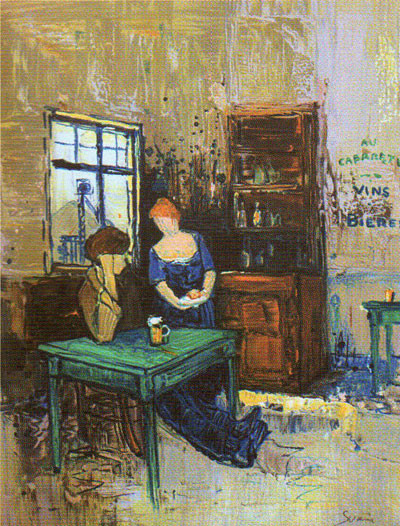
The short poem "Au Cabaret Vert" [At the Green Inn] shows Rimbaud at his best - or at any rate his least pretentious. The poem seems simple and honest, and while there may be certain overtones in it of a boy who's still pretending to be a man, there's no reason to suppose that the poet is unaware of the fact - or, for that matter, of the degree to which he's pandering to such expectations.

Here it is in a number of versions, starting with Ezra Pound's celebrated "Vagabond" translation of 1918:


Paul Verlaine: Rimbaud (Juin 1872)


    Au Cabaret Vert, cinq heures du soir

    - Arthur Rimbaud (October 1870)

    Depuis huit jours, j’avais déchiré mes bottines
    Aux cailloux des chemins. J’entrais à Charleroi.
    - Au Cabaret-Vert : je demandai des tartines
    De beurre et du jambon qui fut à moitié froid.
    
    Bienheureux, j’allongeai les jambes sous la table
    Verte : je contemplai les sujets très naïfs
    De la tapisserie. - Et ce fut adorable,
    Quand la fille aux tétons énormes, aux yeux vifs,
    
    - Celle-là, ce n’est pas un baiser qui l’épeure ! -
    Rieuse, m’apporta des tartines de beurre,
    Du jambon tiède, dans un plat colorié,
    
    Du jambon rose et blanc parfumé d’une gousse
    D’ail, - et m’emplit la chope immense, avec sa mousse
    Que dorait un rayon de soleil arriéré.


    Ezra Pound: Rimbaud (1957)


  1. Cabaret Vert [Vagabond]

  2. - trans. Ezra Pound (1918)

    Wearing out my shoes, 8th day
    On the bad roads, I got into Charleroi.
    Bread, butter, at the Green Cabaret
    And the ham half cold.
    
    Got my legs stretched out
    And was looking at the simple tapestries,
    Very nice when the gal with the big bubs
    And lively eyes,
    
    Not one to be scared of a kiss and more,
    Brought the butter and bread with a grin
    And the luke-warm ham on a colored plate …
    
    Pink ham, white fat and a sprig
    Of garlic, and a great chope of foamy beer
    Gilt by the sun in that atmosphere.


    Robert Lowell: Imitations (1961)


  3. At the Green Cabaret

  4. - trans. Robert Lowell (1961)

    For eight days I had been knocking my boots
    on the road stones. I was entering Charleroi.
    At the Green Cabaret, I called for ham,
    half cold, and a large helping of tartines.
    
    Happy, I kicked my shoes off, cooled my feet
    under the table, green like the room, and laughed
    at the naive Belgian pictures on the wall.
    But it was terrific when the house-girl
    
    with her earth-mother tits and come-on eyes —
    no Snow Queen having cat-fits at a kiss —
    brought me tarts and ham on a colored plate 
    
    She stuck a clove of garlic in the ham,
    red frothed by white, and slopped beer in my stein,
    foam gilded by a ray of the late sun.


    Arthur Rimbaud: The Poems (2012)


  5. At the Green Inn, Five in the Evening

  6. - trans. Oliver Bernard (1962)

    For a whole week I had ripped up my boots
    On the stones of the roads. I walked into Charleroi;
    Into the Green Inn: I asked for some slices
    Of bread and butter, and some half-cooled ham.
    
    Happy, I stuck out my legs under the green
    table: I studied the artless patterns of the
    Wallpaper - and it was charming when the girl
    With the huge breasts and lively eyes,
    
    - A kiss wouldn't scare that one! -
    Smilingly brought me some bread and butter
    And lukewarm ham, on a coloured plate; -
    
    Pink and white ham, scented with a clove of garlic -
    And filled my huge beer mug, whose froth was turned
    Into gold by a ray of late sunshine.


    Rimbaud: Complete Works, Selected Letters. Trans. Wallace Fowlie (1966)


  7. At the Cabaret-Vert At five in the afternoon

  8. - trans. Wallace Fowlie (1966)

    For a week my boots had been torn
    By the pebbles on the roads. I was getting into Charleroi.
    — At the Cabaret-Vert: I asked for bread
    And butter, and for ham that would be half chilled.
    
    Happy, I stretched out my legs under the green
    Table. I looked at the very naïve subjects
    Of the wallpaper. — And it was lovely,
    When the girl with huge tits and lively eyes,
    
    — She’s not one to be afraid of a kiss! —
    Laughing brought me bread and butter,
    Warm ham, in a colored plate,
    
    White and rosy ham flavored with a clove
    Of garlic – and filled my enormous mug, with its foam
    Which a late ray of sun turned gold.


    Arthur Rimbaud: Selected Works in Translation. Trans. A. S. Kline (2008)


  9. At The Green Inn

  10. - trans. A. S. Kline (2003)

     
    For eight days, I’d ripped up my boots
    On the road stones. I’d made Charleroi.
    – At the Green Inn: I ordered bread
    Buttered, along with half-cold ham.
    
    Happy, I stretched my legs out under the table,
    A green one: considering the naïve prints
    On the walls. – And it was charming,
    When the girl with big tits and lively eyes,
    
    – That one, just a kiss wouldn’t scare her! –
    Smiling, brought me slices of bread and butter,
    With lukewarm ham on a coloured platter,
    
    Ham, white and pink, a fragrant garlic clove,
    – And filled a huge beer mug high, its foam
    Turned by a ray of late sunlight to gold.


    Jean-Paul Saurin: Le Cabaret-Vert


  11. Au Cabaret-Vert, cinq heures du soir

  12. - trans. George Lang (2019)

    For a whole week I’d been wearing out my soles
    tramping down rocky paths. When I got home
    I headed to the Cabaret-Vert, ordering rolls
    with butter and a slab of lukewarm ham. 
    
    At peace, I stretched my legs out, admired
    the simple patterns on tapestry hung
    on the wall. Then the girl served up the desired
    buns, her tits big, bright eyes so young 
    
    — not likely would she shy away from a peck!
    The pink ham with its rim of white fat bedecked
    with pungent garlic sat on a fancy dish.
    
    With it she brought a stein topped with froth,
    spume glistening in the sun. In truth,
    there was little more I could ever wish.


    Henri de Toulouse-Lautrec: At the Café La Mie (1891)


  13. At the Green Cabaret, five o’clock in the evening

  14. - trans. Bir Cevap Yazın (2025)

    For eight days, I’d worn my boots, shred by shred
    On the pebbles of the roads. Into Charleroi I strolled
    – At the Green Cabaret: asked for buttered bread
    And a helping of ham that was half cold.
    
    Blissful, I stretched my legs under the green
    Table: at the very naive figures I gazed
    Of the tapestry. – It was a charming scene
    When the girl with enormous tits, with eyes that blazed,
    
    That girl, it’s not a kiss that makes her heart flutter!
    Laughing, she brought me warm bread and butter,
    Lukewarm ham, upon a colored plate,
    
    Pink and white ham, scented with garlic broth,
    And filled the huge mug, with its bubbling froth,
    Gilded by a sunbeam, lingering late.


Ezra Pound: Passport Photo (c.1919)


It's interesting that the first of these translations reads as if it should go last: Ezra Pound sounded more modern in 1918 than virtually any of the later translators. You could say that they chose to be more obedient to the accidentals of Rimbaud's sonnet, but it really comes out to your conception of what a poetry translation is (or should be).

A lot of it hinges on how these various writers deal with that crucial line "Celle-là, ce n’est pas un baiser qui l’épeure". "That girl, it’s not a kiss that makes her heart flutter!", says Bir Cevap Yazın. It's a bit clumsy, but not bad. It does at least get across the idea that it's not a mere kiss that's going to frighten this girl. She's far too experienced for that.

It's important to note here that, as Emad Noujeim has explained on Quora:
According to Le Grand Robert dictionary, the French verb baiser, which usually means “to kiss”, acquired the meaning of “to have sex or intercourse with” in the sixteenth century ...
The verb embrasser initially meant “to embrace or to hug”. It began to be more and more used with the meaning “to give a kiss or kisses” at the beginning of the twentieth century, as the verb baiser was increasingly used in the sense of “to screw (sexually or otherwise)” or “to fuck”.
This ... usage was still regarded as abusive by the lexicographer and encyclopedist Pierre Larousse in 1870 ... and was viewed as a ... neologism as late as the end of the nineteenth century.
In other words, Rimbaud was perfectly aware of the double-meaning of the word "baiser" in his sentence. It could, in fact, be quite legitimately Englished as "That girl, she's not afraid of a fuck!" All the translators must be aware of this. How could they not be? And yet most of them tiptoe through the line with various degrees of timidity:

Characteristically, Ezra Pound sees no reason not to be frank about the double-entendre:
Not one to be scared of a kiss and more
Robert Lowell almost over-emphasises it with his:
no Snow Queen having cat-fits at a kiss
Literalist Oliver Bernard is pretty evasive about it:
- A kiss wouldn't scare that one! -
Wallace Fowlie is a bit more idiomatic, but still not direct enough:
— She’s not one to be afraid of a kiss! —
A. S. Kline contorts the English language unmercifully with his:
– That one, just a kiss wouldn’t scare her! –
And, last and very possibly least, George Lang obliges us with:
— not likely would she shy away from a peck!
That's not to say that it's easy to translate a sonnet by Rimbaud, even one as seemingly straightforward as this. There are subtleties in every word, in every shade of description - and yet it all adds up to that paradisal sense of relief at a cold beer and a sandwich after a long tramp!

Pound gets that across. Do any of the others? Perhaps Lowell and Fowlie. The jury's out on most of the others, I'd say.

One thing's for certain. If you have any desire at all to understand modern poetry, it's probably best to begin with Arthur Rimbaud. His attempts to modernise his contemporaries met with - let's say - somewhat mixed success, but his influence on posterity has been immense.

When Pound and Eliot set out to revolutionise English-language poetry shortly before the First World War they had a number of French poets to choose from. Baudelaire, Laforgue, Lautréamont, Mallarmé - all contributed something. But behind them stood Rimbaud's "bâteau ivre" - not to mention his book of prose poems Les Illuminations ...


Isabelle Rimbaud: Arthur Rimbaud on his deathbed (1895)


Henriego Fantin-Latour: Arthur Rimbaud (1872)

Jean Nicolas Arthur Rimbaud
[Arthur Rimbaud]

(1854-1891)

Books I own are marked in bold:
    Published poems:

  1. "Les Étrennes des orphelins" [1869]. La revue pour tous (2 January 1870)
  2. "Première soirée" [1870]. [aka "Trois baisers" & "Comédie en trois baisers"]. La charge (13 August 1870)
  3. "Le Dormeur du val" [1870]. Anthologie des poètes français (1888)
  4. "Voyelles" [1871 or 1872]. Lutèce (5 October 1883)
  5. "Le Bateau ivre", "Voyelles", "Oraison du soir", "Les assis", "Les effarés", "Les chercheuses de poux" (1870–1872]. Les Poètes maudits. Ed. Paul Verlaine (1884)
  6. "Les corbeaux" (1871 or 1872]. La renaissance littéraire et artistique (14 September 1872)
  7. "Qu'est-ce pour nous mon cœur..." [1872]. La Vogue (7 June 1886)
  8. "Les mains de Marie-Jeanne" [1871]. Littérature (June 1919)

  9. Collections:

  10. Une Saison en Enfer [1873] (Brussels, October 1873)
  11. Illuminations [1872–1875] (1886)
  12. Reliquaire – Poésies. Ed. Rodolphe Darzens (1891)
  13. Poésies complètes. Preface by Paul Verlaine (1895)
  14. Album Zutique [1871]. Littérature (May 1922)
  15. Oeuvres: Édition illustrée. Ed. Suzanne Bernard. Classiques Garnier (1960)
    • Oeuvres: Édition illustrée. Ed. Suzanne Bernard. 1960. Classiques Garnier. Paris: Éditions Garnier Frères, 1975.
  16. Oeuvres Poétiques Complètes. Collection Bouquins (1980)
    • [with Charles Cros / Tristan Corbière / Lautréamont]. Oeuvres Poétiques Complètes. Ed. Alain Blottière, Pascal Pia, Michel Dansel, Jérome Bancilhon. Préface de Hubert Juin. 1980. Collection Bouquins. Ed. Guy Schoeller. Paris: Éditions Robert Laffont S.A., 1989.

  17. Prose:

  18. "Le rêve de Bismarck". Le Progrès des Ardennes (25 November 1870)
  19. Rapport sur l'Ogadine. Société de Géographie (February 1884)
  20. Narration: "Le Soleil était encore chaud..." [1864–1865] (1897)
  21. "Lettre de Charles d'Orléans à Louis XI" [1869 or 1870]. Revue de l'évolution sociale, scientifique et littéraire (November 1891)
  22. "Un coeur sous une soutane" [1870]. Littérature (June 1924)
  23. "Les Déserts de l'amour" [1871–1872]. La revue littéraire de Paris et Champagne (September 1906)
  24. "Proses évangeliques" [1872–1873]. La revue blanche, September 1897 / Le Mercure de France (January 1948)

  25. Letters:

  26. Lettres de Jean-Arthur Rimbaud – Égypte, Arabie, Éthiopie [1880–1891]. Ed. Paterne Berrichon (1899)
  27. "Lettres du Voyant" [13 & 15 May 1871] (1912 / 1928)

  28. Translations:

  29. Illuminations and Other Prose Poems. Trans. Louise Varèse (1946)
    • Illuminations and Other Prose Poems. Trans. Louise Varèse. 1946. Rev. ed. NDP56. New York: A New Directions Paperbook, 1957.
  30. Collected Poems: With Plain Prose Translations of Each Poem. Trans. Oliver Bernard (1962)
    • Collected Poems: With Plain Prose Translations of Each Poem. Ed. & trans. Oliver Bernard. 1962. The Penguin Poets. Ed. J. M. Cohen. Harmondsworth: Penguin, 1969.
  31. A Season in Hell. Trans. Oliver Bernard (1962)
    • A Season in Hell. Trans. Oliver Bernard. 1962. Penguin 60s Classics. Harmondsworth: Penguin, 1995.
  32. Complete Works, Selected Letters: A Bilingual Edition. Trans. Wallace Fowlie (1966)
    • Complete Works, Selected Letters: A Bilingual Edition. Trans. Wallace Fowlie. 1966. Rev. Seth Whidden. Chicago: The University Of Chicago Press, 2005.

  33. Secondary:

  34. Nicholl, Charles. Somebody Else: Rimbaud in Africa, 1880-91. 1997. Vintage. London: Random House UK Ltd., 1998.
  35. Starkie, Enid. Arthur Rimbaud. 1961. Faber Paper Covered Editions. London: Faber, 1973.


William Roberts: The Vorticists at the Restaurant de la Tour Eiffel (1961-62)

Modern Poets in English

  1. C. P. Cavafy (1863-1933)
  2. Anna Akhmatova (1889-1966)
  3. Osip Mandelstam (1891-1938)
  4. Arthur Rimbaud (1854-1891)
  5. Guillaume Apollinaire (1880-1918)
  6. Rainer Maria Rilke (1875-1926)
  7. Fernando Pessoa (1888-1935)
  8. Eugenio Montale (1896-1981)
  9. Federico García Lorca (1898-1938)
  10. Salvatore Quasimodo (1901-1968)
  11. Pablo Neruda (1904-1973)
  12. Paul Celan (1920-1970)


Friday, January 13, 2023

Edgar Allan Poe and The Pale Blue Eye


Scott Cooper: The Pale Blue Eye (2022)


Le tombeau d'Edgar Poe

Tel qu’en lui-même enfin l’éternité le change,
Le Poëte suscite avec un glaive nu
Son siècle épouvanté de n’avoir pas connu
Que la mort triomphait dans cette voix étrange !

Eux, comme un vil sursaut d’hydre oyant jadis l’ange
Donner un sens plus pur aux mots de la tribu
Proclamèrent très haut le sortilège bu
Dans le flot sans honneur de quelque noir mélange.

Du sol et de la nue hostiles, ô grief !
Si notre idée avec ne sculpte un bas-relief
Dont la tombe de Poe éblouissante s’orne,

Calme bloc ici-bas chu d’un désastre obscur,
Que ce granit du moins montre à jamais sa borne
Aux noirs vols du Blasphème épars dans le futur.


- Stéphane Mallarmé (1887)

Pierre-Auguste Renoir: Stéphane Mallarmé (2022)


I thought I'd start off my discussion of the recent Netflix movie The Pale Blue Eye - which I very much enjoyed, in case anyone's wondering - by quoting Mallarmé's immortal poem "The Tomb of Edgar Poe."

I was going to add a literal translation of it, but then I ran across the one below, by American poet Richard Wilbur, which it's hard to imagine improving on:
The Tomb of Edgar Poe

Changed by eternity to Himself at last,
The Poet, with the bare blade of his mind,
Thrusts at a century which had not divined
Death's victory in his voice, and is aghast.

Aroused like some vile hydra of the past
When an angel proffered pure words to mankind,
Men swore that drunken squalor lay behind
His magic potions and the spells he cast.

The wars of earth and heaven - O endless grief!
If we cannot sculpt from them a bas-relief
To ornament the dazzling tomb of Poe,

Calm block here fallen from some far disaster,
Then let this boundary stone at least say no
To the dark flights of Blasphemy hereafter.


Is it just me, or do you see some resemblance between the whiskery face of France's greatest symbolist poet and that of Christian Bale, above, in his role as "Landor" in the movie?

Mallarmé's implication that it is poets who are meant to give "a purer sense to the words of the tribe" [Donner un sens plus pur aux mots de la tribu] lies at the heart of Modernist aesthetics. It ranks with Baudelaire - another Poe fanatic - and his view of the poet as a wave-riding albatross, expounded in his verse of the same name:
Le Poète est semblable au prince des nuées
Qui hante la tempête et se rit de l'archer;
Exilé sur le sol au milieu des huées,
Ses ailes de géant l'empêchent de marcher
.
The Poet is like that wild inheritor of the cloud,
A rider of storms, above the range of arrows and slings;
Exiled on earth, at bay amid the jeering crowd,
He cannot walk for his unmanageable wings.
(The translation, this time, is by George Dillon, Edna St. Vincent Millay's collaborator in their joint 1936 version of Baudelaire's Flowers of Evil)


Edgar Allan Poe (1809-1849)


Edgar Allan Poe ... yes, we know all about him (or think we do): the inventor of the detective story; the misunderstood genius, betrayed by the vindictive jealousy of his literary executor, Rufus Griswold, who almost single-handedly constructed the myth of his drunkenness and infamy; the visionary poet, first recognised by the French before the English-language world reluctantly followed their example; and - somewhat surprisingly - once, briefly, a cadet at West Point, where the film is quite correct in placing him.

What then of the Holmes to Poe's Watson, Augustus Landor? Well, the "Augustus" comes, presumably, from Poe's own prototypical detective Auguste Dupin, the protagonist of "The Murders in the Rue Morgue", "The Mystery of Marie Rogêt", and the distinctly Borgesian "Purloined Letter".


As for "Landor", rather than English poet Walter Savage Landor, it seems probable that his surname is meant to refer to the little-known vignette "Landor's Cottage" - the last story Poe ever wrote, in fact - which describes the house he himself was living in at the time. The Landor of the film, too, inhabits a particularly picturesque and bookish cottage.


Louis Bayard: The Pale Blue Eye (2006)


Mind you, most of this inventiveness must be attributed, not so much to the film-makers as to the author of the novel the movie is based on, Louis Bayard. I'm guessing, like many of us, he found frustrating the inconclusiveness of "Landor's cottage": a long descriptive preamble to a promised story to be told in a next instalment which, alas, was never to appear.


All this trivia aside, I have to admit that I was somewhat surprised to find so lukewarm a response to the movie in a number of quarters. Most of them criticised the film's "implausibility" and "inaction", which struck me as a little perverse, given the prevalence of both factors in Poe's own published writings.

As critics then and now have often failed to grasp, with Romantic artists such as Poe, it's all or nothing: you're in or you're out. If you have a problem with orangutans committing murders or with the propensity of Poe's heroines to get themselves buried alive or have their teeth extracted post-mortem, then you'd better stick to realists like Dickens or Trollope.


Or, in this case, you'd better stick to bad parodies of Agatha Christie, such as the dreadfully tedious and poorly plotted recent whodunit above. I was interested to see that many of those who'd awarded The Pale Blue Eye two or three stars had given See How They Run four or five.

It's not, you understand, that I have a problem with Agatha Christie or the other luminaries of the Golden Age of Detective Fiction in their own right - just with the decision to replay them badly as farce. It does make me realise, though, that in detective films as well as in novels, I'm not really looking for the same things as most aficionados of the genre.


For me, it's all about atmosphere and character. I like the kinds of scenes - so abundant in The Pale Blue Eye - where characters wander around deserted graveyards, or sit in crowded taverns trading witty banter. Best of all are the occasions when large books are taken down from dust-laden shelves and opened to salient passages - translated impromptu, in this case, by Poe himself as Robert Duvall and Christian Bale look on approvingly.

Does any of this advance the plot, or assist us in unmasking the criminal? Not really, no. I don't care. Murders don't really interest me very much - but I do like a picturesque detective, with lots of hidden demons, and a taste for bamboozling even his closest collaborators.

All of this, of course, is anathema to the true devotees of detective fiction. They like an ingenious solution to the mystery, and such curlicues as believable characters or well-painted backdrops are largely irrelevant to them. Hence their preference for the pasteboard mechanics of See How They Run over the ice-bound dramatics of The Pale Blue Eye.


Rian Johnson, dir.: Knives Out (2019)


I suppose, in the end, it's best to have both. I did enjoy the original Knives Out, as well as its sequel Glass Onion, I suppose mainly because Daniel Craig was so obviously having the time of his life playing absurd anti-Bond chicken-fried Southerner Benoit Blanc.

There was, as I recall, some kind of a murder being investigated at the time, but I was more interested in watching the characters score points off one another as each of the superannuated stars tried to steal scenes with ever more outrageous business.


Rian Johnson, dir.: Glass Onion (2022)


Poe, too, could be ridiculous at times (some would say all the time). But he was, in the end, a very serious guy. He felt strongly about the need for rigorous critical judgements in the infancy of American literature, and the hatchet jobs he performed on many of his more celebrated contemporaries were legendary. Funnily enough, many of those authors are now known simply because Poe decided to critique them.

Harry Melling - perhaps better known as Harry Potter's spoilt cousin Dudley Dursley - does an excellent job of animating the touchy, emotional, fiercely intelligent contradiction that was Poe. Some viewers have commented on the incongruity of a Southern accent for someone born in Boston, but Poe did like to portray himself as a Virginian, so this is certainly an arguable quirk to impose on him.

After all, somewhat closer to our own time, Boston Brahmin poet Robert Lowell affected a Southern accent in his own poetry readings - presumably as a salute to his Southern Agrarian mentors John Crowe Ransom and Allen Tate - as you can hear in this recording of his 1964 poem "For the Union Dead".


Jane Bown: Robert Lowell


Talking of poetry, there's been a certain amount of discussion of the verses - allegedly dictated to him by his dead mother - Poe quotes halfway through the movie:
Down, down, down
Came the hot threshing flurry
Ill at heart, I beseeched her to hurry
Lenore
She forbore the reply
Endless night
Caught her then in its slurry
Shrouding all, but her pale blue eye
Darkest night, black with hell
Charneled fury
Leaving only
The deathly blue eye
Needless to say, these were not written by Poe - he may have used some dodgy rhymes at times, but I can't see him combining "hurry" with "flurry" and "slurry". Nor is the syntax precise enough for his almost over-controlled style. They do have a pleasing ring in context, though.

His own poem "Lenore", which presumably inspired these lines, is somewhat more conventional in form:
The sweet Lenore hath "gone before," with Hope, that flew beside
Leaving thee wild for the dear child that should have been thy bride -
For her, the fair and debonair, that now so lowly lies,
The life upon her yellow hair but not within her eyes -
The life still there, upon her hair - the death upon her eyes
.
Presumably the flimmakers also had in mind the narrator's sorrow for "the lost Lenore" in "The Raven":
Ah, distinctly I remember it was in the bleak December;
And each separate dying ember wrought its ghost upon the floor.
Eagerly I wished the morrow; — vainly I had sought to borrow
From my books surcease of sorrow — sorrow for the lost Lenore —
For the rare and radiant maiden whom the angels name Lenore —

Nameless here for evermore.


Somewhat bewilderingly, Poe has more than one grave. The simple headstone above - with its appropriately superimposed raven - is in Baltimore, Maryland. His remains were, however, disinterred in 1875 to be shifted under the rather more pompous monument below - presumably the one which inspired Mallarmé's poem.

A somewhat less accomplished verse - by an equally distinguished admirer, Alfred, Lord Tennyson - was composed for the occasion:
Fate that once denied him,
And envy that once decried him,
And malice that belied him,
Now cenotaph his fame.


What more need one say? If you love the hothouse atmosphere of Gothic extravagance, thrill to the overblown prose of H. P. Lovecraft or Ray Bradbury's early collection Dark Carnival - why not return to their admitted master, the divinely gifted Mister Poe?

As his literary soulmate and principal French translator Charles Baudelaire put it in an 1864 letter to Théophile Thoré - with, perhaps, a mixture of admiration and chagrin:
The first time I opened a book he had written, I saw with equal measures of horror and fascination, not just the things that I had dreamed of, but actual phrases that I had designed and that he had penned twenty years earlier.
One thing's for certain, there will always be a certain region of the imagination identified with Poe's name. If you'd like to explore it further, I strongly recommend a viewing of The Pale Blue Eye.


Thursday, January 03, 2019

Robert Lowell Revisited


Kay Redfield Jamison: Robert Lowell: Setting the River on Fire (2017)


Roughly seven years ago, I wrote a post detailing my views on the work of Robert Lowell's then two principal biographers, Ian Hamilton (1982) and Paul Mariani (1994).


Paul Mariani (1940- )


Now, however, there's a new book out, by psychologist Kay Redfield Jamison, herself a sufferer from bipolar disorder, and therefore uniquely placed (one might think) to give us insights into the true nature of Lowell's mental illness - both its nature, that is, and the effects she alleges it had on his own creativity.


I remember when I first discovered Robert Lowell's writing, back in the early eighties, remarking to my then guru, Prof. D. I. B. [Don] Smith of Auckland University, that it sounded as if Lowell must have been a horrible man. This was based on my reading of Hamilton's biography, then freshly out, hence the major source of information on the subject.

"I'm sure that's quite untrue. Who wrote the biography?" responded Don.

"Ian Hamilton," I replied.

"Oh, the shit!"

"What do you mean?"

"Well, we prescribed a selection of Robert Frost's poetry a few years ago with an introduction by Hamilton. Instead of talking about Frost's poetry, he went into lots of detail about what a terrible person he was: completely unnecessary! Even if it's true, it didn't need to be said."


Ian Hamilton (1938-2001)


Don generally had a new angle on virtually any topic one raised with him. Part of it came from his long years of study and teaching in the UK and Canada, which seemed to have resulted in his meeting virtually every significant literary figure of the time (he had some original views on Alan Bennett, whom he'd met at Oxford - on Auden, as well - but that's another story).

"Lowell was a delightful man," he went on to say.

"How do you know? Did you ever meet him?"

"No, but I've just been reading his essay on Ford Madox Ford, and the man who wrote that must have been a wonderful man."


Ever dutiful, I went off and duly read the essay on Ford, and started to see what Don was driving at. His point was, I think, that whatever the arc of one's biography - moving from misery to happiness to pain, or whatever pattern we impose on it from a distance (the diachronic view, if you prefer that terminology) - the actual experience of being that human being, or even meeting him or her - i.e., the synchronic section cut across that larger chronology - can be completely different.

The Lowell of the Ford essay came across as kindly, relaxed and wise (quite a lot like Don Smith, in fact, if the truth be told). I began to realise that a person only really exists as a series of moments, and the artificiality of any tragic arc - the largely malign one drawn by Hamilton, for instance - should always be taken with a grain of salt.

It's not, mind you, that people always come out better taken moment by moment, or (alternatively) that tout comprendre c'est tout pardonner [to understand all is to forgive all]. It's just that one should never take any biographical construct too seriously, particularly if it's been concocted by someone who never met - or met only fleetingly - their subject.

Meeting Lowell - just like being him - could clearly be hellish at times, but Lowell-on-paper does not come across like that. He reads like someone who found life, not death, an 'awfully big adventure,' and who never gave up on its possibilities, even in the extremes of despair.


Gerard Malanga: Lowell in London (1970)


Since Hamilton's book in the 80s, the only really significant biographical studies have been by Mariani (mentioned above), as well as the tireless Jeffrey Meyers, author of 25 or so biographies to date, among them books on Hemingway, Mansfield, and a host of others, including no fewer than three volumes on Robert Lowell and his circle.


Jeffrey Meyers (1939- )


The first two of these appeared in the late 80s, but his most recent effort is Robert Lowell in Love (2015):


Jeffrey Meyers, ed.: Robert Lowell: Interviews and Memoirs (1988)


Jeffrey Meyers: Robert Lowell in Love (2015)


It's safe to say, then, that the actual incidents of Lowell's life have had a fairly thorough airing in the various accounts above. Jamison begins wisely, then (in my opinion) by stressing that what she has written is "not a biography." Instead of that, she goes on to say:
I have written a psychological account of the life and mind of Robert Lowell; it is as well a narrative of the illness that so affected him, manic-depressive illness. ... My interest lies in the entanglement of art, character, mood and intellect. (5)
Quite a tall order, one would think. After all, when in doubt, a standard, common-or-garden biography can always take refuge in a bit more detail: a few more addresses, a few more laundry lists and bank receipts. Once one has thrown away that crutch, it's hard to know exactly what to fall back on.

Jamison (unfortunately) has a tendency to fold in pages of pretentious waffle about the Bible, the Book of Common Prayer, or any other uplifting subject whenever she runs short of material. Mainly, one is forced to conclude, because she has to admit to knowing little about poetry, and is therefore at the mercy of the contradictory critical assessments of even Lowell's major works, let alone such late books as Day by Day (1976), which she alone seems to see as ranking with Lord Weary's Castle (1946) and Life Studies (1959) as one of the jewels in his diadem.

What expertise she does have lies elsewhere:
My academic and clinical field is psychology and, within that, the study and treatment of manic-depressive (bi-polar) illness, the illness from which Robert Lowell suffered most of his life. I have studied as well the beholdenness of creative work to fluctuations of mood and the changes in thinking that attend such fluctuations. Mood disorders, depression and bipolar illness, occur disproportionately often in writers, as well as in visual artists and composers. Studying the influence of both normal and pathological moods on creative work is critical to understanding how the mind imagines. (5) [my emphases]
I don't have a problem with this agenda per se. There's always something new to be learned from any new approach, and Jamison's close scrutiny of Lowell's psychological records - allowed here for the first time by kind permission of Lowell's daughter Harriet - might certainly be seen to justify a study on this scale (if, like me, you persist in seeing Lowell as one of the most significant twentieth century American poets, that is).

I have underlined out those two statements above, however, since I think they demand further attention. The first appears to posit a link between creativity and mania which one would have thought had long since fallen casualty to the romantic notion of the artist-creator.
The lunatic, the lover and the poet
Are of imagination all compact
...
Jamison is careful to buttress it up with endless clinical details and citations, but she is, it appears, genuinely of the opinion that occasional bouts of mania were of assistance to Lowell in his writing, and provided "material" for him to work over later in the depressions that inevitably followed them.

As her strange saga proceeds, moreover, one begins to realise that its basic postulate is that Lowell can do no wrong (possibly because she too is a sufferer from the same debilitating condition, and therefore can't bear to think otherwise). Even though Lowell himself castigated himself profoundly after each period of madness for the verbal and physical cruelties he had inflicted on those dearest to him, this is - to Jamison - simply proof of his superior "character."


Luise Keller: Friedrich Hölderlin (1842)


And, of course, there's a certain truth in these ideas. One can't really assess Lowell (or, for that matter, Hölderlin, or John Clare, or Christopher Smart) without factoring the influence of their "madness" on the totality of their work (thus perhaps justifying the second bolded-out sentence above). But was it of genuine advantage to them? I think a very strong case could be made for the negative in each case, though of course a final decision on the matter is not really attainable.


It's all very perilous, however: I would see it as a profoundly dangerous way of thinking. It's the kind of stuff John Money spouted when he was trying to persuade the young Janet Frame to commit herself (voluntarily) for psychological treatment: Schumann, Van Gogh, Hugo Wolf were the examples he used to see madness as an essential part - almost as proof - of an artist's character.

That didn't work out so well, and I have to say that Lowell was probably better off with the doctors he had at the time than with one as starry-eyed as Jamison. While (fortunately) a strong believer in the virtues of lithium, she does seem to believe that "poets" are some kind of arcane race of superhumanly gifted beings. Even if that were so (and I don't believe it is), it's rather pointless to use that as a kind of get-out-of-jail-free card when it comes to charting their biographical progress.

There are many things to like and admire in her account. It's very interesting at times. However, with the best will in the world, I'm unable to award it, as a whole, even the qualified thumbs up I conceded in my earlier post to the Hamilton-Mariani double-act. One explanation for this lies in the immense amount of redundancy weighting down her book. As an example of the kind of padding she far too often permits herself, savour these parting words about Lowell's funeral:


A foot of snow lay on the ground outside the church and the wind blew to the bone; it was winter in Cambridge. Had the mourners looked up at the bell tower of the church as they left the service for Robert Lowell on that March day they would have seen the bell that tolled for him. But they would not have been able to see the words carved into the shoulder of the bell. Words for the dead, they had been chosen by Lowell's cousin nearly fifty years earlier, when, as president of Harvard, he donated the bell to the college church. In Memory of Voices That Are Hushed, the bell read. In memory of the dead.

The voices of the living could be hushed as well. Lowell's great-great-grandmother had lived a silent death in madness; her son had said that only as much of her remained as "the hum outliving the hushed bell." The poet's voice speaks for the dead, the hushed, the valorous. It signifies the hours, reminds of death. It gives depth and resonance to blithe times, solace in the dark.


The bells cry: "'Come, / Come home ...,' Robert Lowell wrote. "'Come; I bell thee home.' " (403-4)
Not, I think, since Carl Sandburg's six-volume hagiography of Abraham Lincoln has an American writer permitted herself to go quite so far as this into the realms of footling hyperbole. I remember once reading a long quote from The Prairie Years (1926) about the significance of Lincoln's rocking cradle which did indeed rival the above on the bullshit meter, but it was a pretty close call.

Unfortunately Jamison has failed to learn the distinction between poetry ("the best words in the best order" - S. T. Coleridge) and the poetic (vague, dirge-like words strung together for some kind of solemn - or somnolent - effect).


Robert Lowell: The Dolphin (1973)
[cover by Sidney Nolan]


I'm afraid, however, that where Jamison really falls down for me is in the ethical colour-blindness which continually undermines her version of Robert Lowell's life. Take, for example, her account of the controversy over Lowell's use (without permission) of extensive quotes from his then-wife Elizabeth Hardwick's letters in his 1973 collection The Dolphin, which, as a whole, chronicles the beginning of his new relationship with wife-number-three Caroline Blackwood.

The precise details of the argument to which this has given rise - over the limits of poetic "licence" (as it were) - are a bit niggly. I've chronicled the matter in rather more detail in a lecture originally given in a university course on Life Writing, so I won't bother to rehearse it all again here.


Suffice it to say that Lowell's close friend and poetic colleague Elizabeth Bishop took great exception to this act for the following reasons (as she explained to him in a long, fascinating letter):
One can use one's life as material - one does, anyway - but these letters, aren't you violating a trust? IF you were given permission - IF you hadn't changed them ... etc. But art just isn't worth that much. I keep remembering [Gerard Manley] Hopkins's marvelous letter to [Robert] Bridges about the idea of a "gentleman" being the highest thing ever conceived - higher than a "Christian," even, certainly than a poet. It is not being "gentle" to use personal, tragic, anguished letters that way — it's cruel.
[Letter of March 21, 1972]
Not only had Lowell not received permission to quote from the letters; he'd even taken it upon himself to rewrite them substantially (all within quote marks, mind you), and thus put things she never actually wrote or said into his wife's mouth.


Elizabeth Hardwick: Sleepless Nights (1979)


When I mention this in class, along with various other examples of Lowell's playing fast and loose with other people's words, I've noticed that most students tend to take Bishop's side. Jamison doesn't see it that way at all, however. Her reasons for this are interesting, to say the least.

First, it was all a long time ago:
It has been more than forty years since the publication of The Dolphin, and the indignation over Lowell's taking lines from Hardwick's letters has lessened but not disappeared. Time has a blanketing effect on outrage. (344)
No doubt time does "have a blanketing effect on outrage," but that seems a particularly foolish extenuating cicumstance for a biographer to advance. If outrage wears so thin over time, how about our interest in the minutiae of Lowell's clinical diagnoses and treatment?

Second, it wasn't that bad in the first place:
In many respects, as literary and historical controversies go, the appropriation is not particularly egregious. The issue was an important one to many of those most involved, however, including critics, friends, and, of course, Elizabeth Hardwick, Caroline Blackwood, and Lowell himself. Elizabeth Bishop's burning words to Lowell ... "Art just isn't worth that much" - are repeated still. They raise general questions about the use of private observation in art; they also raise questions of hypocrisy. (344)
So if it's still being discussed, as well as having had the effect of galvanising everyone involved, even peripherally, at the time, then I'd have to say that still sounds pretty important: even, perhaps, "egregious" - to me, at any rate.

Like ex-NY Mayor Rudy Giuliani skating around the latest porkie from his client, the President of the United State, Jamison proceeds to pour even more fuel on the flame, with her admission that "for years he had taken bits of conversation and correspondence from his friends" [a long list of friends and other public sources follows].
Lowell [she informs us] had a poet's magpie eye and an imprinting ear: he spotted, snatched, rejected, revised, incorporated. Words of others became part of his available stock. But it was his imagination that picked, sorted and built. That created poetry. (345)
No doubt he did. But were any of the people she mentions the opposite party in an increasingly acrimonious marital dispute, soon to culminate in divorce? No, they weren't: he may have quoted from Eliot, Pound, Homer, Sophocles, Uncle Tom Cobleigh and all on many occasions, to little controversy, but that was under completely different circumstances.

You might as well say that Lowell had written and published poems before - to no particular objections - so why were they all protesting now? It's deliberately misleading chicanery on Jamison's part, in other words.


Perhaps the most devastating attach on Lowell's behaviour over The Dolphin was expressed in a contemporary review by former friend and fellow-poet Adrienne Rich:
What does one say about a poet who, having left his wife and daughter for another marriage, then titles a book with their names [For Lizzie and Harriet - also 1973], and goes on to appropriate his ex-wife's letters written under the stress and pain of desertion, into a book of poems nominally addressed to the new wife? (346)
"The book," she went on to say, was "cruel and shallow," and the "inclusion of the letter poems stands as one of the most vindictive and mean-spirited acts in the history of poetry."

Ouch! That must have stung a bit. But not for Lowell, who never seems actually to have understood what all this controversy was about. In his reply to Bishop's letter (quoted above) he said only:
Lizzie's letters? I did not see them as slander, but as sympathetic, tho necessarily awful for her to read. She is the poignance of the book, tho that hardly makes it kinder to her. ... It's oddly enough a technical problem as well as a gentleman's problem. How can the story be told at all without the letters. I'll put my heart to it. I can't bear not to publish Dolphin in good form.
[Letter of March 28, 1972]
In other words, yes, it is a bit rough on her, but the alternative would probably be to scrap the book entirely, and that's just not going to happen. He enlarges on this a bit in another letter to his friend, the eventual editor of his Collected Poems, Frank Bidart:
I've read and long thought on Elizabeth's letter. It's a kind of masterpiece of criticism, though her extreme paranoia (For God's sake don't repeat this) about revelations gives it a wildness. Most people will feel something of her doubts. The terrible thing isn't the mixing of fact and fiction, but the wife pleading to her husband to return - this backed by "documents"
[Letter of April 10, 1972]


Frank Bidart (1939- )


And what is Jamison's response to all this? Rather than attempting to engage with them, she is content to call Adrienne Rich's strictures 'a stretch':
Whatever legitimate criticism of Lowell's including excerpts from Hardwick's letters, it is far from the one of the most vindictive acts in the history of poetry. There is too much competition. (346)
In other words, sure, it was bad, but it wasn't the worst - worse things happen at sea. And the culminating point of all this havering around the point is the following piece of pomposity: "Scandals blaze; they die down. Art lasts or it doesn't."
Two years after Lowell died, Elizabeth Hardwick told an interviewer that Lowell was "like no one else - unplaceable, unaccountable." Unplaceable, unaccountable. Perfect words: wife to husband, writer to writer. (348)
Do you see what I mean? The net result of 400 pages of this kind of thing is, unfortunately, to obscure all the paradoxes stated so starkly by Ian Hamilton (in particular), and to make one alternately yawn and gag as one turns the next page to ever more egregious excesses of Lowell-worship.

"Art lasts or it doesn't" - what a crock of shit. If anything in Lowell's art looks likely to last, it certainly isn't that mad rush of sonnets from 1967-1973, culminating in the weird biblioblitz - History, For Lizzie and Harriet, and The Dolphin - of 1973. And, in any case, how could that ever be the point?

The point for my Life Writing students is that they have to make their own decisions on what personal and family details they choose to reveal in their writing. There are precious few signposts on this particular road, and one of them is this particular controversy between Bishop and Lowell. How dare Jamison refer to it simply as some old, dead "scandal"!

True, that's pretty much the line taken by her hero Lowell, who clearly - in his letter to Frank Bidart, at any rate - sees it as more of a technical challenge than a moral one, and goes on to attributes the vehemence of her reaction more to Bishop's "paranoia" about revelations than to any real problems with his own behaviour.

There are no special rules for artists: no special code of conduct that excuses 'great' poets from the normal codes of conduct that apply to the rest of us. Do you hear that, Kay Redfield Jamison, through the blinkered spectacles of your Carlylean "great man" theory of history?

"How far can I go?" is a real, practical problem, which applies to writers - and not just ones in the fields of memoir, autobiography and confessional poetry - every day of their lives. Am I justified in letting the cat out of the bag when it comes to family skeletons - or only about my own misdeeds? Can I really write all those mean things about people without getting ostracised?

Lowell took it pretty far. That's one of the reasons he remains interesting, and still well worth reading (imho). Jamison thinks he's worth reading because he found interesting metaphors and descriptors for the particular madness he suffered from. That may well be true, also. But don't obscure that simple, basic point with a whole lot of palaver about "character" and "moral fibre," as if a self-indulgent, womanising drunk were really some kind of unsung Saint. If he had been he would be boring - it's his flaws that sell him, as he himself knew all along.

"In the kingdom of the dumb, the one-track mind is king." Jamison's hagiography has, it seems, reaped a certain amount of praise from those equally ignorant of the true nature of Lowell's work, but even the most sympathetic reviews acknowledge a certain failure to edit: to cut out all those long apostrophes about Captain Scott (another exemplar of moral heroism, it would appear - you know my views about that), bio-sketches of distant relatives who also ended up in asylums, and - really - just random blah.

The way she writes off Rich's and Bishop's concerns about playing fast and loose with other people's lives and reputations is terrifyingly slick, however - "Satan hath made thee mighty glib," as my old Dad used to say whenever anybody looked likely to best him in argument.

It sounds, in fact, uncomfortably like what we've become used to from PR spokespeople and other paid apologists for any unpalatable view: racism, genocide, fraud, or just plain old lies in general - there's nothing, really, you can't massage with those old cons about how "it was a long time ago and let's hope it never happened. And if it did happen it wasn't my fault. And if did happen and it was my fault then I'm sorry you feel that way about it - let's move on, what's the point of dwelling on it? You really are pathetic in still wanting to drag up that old stuff. Get a life!" I think you all know the kind of thing.

In short, then, I'd like to like Jamison's book, but I just can't. Nor can I really conscientiously recommend it as a valuable contribution to Lowell studies. For the moment, I'd say that those of you still curious about the poet would be far better off reading the fine, comprehensive editions of his poetry, prose and letters which continue to appear forty years after his death.


Saskia Hamilton, ed.: The Letters of Robert Lowell (2005)

Robert Traill Spence Lowell IV
(1917-1977)

    Poetry:

  1. Land of Unlikeness. Massachusetts: The Cummington Press, 1944.

  2. Lord Weary's Castle. 1946. New York: Harcourt, Brace and Company, 1947.

  3. Lord Weary's Castle and The Mills of The Kavanaughs. 1946 & 1951. A Harvest / HBJ Book. San Diego, New York & London: Harcourt Brace Jovanovich, Publishers, 1974.

  4. Poems 1938-1949. 1950. London: Faber, 1970.

  5. Life Studies. 1959. London: Faber, 1968.

  6. Life Studies and For the Union Dead. 1959 & 1964. The Noonday Press. New York: Farrar, Straus and Giroux, 1974.

  7. Selected Poems. 1965. Faber Paper Covered Editions. London: Faber, 1969.

  8. Near the Ocean. London: Faber, 1967.

  9. Notebook 1967-68. The Noonday Press N 402. New York: Farrar, Straus and Giroux, 1969.

  10. Notebook. 1970. London: Faber, 1971.

  11. History. The Noonday Press N 513. New York: Farrar, Straus and Giroux, 1973.

  12. For Lizzie and Harriet. London: Faber, 1973.

  13. The Dolphin. London: Faber, 1973.

  14. The Dolphin. 1973. The Noonday Press N513. New York: Farrar, Straus and Giroux, 1975.

  15. Raban, Jonathan, ed. Robert Lowell’s Poems: A Selection. 1973. London: Faber, 1974.

  16. Selected Poems: Revised Edition. 1976 & 1977. New York: Farrar, Straus, Giroux, 1981.

  17. Day by Day. 1977. London: Faber, 1978.

  18. Hofmann, Michael, ed. Poems. London: Faber, 2001.

  19. Bidart, Frank & David Gewanter, with DeSales Harrison, ed. Collected Poems. New York: Farrar, Straus & Giroux, 2003.

  20. Plays:

  21. The Old Glory. London: Faber, 1966.

  22. Translation:

  23. Phaedra: A Verse Translation of Racine’s Phèdre. 1961. Faber Paper Covered Editions. London: Faber, 1971.

  24. Imitations. 1961. Faber Paper Covered Editions. London: Faber, 1971.

  25. ‘Poems by Osip Mandelstam.’ The Atlantic Monthly, 211 (June, 1963): 63-68.

  26. ‘Poems by Anna Akhmatova.’ The Atlantic Monthly, 214 (October, 1964): 60-65.

  27. The Voyage and other versions of poems by Baudelaire. Illustrated by Sidney Nolan. London: Faber, 1968.

  28. Prometheus Bound: Derived from Aeschylus. New York: Farrar, Straus & Giroux, 1969.

  29. Prometheus Bound: Derived from Aeschylus. 1969. London: Faber, 1970.

  30. The Oresteia of Aeschylus. 1978. London: Faber, 1979.

  31. Prose:

  32. Giroux, Robert, ed. Collected Prose. London: Faber, 1987.

  33. Letters:

  34. Hamilton, Saskia, ed. The Letters of Robert Lowell. New York: Farrar, Straus & Giroux, 2005.

  35. Travisano, Thomas, & Saskia Hamilton, ed. Words in Air: The Complete Correspondence Between Elizabeth Bishop and Robert Lowell. New York: Farrar, Straus and Giroux, 2008.

  36. Secondary:

  37. Axelrod, Stephen Gould. Robert Lowell, Life and Art. Princeton NJ: Princeton University Press, 1978.

  38. Hamilton, Ian. Robert Lowell: A Biography. 1982. London: Faber, 1983.

  39. Mariani, Paul. Lost Puritan: A Life of Robert Lowell. New York & London: W. W. Norton, 1994.

  40. Jamison, Kay Redfield. Robert Lowell: Setting the River on Fire - A Study of Genius, Mania, and Character. 2017. Vintage Books. New York: Penguin Random House LLC, 2018.