
The poster was everywhere. I remember finding it exceptionally soppy and sentimental-looking. The Way, indeed! It reminded me of that pseudo-documentary The Secret which was all the rage a couple of decades ago:

However, lacking a convenient alternative, one day we cracked and went off to see it.
It was good. I won't say great, since there's a certain predictability about Emilio Estevez's buddy-movie approach to the subject of walking the Camino de Santiago, the ancient pilgrim way to Compostela through Northern Spain. But there is something genuinely moving about it, even so: the echoes of the actual father-son bond between the director and his star, Martin Sheen, in the intimate story of mourning and loss Estevez's film sets out to tell.

The real star is the landscape, though. It was hypnotic - entrancing. It made even lazy old me want to get on my feet and start trudging those dusty roads. The whole ancient romance of Spain and the Pyrenees came to life in those vistas.

•
Anyway. All that was in 2010. It seems now as if we were inhabiting a different world: pre-Covid, pre-Gaza, pre-Trump. But that's not where the trail stopped, by any means. Having been alerted to the Camino and its significance, I began to run into references to it everywhere.

The first was in David Lodge's book of essays The Year of Henry James.
Lodge was enraged when his long-meditated novel Author, Author! (2004) - about Henry James's various ill-starred attempts to forge a new career as a playwright in the 1890s - was (slightly) overshadowed by Colm Tóibín's The Master (2004).
The two books are actually very different. Tóibín provides an overview of James's entire career, in a pastiche version of the Master's late prose-style. Lodge, by contrast, focusses on James's horror, in the mid-1890s, at the contrast between the meteoric success of his artist friend George du Maurier's novel Trilby and the almost complete failure of his own highly crafted works of dramatic - and novelistic - art.

Trilby is famous - or should I say notorious - for the creation of the character Svengali, who hypnotises the young orphan girl Trilby O'Ferrall into becoming a great singer. When his influence is finally withdrawn, she subsides into silence. The Henry James of Lodge's novel sees this as a sly reference to his own influence over du Maurier, previously a popular cartoonist, but now one of the most famous novelists of the day - to the Master's own detriment.
There's a very strange section in Lodge's The Year of Henry James where he recounts his first meeting with Colm Tóibín - on the Camino de Santiago - where the latter saw fit to approach him to try and discuss the unfortunate coincidence of their two Henry James novels.

It's a little hard to understand why this should be such a source of indignation to Lodge. The venue was, perhaps, unfortunate. And the two had not been previously introduced. And then there was the fact that Colm Tóibín (as the name would suggest) is Irish. What's more, he's gay - and sported (even at the time) a shaved head. All these factors apparently added up to a feeling of grievance. Who can figure out English etiquette? Not a mere colonial like me, that's for sure ...
I could, admittedly, be misinterpreting the passage. Perhaps it was the implied offense to the spirituality of his pilgrimage by the discussion of "business" in such a setting which really upset Lodge. What it sounds like, though, is something akin to his description of Henry James's reaction to the news that his protégé du Maurier was about to overtake him in popular - and, alas, even critical esteem.
Svengali is stabbed and left to die by one of his accomplices just before Trilby's failure on stage. As the villain of the piece, he can clearly expect no mercy - let alone gratitude - from the friends of the former artist's model Trilby. As for Trilby herself, she dies shortly afterwards.


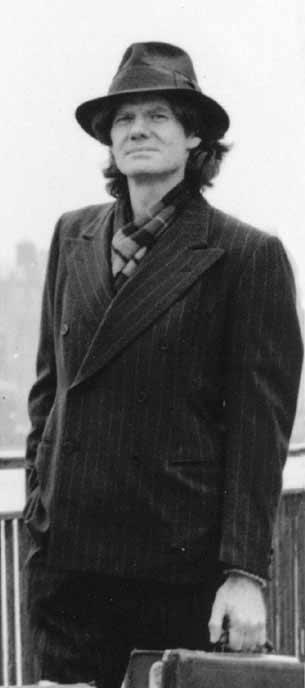
Then there's the long performance piece "Compostela - A Walk" included in New Zealand poet and playwright Alan Brunton's posthumous book Grooves of Glory. Looking at it again, I was a little surprised to discover that I myself was the first to publish it, in brief 25 (2002).
There's a wonderful introduction to the script by Brunton's wife and collaborator Sally Rodwell at the front of the book:

In 1987 we drove to Spain and Portugal in a red diesel van bought untested from the Utrecht van market. It had poor front tyres. We did a deal in Normany at a fly-by-night wreckers - 'deux pneux'. We were had. They were two sizes too small. So the van bounced through the French countryside like a circus bicycle. With the help of friends in Bourdeaux, we balanced the vehicle once more and set out for the Pyrenees. Ruby, our daughter, was two. We stopped at Lourdes on the way. It was a great holy place, with thousands of pilgrims, some on their knees, making their way to the founts of healing water. There was something going on here - it reminded us of our former home in Chimayo, New Mexico. We had lived close to the Sanctuario, a sacred chapel visited by pilgrims to collect the holy mud that miraculously appeared in the floor, The chapel walls were hung with dsicarded braces and walking sticks, tributes to its healing power. At Easter pilgrims walked to Chimayo in vast numbers along the state highways of the South West. There was also a statue of Santo Niño there, peering serenely at the world above a small mountain of baby shoes, gifts from thankful parents.
Later in Portugal we found the shrine of Fátima, where the blessed Virgin had appeared to three children. Fátima was also teeming with pilgrims seeking relief from illness and troubles. We collected water there too. Leaving Portugal in the North, some weeks later, we entered Galicia. I remember we crossed a stone bridge and were once again in Spain. It was hot. We drove towards Santiago de Compostela (Saint James of the Field of Stars). Nothing prepared us for the beauty of the stone buildings of the city, burnt orange in the evening sun, nor the heartstopping grandeur of the cathedral. Once again there were pilgrims everywhere, shops selling cockle shells, tapes of medieval pilgrim songs, prayer cards, rosaries, postcards, all the trappings of the pilgrim trade. There were guidebooks in Spanish and English. Alan bought one of each. We knew at once that we would follow the pilgrim trail, albeit backwards, from Santiago to St Jean de Pied de Port in France.
We were guided by the yellow arrows painted on stone walls and boulders, along a route that was far from the highway, along quiet country roads, through ancient stone towns. We did not enter the modern age, except for brief excursions into the great cities of Burgos and Pamplona. At night we camped, or stayed in small hotels. It was a voyage of discovery, and every few miles we would stop to visit a shrine, a church, a hospice, a convent, a house, a gate, a cross. Later Alan travelled the right way in his performance work Compostela - A Walk, imagining the road that ran all the way from France to Santiago ... The first performance was at Bats Theatre, Wellington on 7 April 2000 ...


Alan's text is far too long and detailed to do justice to here, so I'll just quote a short piece from near the beginning:
we'll live the life
of the romero
the strangers who always
walk on new roads
we'll live the life
of the romero
without a job, without a name
with no place to call home
we'll live the life
of the romero
the strangers who always
walk on new roads
where do you come from, Romero?
Romero, where do you go?
We come from nowhere
But we go to Compostela

Those of you who've watched Annie Goldson's fascinating documentary about Brunton and Rodwell's theatre troupe Red Mole will be familiar with the peripatetic life led by them and their collaborators before returning to Wellington in the 1990s. As he himself explained it to his daughter Ruby in Fq (2002):
There was to be no such old age - but at least we have his body of work to explain that intensely Kiwi desire to escape: to leave "the fuzzy town" of our childhood and eat the wind all our lives ...you will live in an era of new proprioception, quatre étoiles, bright locofocos over Ocean City, leaving me in my old age growing up again in the fuzzy town of my childhood where nothing was original, not even our peccadillos, where I promised with my hand stuck to a tree by a knife I’d eat the wind all my life and ramble from commune to commune ...
Ave atque vale, Alan - till we all meet again.

•
- Lydia Smith, dir.: Walking the Camino: Six Ways to Santiago (USA, 2013)
- Julia von Heinz, dir.: Ich bin dann mal weg (Germany, 2015)
- Martin de Vries: Camino, een feature-length selfie (Holland, 2019)
- Noel Smyth & Fergus Grady, dir.: Camino Skies (NZ, 2019)
- Birgitte Stærmose, dir.: Camino (Denmark, 2023)
- Bill Bennett, dir. & writ.: The Way, My Way (Australia, 2024)
- Gennaro Nunziante, dir.: Buen Camino, writ. Checco Zalone (Italy, 2025)
- Yann Samuel, dir.: Santiago: The Camino Therapy (France, 2026)
- Laurent Granier, dir.: Compostela: The road of stars (France, 2026)

The avalanche of post-The Way Camino-centred feature films and documentaries began innocuously enough with Lydia Smith's Walking the Camino: Six Ways to Santiago in 2013. This was followed by a film of Hape Kerkeling's bestselling travel book I'm Off Then: Losing and Finding Myself on the Camino de Santiago (2006):

Dutch director Martin de Vries took a more direct approach to the subject in his "feature-length selfie" Camino:

Our own New Zealand contribution to the genre, Camino Skies, stressed the element of pilgrimage - not so much for religious reasons, but mainly because of some personal tragedy or loss that needed to be addressed somehow, in a way which could not readily be encompassed within everyday life.

These moving and, at times, quite beautiful documentaries gave way to fictional buddy-movie narrative again with Birgitte Stærmose's Danish film Camino:

In the meantime, Australian Bill Bennett decided that a kind of mockumentary might make an agreeable variation on the theme: a portrait of the artist as an irascible, unreasonable old prick ... Despite everything, though, even Bennett's protagonist manages to achieve a reconciliation of sorts with his long-suffering wife at the end of his peregrinations:

It's always a bit difficult to fathom the humour of other cultures. The French adore Jerry Lewis and Jacques Tati. Americans find Rodney Dangerfield funny. Italians, it would appear, find atrocious buffoon Checco Zalone rib-ticklingly amusing. It's hard to see why. But he too (inevitably) finds an epiphany of a sort in his enforced sojourn on the Camino.

By now, such films needed little introduction beyond the single word "Camino" (for English-speaking viewers) or "Compostela" (for Europeans). Why, then, you may ask, do I keep on watching them?

The fact that a subgenre has become predictable and unchallenging is no reason to give up on it altogether. There's such a thing as cinematic comfort food. When my wife's nephew Finn was asked why he insisted on watching rom-coms in preference to anything else on screen, he replied: "Because they're just good movies."
I'm not sure that Camino films are always good movies, but then, I'm not sure that the majority of rom-coms are either. The truth is that, like Finn, I love them. I love the scenery; I like their sense of mission, and the promise they seem to offer of a higher purpose to the everyday lives we live.
I like it that there's almost always a tear-provoking moment when everything seems to come together in the majestic surrounds of Santiago de Compostela - or even on the rugged Atlantic coast which most of our cinematic pilgrims now seem to regard as the rightful conclusion of their journey.
Maybe David Lodge had a point after all. Maybe the road to Compostela is not the place to argue about the timing of your latest book-tour. I don't know if I'll ever get the chance to walk it myself, but I'm pretty sure that I'll keep on enjoying it vicariously through the eyes of more ambitious travellers.
I really can't see much harm in that.

•



![Trilby [Svengali]](https://en.wikipedia.org/wiki/Svengali#/media/File:Wilton_Lackaye_(SAYRE_11763).jpg)