Showing posts with label W. H. Auden. Show all posts

Saturday, March 21, 2026

Rimbaud in English


Arthur Rimbaud (1854-1891)


This is where modern poetry begins. "Il faut être absolument moderne" [One must be completely modern], is how Rimbaud himself put it in his prose-poetic nightmarish reverie Une Saison en Enfer [A Season in Hell]. He was 18 at the time. The book was printed in Brussels in "a few copies ... distributed to friends" just before his birthday on 20th October, 1873.

He's quite a mine of such provocative aphorisms, in fact: "un long, immense et raisonné dérèglement de tous les sens" [a long, detailed and systematic derangement of the senses], as a prerequisite to the composition of "visionary" poetry, is perhaps the best known of them. "Je est un autre" ["I" is somebody else], from the same 1871 letter to his fellow-poet Paul Demeny, is even more pithy.

There's a demonic energy to most of his work, early and late. By 1875, only a few years after he began, he'd given up writing altogether, preferring the life of a wandering merchant and soldier of fortune. He died in 1891, probably of bone cancer. He was only 37.

There'd been poètes maudits [accursed poets] before him, and there were plenty still to come. At first sight, he doesn't look that different from Baudelaire or Nerval or the rebellious poets of earlier times. His precocity was what really astonished his contemporaries, but he was no flash in the pan. The first thing that strikes you about Rimbaud when you start to read him in earnest is the maturity and complexity of his thought.

That, and the fact that he seems to have been born with an innate talent for versification. Even his earliest poems are technically flawless, and when he departs from the strict rules of French prosody in his later work, it's clearly intentional.

Perhaps the easiest way to show why he seemed so extraordinary to his contemporaries - and to poets and artists ever since - is to look at one of those early poems, the ones where he still sees himself as a contributor to French poetry, rather than the dynamiter of all its pretentions.


Ernest Delahaye: Rimbaud (Charleville, 1871)

Poets at Seven Years Old
Les poètes de sept ans À M. P. Demeny Et la Mère, fermant le livre du devoir, S’en allait satisfaite et très fière, sans voir, Dans les yeux bleus et sous le front plein d’éminences L’âme de son enfant livrée aux répugnances. Tout le jour il suait d’obéissance ; très Intelligent ; pourtant des tics noirs, quelques traits, Semblaient prouver en lui d’âcres hypocrisies. Dans l’ombre des couloirs aux tentures moisies, En passant il tirait la langue, les deux poings À l’aine, et dans ses yeux fermés voyait des points. Une porte s’ouvrait sur le soir : à la lampe On le voyait, là-haut, qui râlait sur la rampe, Sous un golfe de jour pendant du toit. L’été Surtout, vaincu, stupide, il était entêté À se renfermer dans la fraîcheur des latrines : Il pensait là, tranquille et livrant ses narines. Quand, lavé des odeurs du jour, le jardinet Derrière la maison, en hiver, s’illunait, Gisant au pied d’un mur, enterré dans la marne Et pour des visions écrasant son œil darne, Il écoutait grouiller les galeux espaliers. Pitié ! Ces enfants seuls étaient ses familiers Qui, chétifs, fronts nus, œil déteignant sur la joue, Cachant de maigres doigts jaunes et noirs de boue Sous des habits puant la foire et tout vieillots, Conversaient avec la douceur des idiots ! Et si, l’ayant surpris à des pitiés immondes, Sa mère s’effrayait ; les tendresses, profondes, De l’enfant se jetaient sur cet étonnement. C’était bon. Elle avait le bleu regard, – qui ment ! À sept ans, il faisait des romans, sur la vie Du grand désert, où luit la Liberté ravie, Forêts, soleils, rives, savanes ! – Il s’aidait De journaux illustrés où, rouge, il regardait Des Espagnoles rire et des Italiennes. Quand venait, l’œil brun, folle, en robes d’indiennes, À Huit ans, – la fille des ouvriers d’à côté, La petite brutale, et qu’elle avait sauté, Dans un coin, sur son dos, en secouant ses tresses, Et qu’il était sous elle, il lui mordait les fesses, Car elle ne portait jamais de pantalons ; – Et, par elle meurtri des poings et des talons, Remportait les saveurs de sa peau dans sa chambre. Il craignait les blafards dimanches de décembre, Où, pommadé, sur un guéridon d’acajou, Il lisait une Bible à la tranche vert-chou ; Des rêves l’oppressaient chaque nuit dans l’alcôve. Il n’aimait pas Dieu ; mais les hommes, qu’au soir fauve, Noirs, en blouse, il voyait rentrer dans le faubourg Où les crieurs, en trois roulements de tambour, Font autour des édits rire et gronder les foules. – Il rêvait la prairie amoureuse, où des houles Lumineuses, parfums sains, pubescences d’or, Font leur remuement calme et prennent leur essor ! Et comme il savourait surtout les sombres choses, Quand, dans la chambre nue aux persiennes closes, Haute et bleue, âcrement prise d’humidité, Il lisait son roman sans cesse médité, Plein de lourds ciels ocreux et de forêts noyées, De fleurs de chair aux bois sidérals déployées, Vertige, écroulements, déroutes et pitié ! – Tandis que se faisait la rumeur du quartier, En bas, – seul, et couché sur des pièces de toile Écrue, et pressentant violemment la voile ! - Arthur Rimbaud (26 mai 1871)
Shutting her pious book, the Mother rose and kissed her little boy … what mother sees in Angel-face, his big eyes free of guile, bile and disgust tormenting the nude soul? All day long he sweated to obey; clever, quick, yet something seemed to say – little habits, tics – that this was sham. Alone in mildewed corridors, he would scream shit-fuck! clench his fists, stick out his tongue, screw up his eyes into a blood-red sun. A door opened on darkness – the backstairs, the one place he could lie and gasp for air in the dome of day a lamp hung from the night. Burnt stupid by blank waves of summer heat he hid himself inside the dank latrines; there he could breathe – sniff something that was clean. In winter, when the moon washed their back yard with icy candour, he would creep out and hide by the stream that ran inside their boundary wall; trying to see by knuckling at his eyeballs, he heard the pine-trees groan like ships at sea. Although he felt some sneaking sympathy for those trespassing kids who dropped their eyes at his approach (stink-fingers black and creased with yellow clay from damming up the creek), they turned from him like dolts and would not speak. And if his mother caught him at this game and told him off, the fact he looked ashamed fooled her into forgiveness. He was shy. Those lips were always ready with a lie. At seven he made up Westerns: wild romances set in the desert – where freedom reigns (and Dances with Wolves?); sunsets, rivers, cliffs, savannahs … Staring at naked woodcut señoritas till he turned red, he dreamt of foreign girls. So when that saucy eight-year-old, her curls bobbing, thin cotton dresses … like a squaw with soft brown eyes … came over from next door and jumped him – little beast – pulling his hair, caught underneath, he bit her on the bare bum (“wild women never put on drawers!”); then, scratched and beaten by her fists and claws, he carried the scent of her back to his room. Most of all, he feared Sundays at home, brushed clean and collared, sitting with his back straight, reading about a God he’d learnt to hate in a mould-green Bible with a faded back; the nightmares came as soon as it got dark. He loved to watch those swart, roughly-dressed men straggle home from work in the red evening ready for the distractions of the streets – his dreams were of wide prairies of ripe wheat: gold thistledown, rich scents, in the calm light of noon, till rough winds swept them out of sight. He fixated most on things that were dark and old – sitting in a cold blue room with the blinds pulled, damp dripping off the walls, mouthing the words of a story he could see inside his head full of drowned forests; leaden, ochre skies; flesh-haunted flowers; starry immensities; despair; retreat; stiff salmon-leaps; and pity! Engulfed by the vast engine-grinding city – lying in the creased haven of his bed, he bent his sails where a blind future led …

- trans. Jack Ross (7/91-18/5/97)


Christopher Hampton: Total Eclipse (1969 / 2007)


Oscar-winning screenwriter Christopher Hampton's brilliant early play Total Eclipse dramatises the relationship between Rimbaud and the older poet Verlaine, which culminated in the prosecution of the latter for wounding his young lover with a pistol during a drunken argument.

Unfortunately the same cannot be said for Agnieszka Holland's film of the story, marred as it is by poor casting (Leonardo di Caprio as Rimbaud!) and a number of embarrassingly extraneous scenes - such as the one in which di Caprio tries to induce poor David Thewlis (Verlaine) to strip naked so the pair of them can bound around in a field like goats.

The deadpan restraint of the original play gets lost in all this absurdity, and the result is satisfying neither to biopic aficionados or Rimbaud enthusiasts. It's hard to know what Hampton and Holland were thinking ...


Agnieszka Holland, dir.: Total Eclipse (1995)


Enid Starkie: Rimbaud (1961)


In general, the moment you depart from his actual work - the poems and prose-pieces which somehow managed to survive his tempestuous life and the pious censorship of his family - you tend to run into trouble in Rimbaud studies.

In the third, 1961, version of her very entertaining book about the poet (originally published in 1938), eccentric Irish literary critic Enid Starkie finally established to her own satisfaction the precise nature of Rimbaud's relationship with esoteric and hermetic thought in his proposed establishment of a new religion with himself as Messiah (or Sun-God, if that phrasing suits you better).

She was reluctantly forced to acknowledge that most of this could have come from journal articles and encyclopedia entries rather than the magical grimoires she originally had him poring over.

And she may well have been correct. But whether any of that assists us in understanding his work better is another question. Just sitting down and reading it still seems like the best approach. There's always an uncomfortable sense, though, with Rimbaud, that the poet is sitting in judgement on you - as he did with Verlaine - rather than the other way round.


Enid Starkie (1897-1970)


Let's take, for example, another early poem, "Les chercheuses de poux" [The lice-hunters]. It's a wonderful evocation of the "eternal feminine" and the effect of such proximity on a precocious young boy. The intentional grounding of the whole experience in the process of picking out lice from an infected scalp might seem abhorrent to a lazy (i.e. romantically inclined) reader, but actually it serves to ground the whole poem in what Yeats called "the foul rag-and-bone shop of the heart."

Desire is an animal, instinctual thing. Rimbaud knows that, as do we all. The difference is that he's able to express the whole confusion of vague visionary pre-adolescent sexuality by juxtaposing it with the intense practicality of everyday life.


Étienne Carjat: Photo-carte de visite (1871)

Lice-Hunters
Les chercheuses de poux Quand le front de l'enfant, plein de rouges tourmentes, Implore l'essaim blanc des rêves indistincts, Il vient près de son lit deux grandes soeurs charmantes Avec de frêles doigts aux ongles argentins. Elles assoient l'enfant auprès d'une croisée Grande ouverte où l'air bleu baigne un fouillis de fleurs, Et dans ses lourds cheveux où tombe la rosée Promènent leurs doigts fins, terribles et charmeurs. Il écoute chanter leurs haleines craintives Qui fleurent de longs miels végétaux et rosés Et qu'interrompt parfois un sifflement, salives Reprises sur la lèvre ou désirs de baisers. Il entend leurs cils noirs battant sous les silences Parfumés ; et leurs doigts électriques et doux Font crépiter parmi ses grises indolences Sous leurs ongles royaux la mort des petits poux. Voilà que monte en lui le vin de la Paresse, Soupirs d'harmonica qui pourrait délirer ; L'enfant se sent, selon la lenteur des caresses, Sourdre et mourir sans cesse un désir de pleurer. - Arthur Rimbaud (1871)
When the kid's forehead is full of red torments Imploring swarms of dreams with vague contents, Two large and charming sisters come with wafty fingers and silvery nails, to his bedroom. They set the kid by a wide-open window where A tangle of flowers bathes in the blue air And run fine, alluring, terrible fingers through his thick dew-matted hair. He hears the rustling of their timid breath Flower with the long pinkish vegetable honies underneath Or broken anon, sibilant, the saliva's hiss Drawn from a lip, or a desire to kiss. He hears their black eyelashes beat in that quietude And "Crack!" to break his inebriated indolences Neath their electric and so soft fingers death assails The little lice beneath their regal nails. And Lo! there mounts within him Wine of Laziness - a squiffer's sigh Might bring delirium - and the kid feels Neath the slowness of their caresses, constantly Wane and fade a desire to cry.

- trans. Ezra Pound (1957)


Howard Coster: W. H. Auden (1937)
Rimbaud

The nights, the railway-arches, the bad sky, His horrible companions did not know it; But in that child the rhetorician’s lie Burst like a pipe: the cold had made a poet. Drinks bought him by his weak and lyric friend His five wits systematically deranged, To all accustomed nonsense put an end; Till he from lyre and weakness was estranged. Verse was a special illness of the ear; Integrity was not enough; that seemed The hell of childhood: he must try again. Now, galloping through Africa, he dreamed Of a new self, a son, an engineer, His truth acceptable to lying men.

- W. H. Auden (December 1938)

To a truly remarkable degree, this thing we call "Rimbaud" is the creation of his admirers - as well (I should add) as his detractors. Auden, here, imagines him conducting a kind of personal crusade against the falsehood and hypocrisy of late nineteenth-century colonial Europe, searching desperately for a "truth acceptable to lying men."

He seems to be speaking for himself more than he is about Rimbaud.

After all, those last few lines do rather gloss over the more unpleasant aspects of Rimbaud's later career, post-poetry. He was not, it would appear, an actual slaver, but more a gun-runner and general mercantile fixer. But it was not from lack of trying. There are surviving letters where he tries to negotiate the sale of slaves from reluctant colonial contacts in Somalia and Ethiopia.


The story is told in more detail in Charles Nicholl's fascinating book Somebody Else: Rimbaud in Africa. What these repugnant facts do confirm, though, is that the more we find out about him, the less we understand him. How could the visionary poet of the 1870s have turned into the brutal, unscrupulous, unsuccessful entrepreneur of the 1880s?

It's almost as if we're talking about two completely different men. But then, when one looks more carefully at the poems, the longing for exotic experience embodied in his early masterpiece "Le bâteau ivre" [The Drunken Boat] is not so hard to square with an afterlife as a kind of embodied Jules Verne hero.

The fact that it all went so badly is perhaps explicable by the fact that a vivid imagination, however useful it may be to a poet, is not really an ideal prerequisite for a hardbitten man of action.

In any case, here's the poem, together with a version of it by American poet Robert Lowell, who included a number of pieces by Rimbaud in his influential mid-career book Imitations.


Rimbaud: Fresque Le Bâteau Ivre (Saint-Sulpice, Paris, 2012)

The Drunken Boat
Le bâteau ivre Comme je descendais des Fleuves impassibles, Je ne me sentis plus guidé par les haleurs : Des Peaux-Rouges criards les avaient pris pour cibles Les ayant cloués nus aux poteaux de couleurs. J’étais insoucieux de tous les équipages, Porteur de blés flamands ou de cotons anglais. Quand avec mes haleurs ont fini ces tapages Les Fleuves m’ont laissé descendre où je voulais. Dans les clapotements furieux des marées Moi l’autre hiver plus sourd que les cerveaux d’enfants, Je courus ! Et les Péninsules démarrées N’ont pas subi tohu-bohus plus triomphants. La tempête a béni mes éveils maritimes. Plus léger qu’un bouchon j’ai dansé sur les flots Qu’on appelle rouleurs éternels de victimes, Dix nuits, sans regretter l’oeil niais des falots ! Plus douce qu’aux enfants la chair des pommes sures, L’eau verte pénétra ma coque de sapin Et des taches de vins bleus et des vomissures Me lava, dispersant gouvernail et grappin Et dès lors, je me suis baigné dans le Poème De la Mer, infusé d’astres, et lactescent, Dévorant les azurs verts ; où, flottaison blême Et ravie, un noyé pensif parfois descend ; Où, teignant tout à coup les bleuités, délires Et rythmes lents sous les rutilements du jour, Plus fortes que l’alcool, plus vastes que nos lyres, Fermentent les rousseurs amères de l’amour ! Je sais les cieux crevant en éclairs, et les trombes Et les ressacs et les courants : Je sais le soir, L’aube exaltée ainsi qu’un peuple de colombes, Et j’ai vu quelque fois ce que l’homme a cru voir ! J’ai vu le soleil bas, taché d’horreurs mystiques, Illuminant de longs figements violets, Pareils à des acteurs de drames très-antiques Les flots roulant au loin leurs frissons de volets ! J’ai rêvé la nuit verte aux neiges éblouies, Baiser montant aux yeux des mers avec lenteurs, La circulation des sèves inouïes, Et l’éveil jaune et bleu des phosphores chanteurs ! J’ai suivi, des mois pleins, pareille aux vacheries Hystériques, la houle à l’assaut des récifs, Sans songer que les pieds lumineux des Maries Pussent forcer le mufle aux Océans poussifs ! J’ai heurté, savez-vous, d’incroyables Florides Mêlant aux fleurs des yeux de panthères à peaux D’hommes ! Des arcs-en-ciel tendus comme des brides Sous l’horizon des mers, à de glauques troupeaux ! J’ai vu fermenter les marais énormes, nasses Où pourrit dans les joncs tout un Léviathan ! Des écroulement d’eau au milieu des bonaces, Et les lointains vers les gouffres cataractant ! Glaciers, soleils d’argent, flots nacreux, cieux de braises ! Échouages hideux au fond des golfes bruns Où les serpents géants dévorés de punaises Choient, des arbres tordus, avec de noirs parfums ! J’aurais voulu montrer aux enfants ces dorades Du flot bleu, ces poissons d’or, ces poissons chantants. – Des écumes de fleurs ont bercé mes dérades Et d’ineffables vents m’ont ailé par instants. Parfois, martyr lassé des pôles et des zones, La mer dont le sanglot faisait mon roulis doux Montait vers moi ses fleurs d’ombres aux ventouses jaunes Et je restais, ainsi qu’une femme à genoux… Presque île, balottant sur mes bords les querelles Et les fientes d’oiseaux clabaudeurs aux yeux blonds Et je voguais, lorsqu’à travers mes liens frêles Des noyés descendaient dormir, à reculons ! Or moi, bateau perdu sous les cheveux des anses, Jeté par l’ouragan dans l’éther sans oiseau, Moi dont les Monitors et les voiliers des Hanses N’auraient pas repêché la carcasse ivre d’eau ; Libre, fumant, monté de brumes violettes, Moi qui trouais le ciel rougeoyant comme un mur Qui porte, confiture exquise aux bons poètes, Des lichens de soleil et des morves d’azur, Qui courais, taché de lunules électriques, Planche folle, escorté des hippocampes noirs, Quand les juillets faisaient crouler à coups de triques Les cieux ultramarins aux ardents entonnoirs ; Moi qui tremblais, sentant geindre à cinquante lieues Le rut des Béhémots et les Maelstroms épais, Fileur éternel des immobilités bleues, Je regrette l’Europe aux anciens parapets ! J’ai vu des archipels sidéraux ! et des îles Dont les cieux délirants sont ouverts au vogueur : – Est-ce en ces nuits sans fond que tu dors et t’exiles, Million d’oiseaux d’or, ô future Vigueur ? – Mais, vrai, j’ai trop pleuré ! Les Aubes sont navrantes. Toute lune est atroce et tout soleil amer : L’âcre amour m’a gonflé de torpeurs enivrantes. Ô que ma quille éclate ! Ô que j’aille à la mer ! Si je désire une eau d’Europe, c’est la flache Noire et froide où vers le crépuscule embaumé Un enfant accroupi plein de tristesses, lâche Un bateau frêle comme un papillon de mai. Je ne puis plus, baigné de vos langueurs, ô lames, Enlever leur sillage aux porteurs de cotons, Ni traverser l’orgueil des drapeaux et des flammes, Ni nager sous les yeux horribles des pontons. - Arthur Rimbaud (Lutèce, 2 novembre 1883)
I felt my guides no longer carried me - as we sailed down the virgin Amazon, the redskins nailed them to their painted stakes naked, as targets for their archery. I carried Flemish wheat or Swedish wood, but had forgotten my unruly crew; their conversation ended with their lives, the river let me wander where I would. Surf punished me, and threw my cargo out; last winter I was breaking up on land. I fled. These floating river villages had never heard a more triumphant shout. The green ooze spurting through my centreboard was sweeter than sour apples to a boy - it washed away the stains of puke and rot-gut, anchor and wheel were carried overboard. The typhoon spun my silly needle round; ten nights I scudded from the freighters' lights; lighter than cork, I danced upon the surge man calls the rolling coffin of his drowned. Rudderless, I was driven like a plank on night seas stuck with stars and dribbling milk; I shot through greens and blues, where luminous, swollen, drowned sailors rose for light and sank. I saw the lightning turn the pole-star green, currents, icebergs, and waterspouts. One night the sunrise lifted like a flock of doves - I saw whatever men suppose they've seen. I saw the ocean bellowing on the land, cattle stampeding with their tails on fire, but never dreamed Three Marys walked the sea to curb those frothing muzzles with a hand. I saw the salt marsh boil, a whole whale rot in some Louisiana bayou's muck, cutting the blue horizon with its flukes - bon-bons of sunlight and cold azure snot! I was a lost boat nosing through the hulls of Monitors and Hanseatic hulks; none cared to gaff my wreckage from the bilge and yellow beaks of the marauding gulls. I would have liked to show a child those seas, rocking to soothe the clatter of my sails in irons on the equatorial line. Like a woman, I fell upon my knees; then heaven opened for the voyager. I stared at archipelagoes of stars. Was it on those dead watches that I died - a million golden birds, Oh future Vigour! I cannot watch these purple suns go down like actors on the Aeschylean stage. I'm drunk on water. I cry out too much - Oh that my keel might break, and I might drown! Shrunken and black against a twilight sky, our Europe has no water. Only a pond the cows have left, and a boy wades to launch his paper boat frail as a butterfly. Bathed in your languors, Waves, I have no wings to cut across the wakes of cotton ships, or fly against the flags of merchant kings, or swim beneath the guns of prison ships.

- trans. Robert Lowell (1961)


Robert Lowell: Imitations (1961 / 1971)


You'll notice at once the profusion of nautical and New World imagery here, but also the emphasis on trade in the midst of all this florid, perilous exuberance.

The other thing you may spot, if not on the first run-through then perhaps on your second reading, is that Lowell has condensed the 25 quatrains of Rimbaud's original into a scant 15. If you'd like to get a closer sense of the actual meaning of the original, you might prefer to look at Oliver Bernard or Wallace Fowlie's more literal renderings. Or, better still - as my friend Martin Edmond has reminded me - there's an exceptionally adroit version by Samuel Beckett.

I can't help feeling that Lowell's very free retelling of Rimbaud's poem gets us closer to the manic energy of the original, however. It's probably also worth noting that Rimbaud had almost certainly never seen the sea when he wrote these verses.

It was all in his head - or perhaps one should say instead that Rimbaud was an enthusiastic student of the profusely illustrated travel literature of the time. He envisioned, in his mind's eye, what he'd just read. His celebrated sonnet "Voyelles [Vowels]," with its fascinating description of his synaesthetic polychromatic response to the alphabet, gives some idea of the richness of that inner life.

After setting out on his career as a tranp-vagabond at the time of the 1870 Franco-Prussian war (and the subsequent Paris commune), his pictures became more solidly rooted in reality. His equally famous pastoral "Le dormeur du val" [The sleeper in the valley] reminds us of the war raging around him. It's even been claimed by some (notably Enid Starkie) that he was raped by some drunken soldiers in Paris in 1871, an experience she believes can be linked directly to his strange, bitter poem "Le Cœur volé" [The Stolen Heart].


Alphonse Mucha: Bières de la Meuse (1897)


That tramp persona - the boy who walked all over Europe on his own two feet and saw life in its rawest form - has left us a number of vignettes of his experiences.

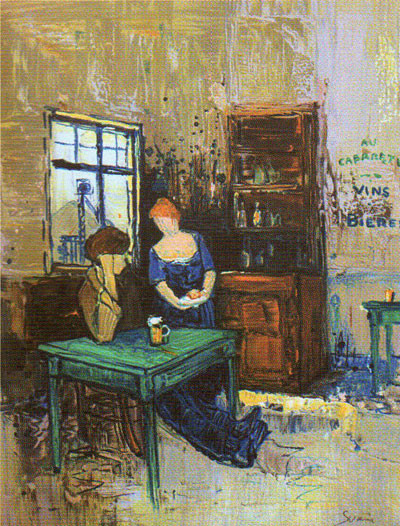
The short poem "Au Cabaret Vert" [At the Green Inn] shows Rimbaud at his best - or at any rate his least pretentious. The poem seems simple and honest, and while there may be certain overtones in it of a boy who's still pretending to be a man, there's no reason to suppose that the poet is unaware of the fact - or, for that matter, of the degree to which he's pandering to such expectations.

Here it is in a number of versions, starting with Ezra Pound's celebrated "Vagabond" translation of 1918:


Paul Verlaine: Rimbaud (Juin 1872)


    Au Cabaret Vert, cinq heures du soir

    - Arthur Rimbaud (October 1870)

    Depuis huit jours, j’avais déchiré mes bottines
    Aux cailloux des chemins. J’entrais à Charleroi.
    - Au Cabaret-Vert : je demandai des tartines
    De beurre et du jambon qui fut à moitié froid.
    
    Bienheureux, j’allongeai les jambes sous la table
    Verte : je contemplai les sujets très naïfs
    De la tapisserie. - Et ce fut adorable,
    Quand la fille aux tétons énormes, aux yeux vifs,
    
    - Celle-là, ce n’est pas un baiser qui l’épeure ! -
    Rieuse, m’apporta des tartines de beurre,
    Du jambon tiède, dans un plat colorié,
    
    Du jambon rose et blanc parfumé d’une gousse
    D’ail, - et m’emplit la chope immense, avec sa mousse
    Que dorait un rayon de soleil arriéré.


    Ezra Pound: Rimbaud (1957)


  1. Cabaret Vert [Vagabond]

  2. - trans. Ezra Pound (1918)

    Wearing out my shoes, 8th day
    On the bad roads, I got into Charleroi.
    Bread, butter, at the Green Cabaret
    And the ham half cold.
    
    Got my legs stretched out
    And was looking at the simple tapestries,
    Very nice when the gal with the big bubs
    And lively eyes,
    
    Not one to be scared of a kiss and more,
    Brought the butter and bread with a grin
    And the luke-warm ham on a colored plate …
    
    Pink ham, white fat and a sprig
    Of garlic, and a great chope of foamy beer
    Gilt by the sun in that atmosphere.


    Robert Lowell: Imitations (1961)


  3. At the Green Cabaret

  4. - trans. Robert Lowell (1961)

    For eight days I had been knocking my boots
    on the road stones. I was entering Charleroi.
    At the Green Cabaret, I called for ham,
    half cold, and a large helping of tartines.
    
    Happy, I kicked my shoes off, cooled my feet
    under the table, green like the room, and laughed
    at the naive Belgian pictures on the wall.
    But it was terrific when the house-girl
    
    with her earth-mother tits and come-on eyes —
    no Snow Queen having cat-fits at a kiss —
    brought me tarts and ham on a colored plate 
    
    She stuck a clove of garlic in the ham,
    red frothed by white, and slopped beer in my stein,
    foam gilded by a ray of the late sun.


    Arthur Rimbaud: The Poems (2012)


  5. At the Green Inn, Five in the Evening

  6. - trans. Oliver Bernard (1962)

    For a whole week I had ripped up my boots
    On the stones of the roads. I walked into Charleroi;
    Into the Green Inn: I asked for some slices
    Of bread and butter, and some half-cooled ham.
    
    Happy, I stuck out my legs under the green
    table: I studied the artless patterns of the
    Wallpaper - and it was charming when the girl
    With the huge breasts and lively eyes,
    
    - A kiss wouldn't scare that one! -
    Smilingly brought me some bread and butter
    And lukewarm ham, on a coloured plate; -
    
    Pink and white ham, scented with a clove of garlic -
    And filled my huge beer mug, whose froth was turned
    Into gold by a ray of late sunshine.


    Rimbaud: Complete Works, Selected Letters. Trans. Wallace Fowlie (1966)


  7. At the Cabaret-Vert At five in the afternoon

  8. - trans. Wallace Fowlie (1966)

    For a week my boots had been torn
    By the pebbles on the roads. I was getting into Charleroi.
    — At the Cabaret-Vert: I asked for bread
    And butter, and for ham that would be half chilled.
    
    Happy, I stretched out my legs under the green
    Table. I looked at the very naïve subjects
    Of the wallpaper. — And it was lovely,
    When the girl with huge tits and lively eyes,
    
    — She’s not one to be afraid of a kiss! —
    Laughing brought me bread and butter,
    Warm ham, in a colored plate,
    
    White and rosy ham flavored with a clove
    Of garlic – and filled my enormous mug, with its foam
    Which a late ray of sun turned gold.


    Arthur Rimbaud: Selected Works in Translation. Trans. A. S. Kline (2008)


  9. At The Green Inn

  10. - trans. A. S. Kline (2003)

     
    For eight days, I’d ripped up my boots
    On the road stones. I’d made Charleroi.
    – At the Green Inn: I ordered bread
    Buttered, along with half-cold ham.
    
    Happy, I stretched my legs out under the table,
    A green one: considering the naïve prints
    On the walls. – And it was charming,
    When the girl with big tits and lively eyes,
    
    – That one, just a kiss wouldn’t scare her! –
    Smiling, brought me slices of bread and butter,
    With lukewarm ham on a coloured platter,
    
    Ham, white and pink, a fragrant garlic clove,
    – And filled a huge beer mug high, its foam
    Turned by a ray of late sunlight to gold.


    Jean-Paul Saurin: Le Cabaret-Vert


  11. Au Cabaret-Vert, cinq heures du soir

  12. - trans. George Lang (2019)

    For a whole week I’d been wearing out my soles
    tramping down rocky paths. When I got home
    I headed to the Cabaret-Vert, ordering rolls
    with butter and a slab of lukewarm ham. 
    
    At peace, I stretched my legs out, admired
    the simple patterns on tapestry hung
    on the wall. Then the girl served up the desired
    buns, her tits big, bright eyes so young 
    
    — not likely would she shy away from a peck!
    The pink ham with its rim of white fat bedecked
    with pungent garlic sat on a fancy dish.
    
    With it she brought a stein topped with froth,
    spume glistening in the sun. In truth,
    there was little more I could ever wish.


    Henri de Toulouse-Lautrec: At the Café La Mie (1891)


  13. At the Green Cabaret, five o’clock in the evening

  14. - trans. Bir Cevap Yazın (2025)

    For eight days, I’d worn my boots, shred by shred
    On the pebbles of the roads. Into Charleroi I strolled
    – At the Green Cabaret: asked for buttered bread
    And a helping of ham that was half cold.
    
    Blissful, I stretched my legs under the green
    Table: at the very naive figures I gazed
    Of the tapestry. – It was a charming scene
    When the girl with enormous tits, with eyes that blazed,
    
    That girl, it’s not a kiss that makes her heart flutter!
    Laughing, she brought me warm bread and butter,
    Lukewarm ham, upon a colored plate,
    
    Pink and white ham, scented with garlic broth,
    And filled the huge mug, with its bubbling froth,
    Gilded by a sunbeam, lingering late.


Ezra Pound: Passport Photo (c.1919)


It's interesting that the first of these translations reads as if it should go last: Ezra Pound sounded more modern in 1918 than virtually any of the later translators. You could say that they chose to be more obedient to the accidentals of Rimbaud's sonnet, but it really comes out to your conception of what a poetry translation is (or should be).

A lot of it hinges on how these various writers deal with that crucial line "Celle-là, ce n’est pas un baiser qui l’épeure". "That girl, it’s not a kiss that makes her heart flutter!", says Bir Cevap Yazın. It's a bit clumsy, but not bad. It does at least get across the idea that it's not a mere kiss that's going to frighten this girl. She's far too experienced for that.

It's important to note here that, as Emad Noujeim has explained on Quora:
According to Le Grand Robert dictionary, the French verb baiser, which usually means “to kiss”, acquired the meaning of “to have sex or intercourse with” in the sixteenth century ...
The verb embrasser initially meant “to embrace or to hug”. It began to be more and more used with the meaning “to give a kiss or kisses” at the beginning of the twentieth century, as the verb baiser was increasingly used in the sense of “to screw (sexually or otherwise)” or “to fuck”.
This ... usage was still regarded as abusive by the lexicographer and encyclopedist Pierre Larousse in 1870 ... and was viewed as a ... neologism as late as the end of the nineteenth century.
In other words, Rimbaud was perfectly aware of the double-meaning of the word "baiser" in his sentence. It could, in fact, be quite legitimately Englished as "That girl, she's not afraid of a fuck!" All the translators must be aware of this. How could they not be? And yet most of them tiptoe through the line with various degrees of timidity:

Characteristically, Ezra Pound sees no reason not to be frank about the double-entendre:
Not one to be scared of a kiss and more
Robert Lowell almost over-emphasises it with his:
no Snow Queen having cat-fits at a kiss
Literalist Oliver Bernard is pretty evasive about it:
- A kiss wouldn't scare that one! -
Wallace Fowlie is a bit more idiomatic, but still not direct enough:
— She’s not one to be afraid of a kiss! —
A. S. Kline contorts the English language unmercifully with his:
– That one, just a kiss wouldn’t scare her! –
And, last and very possibly least, George Lang obliges us with:
— not likely would she shy away from a peck!
That's not to say that it's easy to translate a sonnet by Rimbaud, even one as seemingly straightforward as this. There are subtleties in every word, in every shade of description - and yet it all adds up to that paradisal sense of relief at a cold beer and a sandwich after a long tramp!

Pound gets that across. Do any of the others? Perhaps Lowell and Fowlie. The jury's out on most of the others, I'd say.

One thing's for certain. If you have any desire at all to understand modern poetry, it's probably best to begin with Arthur Rimbaud. His attempts to modernise his contemporaries met with - let's say - somewhat mixed success, but his influence on posterity has been immense.

When Pound and Eliot set out to revolutionise English-language poetry shortly before the First World War they had a number of French poets to choose from. Baudelaire, Laforgue, Lautréamont, Mallarmé - all contributed something. But behind them stood Rimbaud's "bâteau ivre" - not to mention his book of prose poems Les Illuminations ...


Isabelle Rimbaud: Arthur Rimbaud on his deathbed (1895)


Henriego Fantin-Latour: Arthur Rimbaud (1872)

Jean Nicolas Arthur Rimbaud
[Arthur Rimbaud]

(1854-1891)

Books I own are marked in bold:
    Published poems:

  1. "Les Étrennes des orphelins" [1869]. La revue pour tous (2 January 1870)
  2. "Première soirée" [1870]. [aka "Trois baisers" & "Comédie en trois baisers"]. La charge (13 August 1870)
  3. "Le Dormeur du val" [1870]. Anthologie des poètes français (1888)
  4. "Voyelles" [1871 or 1872]. Lutèce (5 October 1883)
  5. "Le Bateau ivre", "Voyelles", "Oraison du soir", "Les assis", "Les effarés", "Les chercheuses de poux" (1870–1872]. Les Poètes maudits. Ed. Paul Verlaine (1884)
  6. "Les corbeaux" (1871 or 1872]. La renaissance littéraire et artistique (14 September 1872)
  7. "Qu'est-ce pour nous mon cœur..." [1872]. La Vogue (7 June 1886)
  8. "Les mains de Marie-Jeanne" [1871]. Littérature (June 1919)

  9. Collections:

  10. Une Saison en Enfer [1873] (Brussels, October 1873)
  11. Illuminations [1872–1875] (1886)
  12. Reliquaire – Poésies. Ed. Rodolphe Darzens (1891)
  13. Poésies complètes. Preface by Paul Verlaine (1895)
  14. Album Zutique [1871]. Littérature (May 1922)
  15. Oeuvres: Édition illustrée. Ed. Suzanne Bernard. Classiques Garnier (1960)
    • Oeuvres: Édition illustrée. Ed. Suzanne Bernard. 1960. Classiques Garnier. Paris: Éditions Garnier Frères, 1975.
  16. Oeuvres Poétiques Complètes. Collection Bouquins (1980)
    • [with Charles Cros / Tristan Corbière / Lautréamont]. Oeuvres Poétiques Complètes. Ed. Alain Blottière, Pascal Pia, Michel Dansel, Jérome Bancilhon. Préface de Hubert Juin. 1980. Collection Bouquins. Ed. Guy Schoeller. Paris: Éditions Robert Laffont S.A., 1989.

  17. Prose:

  18. "Le rêve de Bismarck". Le Progrès des Ardennes (25 November 1870)
  19. Rapport sur l'Ogadine. Société de Géographie (February 1884)
  20. Narration: "Le Soleil était encore chaud..." [1864–1865] (1897)
  21. "Lettre de Charles d'Orléans à Louis XI" [1869 or 1870]. Revue de l'évolution sociale, scientifique et littéraire (November 1891)
  22. "Un coeur sous une soutane" [1870]. Littérature (June 1924)
  23. "Les Déserts de l'amour" [1871–1872]. La revue littéraire de Paris et Champagne (September 1906)
  24. "Proses évangeliques" [1872–1873]. La revue blanche, September 1897 / Le Mercure de France (January 1948)

  25. Letters:

  26. Lettres de Jean-Arthur Rimbaud – Égypte, Arabie, Éthiopie [1880–1891]. Ed. Paterne Berrichon (1899)
  27. "Lettres du Voyant" [13 & 15 May 1871] (1912 / 1928)

  28. Translations:

  29. Illuminations and Other Prose Poems. Trans. Louise Varèse (1946)
    • Illuminations and Other Prose Poems. Trans. Louise Varèse. 1946. Rev. ed. NDP56. New York: A New Directions Paperbook, 1957.
  30. Collected Poems: With Plain Prose Translations of Each Poem. Trans. Oliver Bernard (1962)
    • Collected Poems: With Plain Prose Translations of Each Poem. Ed. & trans. Oliver Bernard. 1962. The Penguin Poets. Ed. J. M. Cohen. Harmondsworth: Penguin, 1969.
  31. A Season in Hell. Trans. Oliver Bernard (1962)
    • A Season in Hell. Trans. Oliver Bernard. 1962. Penguin 60s Classics. Harmondsworth: Penguin, 1995.
  32. Complete Works, Selected Letters: A Bilingual Edition. Trans. Wallace Fowlie (1966)
    • Complete Works, Selected Letters: A Bilingual Edition. Trans. Wallace Fowlie. 1966. Rev. Seth Whidden. Chicago: The University Of Chicago Press, 2005.

  33. Secondary:

  34. Nicholl, Charles. Somebody Else: Rimbaud in Africa, 1880-91. 1997. Vintage. London: Random House UK Ltd., 1998.
  35. Starkie, Enid. Arthur Rimbaud. 1961. Faber Paper Covered Editions. London: Faber, 1973.


William Roberts: The Vorticists at the Restaurant de la Tour Eiffel (1961-62)

Modern Poets in English

  1. C. P. Cavafy (1863-1933)
  2. Anna Akhmatova (1889-1966)
  3. Osip Mandelstam (1891-1938)
  4. Arthur Rimbaud (1854-1891)
  5. Guillaume Apollinaire (1880-1918)
  6. Rainer Maria Rilke (1875-1926)
  7. Fernando Pessoa (1888-1935)
  8. Eugenio Montale (1896-1981)
  9. Federico García Lorca (1898-1938)
  10. Salvatore Quasimodo (1901-1968)
  11. Pablo Neruda (1904-1973)
  12. Paul Celan (1920-1970)


Sunday, June 23, 2024

Auden's Elegies of Exile


W. H. Auden: Another Time (1940)


In 1819, John Keats composed six odes, which are among his most famous and well-regarded poems. Keats wrote the first five poems, "Ode on a Grecian Urn", "Ode on Indolence", "Ode on Melancholy", "Ode to a Nightingale", and "Ode to Psyche" in quick succession during the spring, and he composed "To Autumn" in September. While the exact order in which Keats composed the poems is unknown, some critics contend that they form a thematic whole if arranged in sequence.
If you know any lines of Keats's poetry by heart, chances are they come from one of these odes: ""Beauty is truth, truth beauty," — that is all / Ye know on earth, and all ye need to know" from "Ode on a Grecian Urn"; "Charmed magic casements, opening on the foam / Of perilous seas, in faery lands forlorn" from "Ode to a Nightingale"; or even "Season of mists and mellow fruitfulness, / Close bosom-friend of the maturing sun" from "To Autumn".

I would suggest that there's a similar set of poems to be found among W. H. Auden's multifarious poetical works. Let's call them the elegies of exile. They were all written over the period 1939-1941, after Auden had moved to America, and appear to constitute a close examination of just what exactly he'd left behind by relocating to this new country:
  1. In Memory of W. B. Yeats (February 1939)
  2. In Memory of Ernst Toller (May 1939)
  3. September 1, 1939 (September 1939)
  4. In Memory of Sigmund Freud (November 1939)
  5. At the Grave of Henry James (Spring 1941)

  6. [NB: The dates given above are those of composition, rather than of first publication.]
The first four of them appeared as a group, along with "Spain 1937", in his 1940 volume Another Time. The slightly later "At the Grave of Henry James" was first collected in book form in the 1945 compendium The Collected Poetry of W. H. Auden.


"Spain 1937", which opens the set of six "Occasional Poems" in Another Time, certainly has strong sylistic affinities with the others, but is more engagé than elegiac in tone, as befits a poem written at the height of the Spanish Civil War, when the two sides seemed almost equally poised between victory and defeat. Its first appearance was as a Faber pamphlet, with all profits donated to the Spanish Medical Aid Committee.


W. H. Auden: Spain (1937)


Some, too, would question the inclusion of "September 1, 1939" among this group of elegies. It does, after all, commemorate not so much a particular person as a whole era: the "low dishonest decade" of the 1930s. Given Auden's statement that Freud was "no more a person / now but a whole climate of opinion," along with similarly exemplary claims for his other three subjects, this seems to me a reasonable concession.

I've written about some of these poems before. In fact, I've used three of them as frames for my discussions of, respectively, Sigmund Freud, Henry James, and W. B. Yeats. Never mind. There's a lot more to be said about each of them.


Mind you, Auden made this set of elegies rather inaccessible to readers by excluding both "Spain 1937" and "September 1, 1939" from his oeuvre after Faber's Collected Shorter Poems 1930-1944. "Omissions are not accidents," as Marianne Moore reminds us in her own (so-called) Complete Poems (1967). Auden gives his reasons for leaving out "Spain 1937" in the foreword to Collected Shorter Poems 1927-1957:


Some poems which I wrote and, unfortunately, published, I have thrown out because they were dishonest, or bad-mannered, or boring.
A dishonest poem is one which expresses, no matter how well, feelings or beliefs which its author never felt or entertained ... shamefully, I once wrote:
History to the defeated
May say alas but cannot help nor pardon.
To say this is to equate goodness with success. It would have been bad enough if I had ever held this wicked doctrine, but that I should have stated it because it sounded to me rhetorically effective is quite inexcusable.
Whether or not that's an accurate summary of the two lines in question is beside the point. The later, more pious Auden saw them as potentially misleading to readers. Similarly, he remarked in a letter to Scottish novelist Naomi Mitchison:
The reason (artistic) I left England and went to the U.S. was precisely to stop me writing poems like ‘Sept 1 1939’, the most dishonest poem I have ever written.
- Quoted from Spencer Lenfield: Why Auden Left: “September 1, 1939” and British Cultural Life. Journal of the History of Ideas Blog (9/12/2015)
His specific gripe against the poem seems to have centred on the line: "We must love one another or die." “That’s a damned lie! We must die anyway,” was Auden's later conclusion about this ringing cri de coeur, much lauded by E. M. Forster and other readers at the time.

After toying with a revision to "We must love one another and die," and then (in the 1945 Collected Poetry of W. H. Auden) complete omission of the second-to-last stanza, the one that contains it, he decided to ditch the poem altogether.

What better way to draw attention to something than by trying to restrict access to it, though? Perhaps partly as a result, it's become one of the most quoted - and debated - poems of the twentieth century.


So, if there is an intentional structure to these five poems of Auden's, what is it? The original group of six in Another Time concluded with an "Epithalamion," written to celebrate the marriage of Auden's sister-in-law Elisabeth Mann (daughter of Thomas Mann) to Giuseppe Antonio Borgese on November 23, 1939:
While explosives blow to dust
Friends and hopes, we cannot pray,
Absolute conviction must
Seem the whole of life to youth,
Battle's stupid gross event
Keep all learning occupied:
Yet the seed becomes the tree;
Happier savants may decide
That this quiet wedding of
A Borgese and a Mann
Planted human unity;
Hostile kingdoms of the truth,
Fighting fragments of content,
Here were reconciled by love
Modern policy begun
On this day.
- Quoted from: The Collected Poetry of W. H. Auden (New York: Random House, 1945): 171-75.
While this may have been a creditable attempt to close off the public conversation begun in "Spain 1937", it hardly rings true when you consider what was waiting in the wings for the whole of Western civilisation by the end of 1939. A "quiet wedding" between the daughter of an exiled German sage and the representative of an Italian noble family was hardly likely to plant the seeds of "human unity", and to reconcile "hostile kingdoms of the truth" with love alone!

All in all, this optimistic paean to the reconciliation of the nations really is an occasional poem - privately printed by Auden, and distributed gratis to the wedding guests at the ceremony in Princeton.

It therefore seems to me reasonable to argue that - if a capstone is actually required for this group of elegies written under the shadow of war - "At the Grave of Henry James" has a far better claim to be considered in that light. James, too, died in the midst of a world war. And it was, after all, James who - in an interview he gave to the New York Times in 1915 - lamented that the war had “used up words; they have weakened, they have deteriorated like motor car tires.”


I've therefore attempted, in the discussions of each of these five poems below, to do justice to the complexity of Auden's feelings about the oncoming war. Not that he was unique in this. The prospect of a renewal of conflict just twenty years after the apocalyptic "war to end all wars" seems to have puzzled as much as it horrified those who witnessed these events.

I would argue, then, that each of Auden's elegies - prompted chronologically though they were by the actual deaths of real people - takes on a symbolic role: we are presented, in turn, with an Anglo-Irish nationalist poet, a German-Jewish political playwright, an insane Russian dancer, an Austrian-Jewish mind doctor, and finally an immensely scrupulous Anglo-American novelist. Each of them was - in one sense or another - an exile.

Between them, they cover an impressive number of angles on the "unmentionable odour of death [offending] the September night", right at the beginning of the Second World War.


Marekbartelik’s Blog: Ants (12/5/2021)


Irish Newspaper Archive: The Death of W. B. Yeats (28/1/1939)

William Butler Yeats
(1865-1939)

Anglo-Irish poet and playwright. Co-founded, with Lady Gregory, the Abbey Theatre in Dublin. Awarded the Nobel Prize for Literature in 1923 "for his always inspired poetry, which in a highly artistic form gives expression to the spirit of a whole nation".

In Memory of W. B. Yeats
(February, 1939)

He disappeared in the dead of winter:
The brooks were frozen, the airports almost deserted,
And snow disfigured the public statues;
The mercury sank in the mouth of the dying day.
What instruments we have agree
The day of his death was a dark cold day.

W. B. Yeats spent most of his life in exile. When he was in London, he dreamed of being in Galway, on the Lake Isle of Innisfree. However, when he took his wife for a row on the lake many years later, he was unable to locate that one amongst all the other small islands.

He may have been the most Irish of poets, but he didn't speak - or write in - Irish. Nor was he often there. Even the much vaunted tower, Thoor Ballylee, he moved into in the 1920s was never really a permanent abode.

It therefore seems rather appropriate for him to have died while convalescing in the South of France, rather than in either England or Ireland. Shipping him back home after the war was not the easiest of procedures, either. There's still a strong suspicion that they picked the wrong corpse.

In any case, whoever it is who's buried there, there's now a tombstone in Drumcliff Churchyard which more or less matches the prescriptions in his Villonesque last-will-and-testament poem "Under Ben Bulben":
Under bare Ben Bulben's head
In Drumcliff churchyard Yeats is laid,
An ancestor was rector there
Long years ago; a church stands near,
By the road an ancient Cross.
No marble, no conventional phrase,
On limestone quarried near the spot
By his command these words are cut:
Cast a cold eye
On life, on death.
Horseman, pass by!

Yeats Thoor Ballylee Society: Yeats's Bones (1946)


I should know, as I spent a quarter of an hour trying to find it there one day in 1987, only to discover the friend I was driving around Ireland with standing smirking in front of it. It's actually the first thing you come to when you step out of the carpark ...
Now he is scattered among a hundred cities
And wholly given over to unfamiliar affections,
To find his happiness in another kind of wood
And be punished under a foreign code of conscience.
The words of a dead man
Are modified in the guts of the living.
That reference to being "punished" is interesting. For Auden, Yeats was an immensely seductive example of how not to conduct yourself. Yeats was always (in Auden's view) saying things because he found them "rhetorically effective," regardless of whether or not he actually believed them.

In fact Yeats virtually admitted as much in another late poem, "The Circus Animals' Desertion":
Winter and summer till old age began
My circus animals were all on show,
Those stilted boys, that burnished chariot,
Lion and woman and the Lord knows what.
And yet, looking back at all the opinions he himself had spouted during the 1930s, Auden had to admit that he, too, was fatally drawn to striking attitudes, to the "skyline operations" he decried in the early poem "Missing" (1929):
I know that all the verse I wrote, all the positions I took in the thirties, didn't save a single Jew. These attitudes, these writings, only help oneself.
- quoted from W. H. Auden: A Tribute, ed. Stephen Spender (1975): 89.
Auden once referred to the long poem The Sea and the Mirror (1944) as his Ars Poetica: his own version of the Latin poet Horace's versified manual for poets. That may well be, but I'd prefer to see this elegy for Yeats as a far more compact set of lesssons for writers in general. However far Yeats may have wandered from the path of rectitude, no-one can deny the sheer power of his words and his example:
You were silly like us; your gift survived it all:
The parish of rich women, physical decay,
Yourself. Mad Ireland hurt you into poetry.
Judge not lest ye be judged, in other words. The poem continues:
Now Ireland has her madness and her weather still,
For poetry makes nothing happen: it survives
In the valley of its making where executives
Would never want to tamper, flows on south
From ranches of isolation and the busy griefs,
Raw towns that we believe and die in; it survives,
A way of happening, a mouth.
Originally, in 1940, that third line read "the valley of its saying" - not of "making" - as you can see in the text quoted below. (I've used the later, revised texts of each of these elegies in my discussions, but the original 1940s texts are all preserved at the foot of this post).

Is there very much difference? Not a lot, perhaps, but it's interesting that Auden has shifted from the idea of the poet as spokesperson to the poet as crafter. Executives beware!

The third, concluding section of the poem contains some of Auden's most famous and resonant lines. In fact, some of them are inscribed on his own tombstone in Westminster Abbey:
Follow, poet, follow right
To the bottom of the night,
With your unconstraining voice
Still persuade us to rejoice;
...

In the deserts of the heart
Let the healing fountain start,
In the prison of his days
Teach the free man how to praise.

Westminster Abbey: Poet's Corner (1974)


Lydia Gibson: Portrait of Ernst Toller (c.1925)

Ernst Toller
(1893-1939)

German-Jewish playwright, famous for anti-war plays such as Transfiguration [Die Wandlung] (1919), Hinkemann [Der deutsche Hinkemann] (1923), and Hoppla, We're Alive! [Hoppla, wir leben!] (1927). Imprisoned for five years for his part in setting up the short-lived Bavarian Soviet Republic in 1919, he was exiled from Germany in 1933, and emigrated to America in 1936. He hanged himself in his New York hotel room, after laying out on his hotel desk "photos of Spanish children who had been killed by fascist bombs". A friend of his, Robert Payne, wrote in his diary that Toller had said shortly before his death:
"If ever you read that I committed suicide, I beg you not to believe it." Payne continued: "He hanged himself with the silk cord of his nightgown in a hotel in New York two years ago. This is what the newspapers said at the time, but I continue to believe that he was murdered".
- Wikipedia: Ernst Toller

The shining neutral summer has no voice
To judge America, or ask how a man dies;
And the friends who are sad and the enemies who rejoice

Are chased by their shadows lightly away from the grave
Of one who was egotistical and brave,
Lest they should learn without suffering how to forgive.
The only one of Ernst Toller's plays I myself have a copy of is "Hinkemann". It's included in volume 2 of a set of German Expressionist plays I picked up in a second-hand shop: Vision and Aftermath: Four Expressionist War Plays, ed. & trans. J. M. Ritchie & J. D. Stowell (London: Calder & Boyars, 1969). It's been produced a number of times, under a number of titles - "The Red Laugh" and "Bloody Laughter" (US, 1923); "Brokenbrow" (UK, 1926); and, mostly recently, "Broken," in a 2011 adaptation by English dramatist Torben Betts.

Even at the time he must have seemed a far less prominent subject for an elegy than most of the others chosen by Auden. Auden knew him quite well, it would appear - both in Germany and subsequently in New York. Certainly he was the most directly political among this set of people who died in 1939 - and (apart from Freud) the only suicide among them.

Perhaps it's for this reason that Auden addresses him mainly in psychoanalytical terms:
What was it, Ernst, that your shadow unwittingly said?
Did the child see something horrid in the woodshed
Long ago? Or had the Europe which took refuge in your head

Already been too injured to get well?
For just how long,like the swallows in that other cell,
Had the bright little longings been flying in to tell

About the big friendly death outside,
Where people do not occupy or hide;
No towns like Munich; no need to write?
The reference to the "shadow" makes it probable that it's the Jungian rather than the Freudian model of the human personality Auden is relying on here.


Stella Gibbons: Cold Comfort Farm (1932)


However, Auden expert Nicholas Jenkins also sees in those lines "Did the child see something horrid in the woodshed / Long ago?" a possible reference to Stella Gibbons' comic classic Cold Comfort Farm, one of whose characters, Aunt Ada Doom, became deranged as a result of an incident in childhood:
When you were small – so small the lightest puff of breeze blew your little crinoline skirt over your head – you had seen something nasty in the woodshed.
Is there an element of black humour in this poem, too? Certainly Auden seems to identify an element of relief in this decision to give up the fight to keep your end up amongst unsympathetic foreigners:
Dear Ernst, lie shadowless at last among
The other war-horses who existed till they’d done
Something that was an example to the young.
Is that how he too felt at times? The Auden who'd written "Today the struggle" in "Spain 1937" surely felt a certain liberation in the idea that it might not be necessary - or even desirable - to live anymore as an example to others:
We are lived by powers we pretend to understand:
They arrange our loves; it is they who direct at the end
The enemy bullet, the sickness, or even our hand.

It is their to-morrow hangs over the earth of the living
And all that we wish for our friends; but existing is believing
We know for whom we mourn and who is grieving.
My own reading of this poem, then, is that it may be the one closest to Auden's heart - and therefore the most masked and mysterious - of the whole group. Once the comic element creeps in (as it so often does in Auden's poetry) it becomes increasingly difficult to distinguish grand guignol from camp.

It puts me in mind, in fact, of another short verse by Auden, written in a copy of the then poet laureate Robert Bridges' long poem The Testament of Beauty presented to his friend Christopher Isherwood:
He isn't like us
He isn't a crook
The man is a heter
Who wrote this book.
- quoted from W. H. Auden: A Tribute, ed. Stephen Spender (1975): 79.

Robert Bridges (1844-1930): The Testament of Beauty (1929)


Romola Nijinsky, ed.: The Diary of Vaslav Nijinsky (1937)

Vaslav Nijinsky
(1843-1916)

Russian ballet dancer and choreographer, often described as the greatest male dancer of the early 20th century. After leaving his lover Diaghilev's Ballets Russes in 1913, he married Romola de Pulszky, and undertook independent tours of South America and the United States. His mental health deteriorated during the war, and he wrote his celebrated "Diary" in Switzerland in 1919. Among various comments he makes in it about Diaghilev, the most striking is:
Some politicians are hypocrites like Diaghilev, who does not want universal love, but to be loved alone. I want universal love.

September 1, 1939
(September, 1939)

The windiest militant trash
Important Persons shout
Is not so crude as our wish:
What mad Nijinsky wrote
About Diaghilev
Is true of the normal heart;
For the error bred in the bone
Of each woman and each man
Craves what it cannot have,
Not universal love
But to be loved alone.
Auden's "September 1, 1939" is clearly - on one level, at least - a response to Yeats's great lament "Easter 1916", written hard on the heels of the doomed rebellion against the English led by Patrick Pearse and James Connolly.

Let's compare the openings of each poem. Here's Yeats:
I have met them at close of day
Coming with vivid faces
From counter or desk among grey
Eighteenth-century houses.
I have passed with a nod of the head
Or polite meaningless words,
Or have lingered awhile and said
Polite meaningless words,
And thought before I had done
Of a mocking tale or a gibe
To please a companion
Around the fire at the club,
Being certain that they and I
But lived where motley is worn:
All changed, changed utterly:
A terrible beauty is born.
And here's Auden, some twenty years later:
I sit in one of the dives
On Fifty-second Street
Uncertain and afraid
As the clever hopes expire
Of a low dishonest decade:
Waves of anger and fear
Circulate over the bright
And darkened lands of the earth,
Obsessing our private lives;
The unmentionable odour of death
Offends the September night.
Yeats's sonorous 16-line stanza has shrunk to Auden's uneven eleven lines. Yeats's slow trimeters have condensed into Auden's own pacey, staccato three-beat lines. Where Yeats goes off to the club, Auden sits in a dive. Where Yeats is entranced by the "terrible beauty" which has somehow been born, Auden can smell only "the unmentionable odour of death."

But the two poems have a certain amount in common, too. Both begin directly, in the first person, and then shift to a more philosophical distance from the events they chronicle. Both poets are a long, long way from the action: Yeats in London; Auden in New York - and therefore far from any particular consequences from what they have to say.


Partisan Review 6: 3 (Spring 1939)


In his 1939 Partisan Review article "The Public vs. the late Willliam Butler Yeats," Auden admitted that 'Easter 1916":
has been called a masterpiece. It is. To succeed at such a time in writing a poem which could offend neither the Irish Republican nor the British Army was indeed a masterly achievement.
- The English Auden. Ed. Edward Mendelson. 1977 (London: Faber, 1986): 390.
That certainly is a damning indictment, and it seems a terrible irony that, in the same year he wrote this article, he himself committed the same sin. After all, who (besides its author) was actually offended by "September 1, 1939"? Its ringing diction and sweeping vision sounds more and more Yeatsian the longer it goes on.

The Defence in Auden's article goes on to explain that "Poets ... stop writing poetry when they stop reacting to the world they live in":
The later Wordsworth is not inferior to the earlier because the poet had altered his political opinions, but because he had ceased to think and feel so strongly, a change which happens, alas, to most of us as we grow older.
Yeats, by contrast, he argues, confronts us with:
the amazing spectacle of a man of great poetic talent, whose capacity for excitement not only remained with him to the end, but actually increased. In two hundred years ... who but a historian will care a button whether the deceased was right about the Irish question or wrong about the transmigration of souls?
"But because the excitement out of which his poems arose was genuine, they will still ... be capable of exciting others."

This remark, too, sounds a little ironic in retrospect. While this may well be true of late Yeats, I suspect that most readers would concur that it's not really true of the later Auden. He, like Wordsworth, "ceased to think and feel so strongly," and a good deal of that may have come from his refusal to accept the rhetorical compromises Yeats continued to experiment with, even in his last years.

But it was a conscious choice that Auden made. He understood what he was doing in abandoning the high manner of "September 1, 1939", and instead attempting to forge a more honest, more democratic poetic diction out of the new Americanised argot he had decided to inhabit instead.

Overall, was it a success or a failure? Few of us, if given the choice, would trade the early Auden for the later one - but there's no doubt that the direction of English poetry over the past fifty or so years has been far more vitally influenced by the latter than the former. Luckily, as readers, we can continue to read him in both of his manners, all of his various moods. Standing still and repeating what you've already done is seldom the right strategy in art or in life.


The Open University: Yeats and Auden (1976)


Sigmund Freud in his study

Sigmund Freud
(1843-1916)

German-Jewish doctor, founder of psychoanalysis. He was forced into exile in London by the Nazis after Hitler's Anschluss with Austria in 1938.

In Memory of Sigmund Freud
(November, 1939)

Of course they called on God, but he went his way
down among the lost people like Dante, down
to the stinking fosse where the injured
lead the ugly life of the rejected,

and showed us what evil is, not, as we thought,
deeds that must be punished, but our lack of faith,
our dishonest mood of denial,
the concupiscence of the oppressor.
When I first showed signs of wanting to dabble in Freudian criticism, I recall being instructed by my Masters supervisor Don Smith to read all three volumes of Ernest Jones' Life of Freud. There was an easily available Penguin abridgement available, but he told me that it was important to study the whole thing.


Ernest Jones: The Life of Sigmund Freud (3 vols: 1953-57)


It was quite a revelation to me, I must admit. Of course I knew the basics of the Oedipus complex, the structure of the Ego, and the other building-blocks of Freud's model of the mind, but the details of his struggle to explore this new cosmos - along with the vanity, the back-biting, the personal animosities which surrounded the growth of this new faith, as they did the early days of Christianity or any other religion - were instrumental in convincing me that it had to be treated seriously.

Since then I've developed a taste for Jung, as well - anathema to all true Freudians - and have to come to see such models of the psyche more as "metaphors for poetry" (in Yeats's phrase) than as scientific descriptions of the nature of the human personality.

Freud remains a hero to me, though, as he clearly was for Auden. There has, of course, been much debunking since then of the old man and his compromises with this, that, and the other piece of data. At the very least one has to concede to him that he was a great writer. His case studies are models for the deconstruction of texts: just as his work in general offered artists of the time - in virtually all genres - new ways to present their aperçus.

His great metaphors - the pleasure principle, the death instinct - continue to shape our thinking even now. Even if psychologists have thrown up their hands and refused to acknowledge any benefit in ideas such as "the unconscious mind", storytellers continue to benefit from them.

All that is foreshadowed in Auden's extraordinary poem: one of the very richest of this extremely crucial time in his life.


Henry James in his study

Henry James
(1843-1916)

Anglo-American novelist, famed for the complexity (and obscurity) of his late prose style, as exemplified by such works as The Ambassadors and The Golden Bowl.

The snow, less intransigeant than their marble,
Has left the defence of whiteness to these tombs,
And all the pools at my feet
Accommodate blue now, echo such clouds as occur
To the sky, and whatever bird or mourner the passing
Moment remarks they repeat.

While rocks, named after singular spaces
Within which images wandered once that caused
All to tremble and offend,
Stand here in an innocent stillness, each marking the spot
Where one more series of errors lost its uniqueness
And novelty came to an end.
Auden had a long and complex relationship with Henry James. In his last years he apparently used to tell an anecdote about being asked by a telephone repair man to keep on talking until the latter could detect the problem on the line. Instead of random chatter, Auden chose to recite from memory a long passage from Henry James's travel book The American Scene (1907). One witness described it as follows:
It was impressive. It was moving. It was less impressive when one heard him doing it again a short time later - and even less so when one heard it once more from another corner of the room.
It's a bit like the horrifying account of the man who came to repair Coleridge's chair, and heard him make precisely the same "impromptu" speech six or seven times over to successive waves of visitors ...
To whose real advantage were such transactions,
When worlds of reflection were exchanged for trees?
What living occasion can
Be just to the absent? Noon but reflects on itself,
And the small taciturn stone, that is the only witness
To a great and talkative man,

Has no more judgement than my ignorant shadow
Of odious comparisons or distant clocks
Which challenge and interfere
With the heart's instantaneous reading of time, time that is
A warm enigma no longer to you for whom I
Surrender my private cheer,


Then there's "Caliban to the Audience", the long monologue couched in the most elaborately Jamesian terms which the character Caliban contributes to Auden's long poem The Sea and the Mirror (1944).
As I stand awake on our solar fabric,
That primary machine, the earth, which gendarmes, banks
And aspirin pre-suppose,
On which the clumsy and sad may all sit down, and any who will
Say their a-ha to the beautiful, the common locus
Of the Master and the rose,

Shall I not especially bless you as, vexed with
My little inferior questions, I stand
Above the bed where you rest,
Who opened such passionate arms to your Bon when it ran
Towards you with Its overwhelming reasons pleading
All beautifully in Its breast?
Auden also had a long-standing fascination with the figure of Caliban, whom he once played in a school production in such a way as to make it clear - to himself and his closest friends, at any rate - that this aboriginal inhabitant of the island was its sole worthy inheritor. The Imperial and colonial values taught at his Public School, and embodied in the figure of Prospero, were not those which inspired him.

His choice of Jamesian diction for Caliban was also a reaction against Victorian poet Robert Browning's "Caliban upon Setebos", where the curious beliefs of this barbaric subman were held up for the disgust of the audience. Auden's Caliban, by contrast, is only too eloquent, reflecting learnedly and wittedly on the complex - but necessary - inter-relationship of life and art.
With what an innocence your hand submitted
To those formal rules that help a child to play,
While your heart, fastidious as
A delicate nun, remained true to the rare noblesse
Of your lucid gift and, for its love, ignored the
Resentful muttering Mass,

Whose ruminant hatred of all that cannot
Be simplified or stolen is yet at large:
No death can assuage its lust
To vilify the landscape of Distinction and see
The heart of the Personal brought to a systolic standstill,
The Tall to diminished dust.
So what precisely did James mean to Auden? On the one hand, his elaborate, over-nuanced speech was the quintessence of camp. On the other hand, there was the genuine kindliness and consideration which lay behind these final elaborations of careful politeness: "the truest poetry", after all (as Shakespeare taught us), "is the most feigning."
Preserve me, Master, from its vague incitement;
Yours be the disciplinary image that holds
Me back from agreeable wrong
And the clutch of eddying Muddle, lest Proportion shed
The alpine chill of her shrugging editorial shoulder
On my loose impromptu song.

All will be judged. Master of nuance and scruple,
Pray for me and for all writers, living or dead:
Because there are many whose works
Are in better taste than their lives, because there is no end
To the vanity of our calling, make intercession
For the treason of all clerks.
In the end, James seems to have been a kind of Saint of Letters for Auden. He was both infinitely susceptible to parody and infinitely loveable at the same time. He'd more-or-less successfully made the crossing from the New World to the Old and made this "international theme" the subject of his work.

Auden desired above all things to accomplish this passage in reverse: to go from the Old to the New. At this point it was almost impossible for him to say just how the experiment would pan out. No wonder he felt the need to memorise long passages from The American Scene ...


Henry James: The American Scene (1907)


W. H. Auden: For the Time Being (1944)


It's not that there aren't other elegies in his Auden's collected works: there's a 1953 one for his cat Lucina ("At peace under this mandarin, sleep, Lucina); "Memorial for the City" (1949), for Charles Williams; "Friday's Child" (1958), for Dietrich Bonhoeffer; culminating in the long piece "The Cave of Making" (July 1964), for Louis MacNeice.

There are also a number of epitaphs - 'On a Tyrant' (January 1939), 'The Unknown Citizen' (March 1939). These are two slightly different things: witness Ben Jonson's Shakespeare Epitaph ("The figure that thou here seest put ...") and Elegy ("To the Memory of My Beloved the Author, Mr. William Shakespeare"), both of which are included in the First Folio.

Auden was also very keen, especially at this mid-point in his career, on writing profiles of other writers: A. E. Housman (1938), Herman Melville (1939), Arthur Rimbaud (1938), Voltaire (1939) - not to mention such marvellously discursive conversation pieces such as "Letter to Lord Byron" (1936).

The 1939 elegies stand apart from the rest, however. They seem more purposeful, more directly related to the larger intentions behind his work - insofar as he was aware of them, at least.

After this came a decade largely devoted to the composition of four long poems: New Year Letter (1941), For the Time Being (1944), The Sea and the Mirror (1944), and The Age of Anxiety (1947).


W. H. Auden: New Year Letter (1941)


These certainly have their fans, and the last three in particular have benefitted from stand-alone, annotated editions in the Princeton Auden series. However, while he may have explored some of the same themes in more detail in these full-dress works, for me they lack the concision and urgency of the Elegies.

As in the case of Keats's Odes, it's these five poems which continue to provoke and inspire people, especially those caught up in the pitiless destruction of war - Gaza, Ukraine - even now, some nine decades later.


W. H. Auden: The Double Man (1941)


Life: W. H. Auden (1940)


I

He disappeared in the dead of winter:
The brooks were frozen, the airports almost deserted,
And snow disfigured the public statues;
The mercury sank in the mouth of the dying day.
O all the instruments agree
The day of his death was a dark cold day.

Far from his illness
The wolves ran on through the evergreen forests,
The peasant river was untempted by the fashionable quays;
By mourning tongues
The death of the poet was kept from his poems.

But for him it was his last afternoon as himself,
An afternoon of nurses and rumours;
The provinces of his body revolted,
The squares of his mind were empty,
Silence invaded the suburbs,
The current of his feeling failed: he became his admirers.

Now he is scattered among a hundred cities
And wholly given over to unfamiliar affections;
To find his happiness in another kind of wood
And be punished under a foreign code of conscience.
The words of a dead man
Are modified in the guts of the living.

But in the importance and noise of to-morrow
When the brokers are roaring like beasts on the floor of the Bourse,
And the poor have the sufferings to which they are fairly accustomed,
And each in the cell of himself is almost convinced of his freedom;
A few thousand will think of this day
As one thinks of a day when one did something slightly unusual.

O all the instruments agree
The day of his death was a dark cold day.


II

You were silly like us: your gift survived it all;
The parish of rich women, physical decay,
Yourself; mad Ireland hurt you into poetry.
Now Ireland has her madness and her weather still,
For poetry makes nothing happen: it survives
In the valley of its saying where executives
Would never want to tamper; it flows south
From ranches of isolation and the busy griefs,
Raw towns that we believe and die in; it survives,
A way of happening, a mouth.


III

Earth, receive an honoured guest;
William Yeats is laid to rest.
Let the Irish vessel lie
Emptied of its poetry.

Time that is intolerant
Of the brave and innocent,
And indifferent in a week
To a beautiful physique,

Worships language and forgives
Everyone by whom it lives;
Pardons cowardice, conceit,
Lays its honours at their feet.

Time that with this strange excuse
Pardoned Kiping and his views,
And will pardon Paul Claudel,
Pardons him for writing well.

In the nightmare of the dark
All the dogs of Europe bark,
And the living nations wait,
Each sequestered in its hate;

Intellectual disgrace
Stares from every human face,
And the seas of pity lie
Locked and frozen in each eye.

Follow, poet, follow right
To the bottom of the night,
With your unconstraining voice
Still persuade us to rejoice;

With the farming of a verse
Make a vineyard of the curse,
Sing of human unsuccess
In a rapture of distress;

In the deserts of the heart
Let the healing fountain start,
In the prison of his days
Teach the free man how to praise.


The shining neutral summer has no voice
To judge America, or ask how a man dies;
And the friends who are sad and the enemies who rejoice

Are chased by their shadows lightly away from the grave
Of one who was egotistical and brave,
Lest they should learn without suffering how to forgive.

What was it, Ernst, that your shadow unwittingly said?
O did the child see something horrid in the woodshed
Long ago? Or had the Europe which took refuge in your head

Already been too injured to get well?
O for how long,like the swallows in that other cell,
Had the bright little longings been flying in to tell

About the big friendly death outside,
Where people do not occupy or hide;
No towns like Munich; no need to write?

Dear Ernst, lie shadowless at last among
The other war-horses who existed till they’d done
Something that was an example to the young.

We are lived by powers we pretend to understand:
They arrange our loves; it is they who direct at the end
The enemy bullet, the sickness, or even our hand.

It is their tomorrow hangs over the earth of the living
And all that we wish for our friends: but existing is believing
We know for whom we mourn and who is grieving.


September 1, 1939
(September 1939) [3]

I sit in one of the dives
On Fifty-Second Street
Uncertain and afraid
As the clever hopes expire
Of a low dishonest decade:
Waves of anger and fear
Circulate over the bright
And darkened lands of the earth,
Obsessing our private lives;
The unmentionable odour of death
Offends the September night.

Accurate scholarship can
Unearth the whole offence
From Luther until now
That has driven a culture mad,
Find what occurred at Linz,
What huge imago made
A psychopathic god:
I and the public know
What all schoolchildren learn,
Those to whom evil is done
Do evil in return.

Exiled Thucydides knew
All that a speech can say
About Democracy,
And what dictators do,
The elderly rubbish they talk
To an apathetic grave;
Analysed all in his book,
The enlightenment driven away,
The habit-forming pain,
Mismanagement and grief:
We must suffer them all again.

Into this neutral air
Where blind skyscrapers use
Their full height to proclaim
The strength of Collective Man,
Each language pours its vain
Competitive excuse:
But who can live for long
In an euphoric dream;
Out of the mirror they stare,
Imperialism's face
And the international wrong.

Faces along the bar
Cling to their average day:
The lights must never go out,
The music must always play,
All the conventions conspire
To make this fort assume
The furniture of home;
Lest we should see where we are,
Lost in a haunted wood,
Children afraid of the night
Who have never been happy or good.

The windiest militant trash
Important Persons shout
Is not so crude as our wish:
What mad Nijinsky wrote
About Diaghilev
Is true of the normal heart;
For the error bred in the bone
Of each woman and each man
Craves what it cannot have,
Not universal love
But to be loved alone.

From the conservative dark
Into the ethical life
The dense commuters come,
Repeating their morning vow;
'I will be true to the wife,
I'll concentrate more on my work,'
And helpless governors wake
To resume their compulsory game:
Who can release them now,
Who can reach the deaf,
Who can speak for the dumb?

All I have is a voice
To undo the folded lie,
The romantic lie in the brain
Of the sensual man-in-the-street
And the lie of Authority
Whose buildings grope the sky:
There is no such thing as the State
And no one exists alone;
Hunger allows no choice
To the citizen or the police;
We must love one another or die.

Defenceless under the night
Our world in stupor lies;
Yet, dotted everywhere,
Ironic points of light
Flash out wherever the Just
Exchange their messages:
May I, composed like them
Of Eros and of dust,
Beleaguered by the same
Negation and despair,
Show an affirming flame.


When there are so many we shall have to mourn,
When grief has been made so public, and exposed
         To the critique of a whole epoch
         The frailty of our conscience and anguish,

Of whom shall we speak? For every day they die
Among us, those who were doing us some good,
         Who knew it was never enough but
         Hoped to improve a little by living.

Such was this doctor: still at eighty he wished
To think of our life from whose unruliness
         So many plausible young futures
         With threats or flattery ask obedience,

But his wish was denied him: he closed his eyes
Upon that last picture, common to us all,
         Of problems like relatives gathered
         Puzzled and jealous about our dying. 

For about him till the very end were still
Those he had studied, the fauna of the night,
         And shades that still waited to enter
         The bright circle of his recognition

Turned elsewhere with their disappointment as he
Was taken away from his life interest
         To go back to the earth in London,
         An important Jew who died in exile.

Only Hate was happy, hoping to augment
His practice now, and his dingy clientele
         Who think they can be cured by killing
         And covering the garden with ashes.

They are still alive, but in a world he changed
Simply by looking back with no false regrets;
         All he did was to remember
         Like the old and be honest like children.

He wasn't clever at all: he merely told
The unhappy Present to recite the Past
         Like a poetry lesson till sooner
         Or later it faltered at the line where

Long ago the accusations had begun,
And suddenly knew by whom it had been judged,
         How rich life had been and how silly,
         And was life-forgiven and more humble.

Able to approach the Future as a friend
Without a wardrobe of excuses, without
         A set mask of rectitude or an 
         Embarrassing over-familiar gesture.

No wonder the ancient cultures of conceit
In his technique of unsettlement foresaw
         The fall of princes, the collapse of
         Their lucrative patterns of frustration:

If he succeeded, why, the Generalised Life
Would become impossible, the monolith
         Of State be broken and prevented
         The co-operation of avengers.

Of course they called on God, but he went his way
Down among the lost people like Dante, down
         To the stinking fosse where the injured
         Lead the ugly life of the rejected,

And showed us what evil is: not as we thought
Deeds that must be punished, but our lack of faith,
         Our dishonest mood of denial,
         The concupiscence of the oppressor.

And if some traces of the autocratic pose,
The paternal strictness he distrusted, still
         Clung to his utterance and features,
         It was a protective coloration

For one who'd lived among enemies so long:
If often he was wrong and, at times, absurd,
         To us he is no more a person
         Now but a whole climate of opinion

Under whom we conduct our different lives:
Like weather he can only hinder or help,
         The proud can still be proud but find it
         A little harder, the tyrant tries to

Make do with him but doesn't care for him much:
He quietly surrounds all our habits of growth
         And extends, till the tired in even
         The remotest miserable duchy

Have felt the change in their bones and are cheered
Till the child, unlucky in his little State,
         Some hearth where freedom is excluded,
         A hive whose honey is fear and worry,

Feels calmer now and somehow assured of escape,
While, as they lie in the grass of our neglect, 
         So many long-forgotten objects
         Revealed by his undiscouraged shining

Are returned to us and made precious again;
Games we had thought we must drop as we grew up,
         Little noises we dared not laugh at,
         Faces we made when no one was looking.

But he wishes us more than this. To be free
Is often to be lonely. He would unite
         The unequal moieties fractured
         By our own well-meaning sense of justice,

Would restore to the larger the wit and will 
The smaller possesses but can only use
         For arid disputes, would give back to
         The son the mother's richness of feeling:

But he would have us remember most of all 
To be enthusiastic over the night
         Not only for the sense of wonder
         It alone has to offer, but also

Because it needs our love: for with sad eyes
Its delectable creatures look up and beg
         Us dumbly to ask them to follow:
         They are exiles who long for the future

That lies in our power. They too would rejoice
If allowed to serve enlightenment like him,
         Even to bear our cry of 'Judas', 
         As he did and all must bear who serve it.

One rational voice is dumb: over a grave
The household of Impulse mourns one dearly loved.
         Sad is Eros, builder of cities,
         And weeping anarchic Aphrodite.


The snow, less intransigeant than their marble,
Has left the defence of whiteness to these tombs;
  For all the pools at my feet
Accommodate blue, now, and echo such clouds as occur
To the sky, and whatever bird or mourner the passing
  Moment remarks they repeat

While the rocks, named after singular spaces
Within which images wandered once that caused
  All to tremble and offend,
Stand here in an innocent stillness, each marking the spot
Where one more series of errors lost its uniqueness
  And novelty came to an end.

To whose real advantage were such transactions
When worlds of reflection were exchanged for trees?
  What living occasion can 
Be just to the absent? O noon but reflects on itself,
And the small taciturn stone that is the only witness
  To a great and talkative man

Has no more judgment than my ignorant shadow
Of odious comparisons or distant clocks 
  Which challenge and interfere
With the heart's instantaneous reading of time, time that is
A warm enigma no longer in you for whom I
  Surrender my private cheer

Startling the awkward footsteps of my apprehension,
The flushed assault of your recognition is
  The donnée of this doubtful hour:
O stern proconsul of intractable provinces,
O poet of the difficult, dear addicted artist,
  Assent to my soil and flower.

As I stand awake on our solar fabric,
That primary machine, the earth, which gendarmes, banks,
  And aspirin presuppose,
On which the clumsy and sad may all sit down, and any who will
Say their a-ha to the beautiful, the common locus
  Of the master and the rose.

Our theatre, scaffold, and erotic city
Where all the infirm species are partners in the act
  Of encroachment bodies crave,
Though solitude in death is de rigueur for their flesh,
And the self-denying hermit flies as it approaches
  Like the carnivore to a cave.

That its plural numbers may unite in meaning,
Its vulgar tongues unravel the knotted mass
  Of the improperly conjunct,
Open my eyes now to its hinted significant figures,
Sharpen my cars to detect amid its brilliant uproar
  The low thud of the defunct.

O dwell ironic at my living centre,
Half ancestor, half child; because the actual self
  Round whom time revolves so fast
Is so afraid of what its motions might possibly do,
That the actor is never there when his really important
  Acts happen. Only the past

Is present, no one about but the dead as,
Equipped with a few inherited odds and ends,
  One after another we are
Fired into life to seek that unseen target where all
Our equivocal judgments are judged and resolved in
  One whole Alas or Hurrah.

And only the unborn mark the disaster
When, though it makes no difference to the pretty airs
  The bird of Appetite sings,
And Amour Propre is his usual amusing self,
Out from the jungle of an undistinguished moment
  The flexible Shadow springs.

[ Perhaps the honour of a great house, perhaps its
Cradles and tombs may persuade the bravado of
  The bachelor mind to doubt
The dishonest path, or save from disgraceful collapse
The creature's shrinking withness bellowed at and tickled
  By the huge Immodest Without. ]

Now more than ever, when torches and snare-drum
Excite the squat women of the saurian brain
  Till a milling mob of fears
Break in insultingly on anywhere, when in our dreams
Pigs play on the organs and the blue sky runs shrieking
  As the Crack of Doom appears,

Are the good ghosts needed with the white magic
Of their subtle loves. War has no ambiguities
  Like a marriage; the result
Required of its affaire fatale is simple and sad,
The physical removal of all human objects
  That conceal the Difficult.

Then remember me that I may remember
The test we have to learn to shudder for is not
  An historical event,
That neither the low democracy of a nightmare nor
An army's primitive tidings may deceive me
  About our predicament.

That catastrophic situation which neither
Victory nor defeat can annul: to be
  Deaf yet determined to sing,
To be lame and blind yet burning for the Great Good Place,
To be essentially corrupt yet mournfully attracted
  By the Real Distinguished Thing.

[ Let this orchard point to its stable arrangement
Of accomplished bones as a proof that our lives
  Conceal a pattern which shows
A tendency to execute formative movements, to have
Definite experiences in their execution,
  To rejoice in knowing it grows. ]

And shall I not specially bless you as, vexed with
My little inferior questions, today I stand
  Beside the bed where you rest
Who opened such passionate arms to your Bon when It ran
Towards you with its overwhelming reasons pleading
  All beautifully in Its breast?

O with what innocence your hand submitted
To those formal rules that help a child to play,
  While your heart, fastidious as
A delicate nun, remained true to the rare noblesse
Of your lucid gift and, for its own sake, ignored the
  Resentful muttering Mass.

Whose ruminant hatred of all which cannot
Be simplified or stolen is still at large;
  No death can assuage its lust
To vilify the landscape of Distinction and see
The heart of the Personal brought to a systolic standstill,
  The Tall to diminished dust.

Preserve me, Master, from its vague incitement,
Yours be the disciplinary image that holds
  Me back from agreeable wrong,
And the clutch of eddying muddle, lest Proportion shed 
The alpine chill of her shrugging editorial shoulder
  On my loose impromptu song.

Suggest; so may I segregate my disorder
Into districts of prospective value: approve;
  Lightly, lightly, then, may I dance
Over the frontier of the obvious and fumble no more
In the old limp pocket of the minor exhibition,
  Nor riot with irrelevance.

And no longer shoe geese or water stakes but
Bolt in my day my grain of truth to the barn
  Where tribulations may leap
With their long-lost brothers at last in the festival
Of which not one has a dissenting image, and the
  Flushed immediacy sleep.

[ Knowing myself a mobile animal descended
From an ancient line of respectable fish,
  With a certain mechant charm,
Occupying the earth for a grass-grown interval between
Two oscillations of polar ice, engaged in weaving
  His conscience upon its calm.

Despising Now yet afraid of Hereafter,
Unable in spite of his stop-watch and lens
  To imagine the rising Rome
To which his tools and tales migrate, to guess from what shore
The signal will flash, to observe the anarchist's gestation
  In the smug constricted home. ]

Into this city from the shining lowlands
Blows a wind that whispers of uncovered skulls
  And fresh ruins under the moon,
Of hopes that will not survive the secousse of this spring,
Of blood and flames, of the terror that walks by night and
  The sickness that strikes at noon.

All will be judged. Master of nuance and scruple,
Pray for me and for all writers living or dead;
  Because there are many whose works
Are in better taste than their lives; because there is no end
To the vanity of our calling: make intercession
  For the treason of all clerks.

Because the darkness is never so distant,
And there is never much time for the arrogant
  Spirit to flutter its wings,
Or the broken bone to rejoice, or the cruel to cry,
For Him whose property is always to have mercy, the author
  And giver of all good things.


Notes:

1. The text presented here comes from Another Time: Poems by W. H. Auden (London: Faber, 1940): 107-10. The three stanzas beginning "Time that is intolerant" were subsequently pruned from the poem.

2. The text presented here comes from Another Time: Poems by W. H. Auden (London: Faber, 1940): 111.

3. The text presented here comes from Another Time: Poems by W. H. Auden (London: Faber, 1940): 112-15. The second-to-last stanza, beginning "All I have is a voice" was omitted when it was reprinted in The Collected Poetry of W. H. Auden (New York: Random House, 1945): 57-59.

4. The text presented here comes from Another Time: Poems by W. H. Auden (London: Faber, 1940): 116-20, with the exception of the last line, which was changed from: "And weeping of anarchic Aphrodite" to the smoother "And weeping anarchic Aphrodite" when the poem was reprinted in The Collected Poetry of W. H. Auden (New York: Random House, 1945): 163-67. The capitalisations at the beginnings of lines, and a few other details of spacing, were further revised in subsequent reprintings.

5. The italicised sections between square brackets come from the original 28-stanza version of the poem printed in Horizon (June 1941). The rest of the 24-stanza text presented here comes from The Collected Poetry of W. H. Auden (New York: Random House, 1945): 126-31. The poem was further condensed to ten stanzas in 1966.


Centuries of Sound: 1939 (2021)