Showing posts with label George Orwell. Show all posts

Tuesday, February 17, 2026

The Cult of the Bully


The Simpsons: Homer chokes Bart (2023)


Way, way back in history, virtually at the dawn of time, I remember hearing a lot of buzz about a brand new TV show about a subversive young punk named Bart. His catch-phrases: "Eat my shorts!," "Ay, caramba!," and "Don't have a cow, man!" were already legendary.

But then I watched the programme.

It didn't take long to work out that Bart's was a mere bit part - along with the saxophone-playing Lisa and the long-suffering Marge. There could be only one hero: the fat, stupid, bigoted paterfamilias Homer.

I couldn't really understand it at first. Why was he the star? The other characters were so much more interesting. Why should he be the sun they all revolved around?

But then I started to grasp it. In the bizarre travesty of "family-friendly" (i.e. thought-hostile) norms which had gradually accreted in American pop culture - first in Hollywood, then Network TV - the change-resistant, ideologically as well as racially conservative white man must ipso facto be at the centre of everything.

The workings of this machine are adroitly analysed in Slavoj Žižek's notorious "Pervert's Guide to Cinema", where he points out the "secret motif" in (for instance) all the key Spielberg movies: "the recovery of the father, of his authority."


All in the Family: Carroll O'Connor as Archie Bunker (1971-83)


Archie Bunker was one of the most successful archetypes of this hero with a thousand faces. Again, at the time, I couldn't work out why the butt of almost all the jokes in the show was gradually humanised and centralised until he, inexorably, assumed the mantle of the whole production (remember Archie Bunker's Place?).

It put me in mind of Toril Moi's celebrated comment (from her 1985 book Sexual/textual Politics) about the oppressed subject "internalising the standards of the aggressor." [1] A character may start as a target for satire (like Archie Bunker's original, Alf Garnett, in the mordant British sit-com Till Death Us Do Part), but then the picture begins to adjust back to normal: and the unwise-at-times but basically loveable head-of-the-family model reasserts itself.

It also reminded me of the infamous 2005 "Monkey Pay-per-View" study, where a group of Macaques turned out to be willing to trade cups of fruit-juice for a chance to look at pictures of attractive, celebrity monkeys. Male macaques wanting to look at sexy females seems normal enough - but monkeys of all genders paying out juice to gaze on the images of powerful males is, I fear, yet another manifestation of this thesis.


Colin Watson: Snobbery with Violence (1971)


Let's not pretend that this is an exclusively American phenomenon. Colin Watson's entertaining analysis of the classic English Crime Story gives some startling data about the kinds of heroes who flourished in Britain between the wars. Take "Sapper"'s protagonist Bulldog Drummond, for instance. Here are a few salient quotes from his merry adventures:
[To an adversary he addresses as "fungus face']: "Only a keen sense of public duty restrains me from plugging you where you sit, you ineffable swine."

[His idea of a hobby]: "Years ago we had an amusing little show rounding up Communists and other unwashed people of that type. We called ourselves the Black Gang, and it was a great sport while it lasted."

[His views on Russia, "ruled by its clique of homicidal, alien jews"]: "The most frightful gang of murderous-looking cut-throats I've ever seen (officers seem to have no control)."
In the last case, it appears to be their disrespect for officers which weighs more in the balance for Drummond than any other aspect of the Bolshevik creed.


'Sapper': Bulldog Drummond at Bay (1935)


Prominent leftist poet Cecil Day-Lewis (himself an accomplished detective story writer) referred to Bulldog Drummond as "that unspeakable Public School bully." But, as Colin Watson explains:
... fantasy heroes usually are bullies. They must win, and since their opponents seem to enjoy a monopoly of cunning, sheer physical advantage has to be invoked.
It rather puts one in mind of Goering's much-quoted remark: "When I hear the word 'culture', I reach for my revolver." [2]


There was an interesting case reported in the media the other day about a British woman who was "shot dead by her father after a heated argument about Donald Trump." As so often on these occasions, it's the line taken by the defence that's really jaw-dropping. The father, a certain Kris Harrison, explained that:
he owned a Glock 9mm handgun for “home defence” and had received no formal firearms training. He initially denied drinking that day but later admitted consuming a 500ml carton of wine in the morning, though he insisted alcohol did not influence his actions [my emphasis].
He further claimed that "he had a conversation about guns with his daughter and she asked to see the gun" - despite never having "discussed his gun ownership with him before."

The sequence of events appears to have been more-or-less as follows: the father got into an argument with his daughter, Lucy Harrison, over the merits of Donald Trump's dismissal without penalty after his conviction for falsifying business records to hide the payment of hush-money to adult film actress Stormy Daniels.

Lucy's boyfriend, Sam Littler, told the court that:
Harrison asked her father: “How would you feel if I was the girl in that situation and I’d been sexually assaulted?”
He said Kris replied that it would not upset him much because he had two other daughters living with him. Harrison then ran upstairs, visibly distressed.
Around half an hour later, Kris took his daughter’s hand and led her into his bedroom. Seconds later, a gunshot rang out.
Littler said he rushed in and found Harrison lying on the floor, while her father screamed incoherently.
Police later concluded she died from a gunshot wound to the heart fired at medium range.
And the father's explanation?
"As I lifted the gun to show her I suddenly heard a loud bang. I did not understand what had happened. Lucy immediately fell."
He told police who attended the scene: "We got it out to have a look and just as I picked it up it just went off."
Needless to say, "a grand jury in the US ... determined there was insufficient evidence to charge anyone in connection with Lucy Harrison's death."

I mean, don't get me wrong, it may have been an accident. The contention that she "asked to see the gun" sounds a little unlikely, though, given her well-documented abhorrence of firearms. Also, it seems an odd thing to want to do a few minutes before leaving for the airport to fly home.

Back in Britain, at the Cheshire Coroners' Court, matters panned out a little differently:
Coroner Jacqueline Devonish announced that she found Lucy Harrison died due to unlawful killing on the grounds of gross negligence manslaughter.
The coroner said: "To shoot her through the chest whilst she was standing would have required him to have been pointing the gun at his daughter, without checking for bullets, and pulling the trigger.
"I find these actions to be reckless."
Unfortunately these findings are from a coroner's court and not a criminal court, so have no actual effect on Kris Harrison, "described by the coroner as a functioning alcoholic."

So just what does a guy have to do to get indicted for manslaugher - let alone murder - in a court in Texas? Maybe if it had been the other way round, and the daughter was the Trump suppporter? I suspect Kris Harrison might well be looking at a bit of jailtime then ...


Mark Twain: Roughing It (1872)


Given these contradictory responses from two courts in two different countries ("divided by a common language," as George Bernard Shaw once put it), the question remains: Is there something in American culture which particularly lends itself to idealisation of the violent bully?

George Orwell certainly thought so. As he said in his classic 1944 essay "Raffles and Miss Blandish":
In America, both in life and fiction, the tendency to tolerate crime, even to admire the criminal so long as he is successful, is very much more marked [than in England]. It is, indeed, ultimately this attitude that has made it possible for crime to flourish upon so huge a scale. Books have been written about Al Capone that are hardly different in tone from the books written about Henry Ford, Stalin, Lord Northcliffe and all the rest of the “log cabin to White House” brigade. And switching back eighty years, one finds Mark Twain adopting much the same attitude towards the disgusting bandit Slade, hero of twenty-eight murders, and towards the Western desperadoes generally. They were successful, they “made good,” therefore he admired them.
This may be a little unfair to Mark Twain. Orwell may have read as blind admiration a description originally meant ironically. At this distance in time, it's hard to be sure. Certainly Twain had no time for that bully extraordinaire, the much-hyped "hero" of San Juan Hill, President Theodore Roosevelt.


Here are a few extracts from Matt Seybold's amusing article "The Nastiest Things Mark Twain Said About Teddy Roosevelt":
“[Roosevelt] is naively indifferent to the restraints of duty and even unaware of them; ready to kick the Constitution into the back yard whenever it gets in the way; and whenever he smells a vote, not only is he willing but eager to buy it, give extravagant rates for it and pay the bill not out of his own pocket or the party’s, but out of the nations, by cold pillage.” (February 16, 1905)

“The list of unpresidential things, things hitherto deemed impossible, wholly impossible, measurelessly impossible for a president of the United States to do — is much too long for invoicing here.” (May 29, 1907)

“Mr. Roosevelt is the most formidable disaster that has befallen the country since the Civil War – but the vast mass of the nation loves him, is frantically fond of him, even idolizes him. This is the simple truth. It sounds like a libel upon the intelligence of the human race, but it isn’t; there isn’t any way to libel the intelligence of the human race.” (September 13, 1907)

“Mr. Roosevelt is the Tom Sawyer of the political world of the twentieth century; always showing off; always hunting for a chance to show off; in his frenzied imagination the Great Republic is a vast Barnum circus with him for a clown and the whole world for audience; he would go to Halifax for half a chance to show off, and he would go to hell for a whole one.” (December 2, 1907)

“We have never had a President before who was destitute of self-respect and of respect for his high office; we have had no President before who was not a gentleman; we have had no President before who was intended for a butcher, a dive-keeper or a bully, and missed his mission.” (January 5, 1909)

“Roosevelt is the whole argument for and against, in his own person. He represents what the American gentleman ought not to be, and does it as clearly, intelligibly, and exhaustively as he represents what the American gentleman is. We are by long odds the most ill-mannered nation, civilized or savage, that exists on the planet to-day, and our President stands for us like a colossal monument visible from all the ends of the earth.” (April 3, 1906)

Ct Mirror: Trump and Teddy Roosevelt (2017)


Is it just me, or could one just as easily substitute another recent presidential surname for "Roosevelt" above?

Interestingly, Mark Twain's main theme here seems to be the President's vulgarity and lack of culture. The examples Twain analysed in more detail were mostly instances of "ungentlemanly" disrespect towards women - though he was also unsparing in his denunciations of the hypocrisy and perfidy shown by his countrymen in the brutal annexation of the Philippines.


RNZ: NZ's Coalition Goverment (2023)
l-to-r: Winston Peters, Christopher Luxon, David Seymour


In conclusion, I guess I'd like to see this set of interesting - to me, at any rate - data-points as a bit more than just another anti-Trump diatribe. Most of those try to present him as something egregious, unprecedented in American - possibly in world - culture.

On the contrary, I'd like to argue that the real problem is that he's so completely typical. Every run-of-the-mill male chauvinist has contributed a little to this particular conundrum. Even in little old New Zealand we have more than our fair share of such consummate asses.


Mystic River: "Daddy is a king" (2003)


I think that one of the most striking instances of the cult in full cry would have to be the bizarre monologue delivered by Laura Linney at the end of Clint Eastwood's 2003 film Mystic River, where she extols her murderous criminal of a husband, played by Sean Penn, because he is, in her eyes, "a king." The fact that he's just ordered the killing of an old schoolmate, whom he and his gang suspected (wrongly) of having raped Sean Penn's daughter, simply serves to redouble her blind adoration.

We hear the same poisonous slop every day from the grovelling fools surrounding the great Don - even though each of them knows beyond question that they'll be replaced in an instant the moment they cease to genuflect ... and start to question.

Is it his fault they're such spineless jellyfish? No, it's theirs - and ours.


Notes:

1. While I did myself (I think) first encounter "internalising the standards of the aggressor" in Toril Moi's influential book, the actual source of the phrase is Hungarian Psychoanalyst Sándor Ferenczi. In his 1932 paper "Confusion of the Tongues Between the Adults and the Child," Ferenczi argued that children facing extreme aggression or abuse "survive by internalizing ... the attacker, turning themselves into the object of use, and dissociating from their own feelings." This has a tendency to lead to "self-blame and compliance" to manage trauma.

2. My friend Richard Taylor has reminded me that the quote "When I hear the word 'culture', I reach for my revolver," frequently attributed to Hermann Goering, "actually originates from the play Schlageter by Hanns Johst. The original line from the play is slightly different: "Wenn ich Kultur höre ... entsichere ich meinen Browning!" (When I hear culture, I release the safety catch of my Browning!). This line was performed in 1933 to celebrate Adolf Hitler's birthday and has been misattributed to several prominent Nazis, including Hermann Göring and Heinrich Himmler."


Monday, July 15, 2024

Must We Burn Alice Munro?


Simone de Beauvoir: Faut-il brûler Sade ? (1951)


I wrote a post about the Chinoiserie-inflected "Kai Lung" stories of English writer Ernest Bramah a year or so ago. In it, I mentioned Simone de Beauvoir's classic essay Must We Burn de Sade?, first published in the early 1950s. Certainly the ethnic stereotyping and yellow-face clichés with which Bramah's work is saturated are extremely reprehensible by modern standards.


Ernest Bramah: Kai Lung Beneath the Mulberry Tree (1940)


And yet ... given that it's the very absurdity and exaggeration of such traits which constitutes the point of these hundred-year-old stories - as well as any humorous content they may contain - it does seem a little like breaking a butterfly on a wheel to insist on explicit public condemnation of his work.

After all, in a world where Robert van Gulik's not dissimilarly flavoured "Judge Dee" detective stories can be filmed by a Chinese production company, for mainland Chinese audiences, conventional ideas of cultural appropriation don't appear to apply so straightforwardly anymore.


But now a far more serious test-case has arisen. Hot on the heels of the accusations of sexual assault against Sandman-creator Neil Gaiman, some truly awful revelations about Nobel-prize-winning Canadian writer Alice Munro have come out in an op-ed article written by her estranged daughter, Andrea Skinner.

Nor is this one of those "he said / she said", Mommy Dearest scandals where true believers can continue to insist on the innocence of their hero. Alice Munro's second husband, Gerald Fremlin, sexually assaulted his stepdaughter Andrea in 1976, when she was nine years old. He was convicted of this offence - for which he received a suspended sentence and two years probation - in 2005.

In 1992, at the age of 25, Andrea Skinner
wrote a letter to Munro, finally coming forward about the abuse.

Munro told her she felt betrayed and likened the abuse to an affair, a response that devastated Skinner, she wrote.

In response, Fremlin wrote letters to Munro and the family, threatening to kill Skinner if she ever went to the police. He blamed Skinner for the abuse and described her as a child as a "home wrecker." He also threatened to expose photos he took of Skinner when she was a girl.
What a prince! It was on the evidence of these letters that he was convicted, however, so he may have overreached a bit there.
Munro went back to Fremlin and stayed with him until he died in 2013 ... Munro allegedly said “that she had been ‘told too late,’ she loved him too much, and that our misogynistic culture was to blame if I expected her to deny her own needs, sacrifice for her children, and make up for the failings of men. She was adamant that whatever had happened was between me and my stepfather. It had nothing to do with her," Skinner wrote in her essay.

Alice Munro (1931-2024)


In any way you've got to hand it to Munro. She certainly came out swinging! And yet the courage and restraint that Andrea Skinner has shown in not airing her own story till her mother was dead seems to me far more admirable.

Nor can I quite follow the reasoning which equates any critique of Tammy Wynette-style standing by your man with "misogyny", but clearly Munro thought it was unreasonable for anyone to expect her to leave her husband for good just because he was a murderous paedophile. Perhaps it is. I can't help feeling that it might slightly inhibit the banter over the conrnflakes each morning, but that's just me.


In his 1944 essay "Benefit of Clergy: Some Notes on Salvador Dali", Orwell grapples with the question of whether or not one can admire the work of someone who is undoubtedly a reprehensible human being. He says of the then recently published Secret Life of Salvador Dali:
If it were possible for a book to give a physical stink off its pages, this one would — a thought that might please Dali, who before wooing his future wife for the first time rubbed himself all over with an ointment made of goat's dung boiled up in fish glue. But against this has to be set the fact that Dali is a draughtsman of very exceptional gifts. He is also, to judge by the minuteness and the sureness of his drawings, a very hard worker. He is an exhibitionist and a careerist, but he is not a fraud. He has fifty times more talent than most of the people who would denounce his morals and jeer at his paintings. And these two sets of facts, taken together, raise a question which for lack of any basis of agreement seldom gets a real discussion.


That question is, I presume, whether or not art can co-exist with depravity. Coming back to Simone de Beauvoir's essay, mentioned above, should the Marquis de Sade be seen as an important writer and thinker, or simply as a revolting cockroach who ought to have been crushed on sight? Orwell continues:
The point is that you have here a direct, unmistakable assault on sanity and decency; and even — since some of Dali's pictures would tend to poison the imagination like a pornographic postcard — on life itself. What Dali has done and what he has imagined is debatable, but in his outlook, his character, the bedrock decency of a human being does not exist. He is as anti-social as a flea. Clearly, such people are undesirable, and a society in which they can flourish has something wrong with it.
The people who simply see him as an undesirable, and refuse even to acknowledge the possibility of any talent in such a deviant, he continues, at any rate have the virtue of consistency:
But if you talk to the kind of person who can see Dali's merits, the response that you get is not as a rule very much better. If you say that Dali, though a brilliant draughtsman, is a dirty little scoundrel, you are looked upon as a savage. If you say that you don't like rotting corpses, and that people who do like rotting corpses are mentally diseased, it is assumed that you lack the aesthetic sense ... On the one side Kulturbolschevismus: on the other (though the phrase itself is out of fashion) ‘Art for Art's sake.’ Obscenity is a very difficult question to discuss honestly. People are too frightened either of seeming to be shocked or of seeming not to be shocked, to be able to define the relationship between art and morals.

Salvador Dalí: The Great Masturbator (1929)


In the age of "cancel culture" (so-called), these questions have become even harder to debate. However, as Beauvoir reminds us, burning Sade - or banning his works and pillorying anyone who dares to read them - is unlikely to advance us in our attempts to understand the stranger recesses of human psychology.

In my younger days, I felt very strongly that (in Thomas Hardy's words):
if way to the Better there be, it exacts a full look at the Worst.
In fact I wrote a whole novel in this spirit, Nights with Giordano Bruno (2000). It was characterised as follows by a local reviewer:
The untitled cover of this book opens to horrors akin to those of Pandora. Not all the contents are evil but the spirit of darkness certainly prevails.

Andrei Tarkovsky: Sculpting in Time (1986)


"Not all the contents are evil." Fortunately this was not the view which prevailed among other reviewers and readers, most of whom seemed to have a pretty good idea what I was driving at.

Perhaps the best way to sum it up is in the words of the Russian film director Andrei Tarkovsky, who said in his book of essays on cinema, Sculpting in Time:
To tell of what is living, the artist uses something dead; to speak of the infinite, he describes the finite.
Unable to speak of heaven without descending into banality, instead you might choose to describe one of the many hells - a much easier assignment! By portraying that one thing, however, the lines of its antithesis are also being made out at the same time, by implication.

It sounds paradoxical, but it's really not. It's much harder to draw a saint than a villain, but to make your saint believable is virtually impossible. That's not to say that saintliness is an undesirable attribute, however. We could do with far, far more of them. And I'm convinced that they do exist. I'm just not one of them.


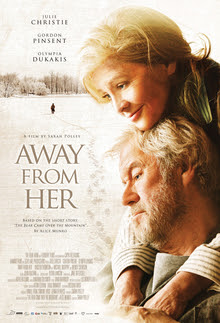
Sarah Polley, dir.: Away from Her (2006)


Nor, it appears, was Alice Munro. Before all this erupted, I had two main associations with her work.

The first was the Sarah Polley film above, based on Munro's 1999 story "The Bear Came Over the Mountain". The grim paradox in the plot is that a man who is forced to institutionalise his wife, who is suffering from Alzheimer's disease, then has to watch her shift her affections to another man, Aubrey, a wheelchair-bound mute at the same nursing home. She becomes convinced that it is Aubrey with whom she has had a long-term relationship, whereas her actual husband is now a stranger to her.

The film (and the story) are poignant and powerful, but there's a certain coldness and cruelty behind the idea which explains at least part of its success, it seems to me.

The second thing was a short story conference in Shanghai which Bronwyn and I attended in 2016. After a while it became apparent that virtually all of the earnest young graduate students there were working on Alice Munro, and (accordingly) giving papers on her stories. She was definitely the author du jour for them.

This came as a bit of a surprise to those of us still enmeshed in the web of Raymond Carver and the dirty realists. Alice Munro? Who she? We determined to find out, so one of the first things we did when we got home was to buy a copy of the Everyman edition of her selected stories, pictured near the top of this post.

I can't say I was particularly turned on by her work. I could see how it accomplished it was, but it didn't seem quite my sort of thing.


Now, in retrospect, the plot of Away from Her seems more meaningful than ever. For a start, Munro herself suffered from dementia "for at least 12 years". The idea that the wife needs her new relationship, with the wheelchair-bound mute Aubrey, more than the former one with her actual husband is also a suggestive one. It may seem illogical to outsiders, but it's truer to her own emotional temperature.

The horrible, almost unpalatable truth about this scandal based on a mother's failure to support or even empathise with her own daughter, is that it's likely to do nothing but good to Munro's career. There may be a few temporary blips in sales, but more readers are drawn to turbulent, demon-ridden souls such as Dostoyevsky and Dickens than they are to the sanity and order of better-balanced authors.

Did Dickens lose any readers over the late revelation of his cruel rejection of his wife in order to pursue an affair with the young actress Nelly Ternan? Nelly, it seems, had little choice in the matter - neither did Mrs. Dickens. His saccharine morality showed its pinchbeck quality once and for all in his later life. And yet we continue to pore over the complexities of his last fictions, full of young heroines sacrificing themselves for self-pitying older men.


Mikhail Petrashevsky: Dostoyevsky's mock execution (1849)


Fyodor Dostoyevsky was a gambler, a drunkard, a rabid anti-semite. He appears to have suffered from lifelong PTSD after experiencing a mock execution in front of one of the Tsar's firing squads, followed by exile to Siberia. As a result, it's not hard for us to believe in the appallingly damaged characters who inhabit such novels as Crime and Punishment or The Devils.

I must confess to having yawned once or twice when I first started reading Munro's stories. They didn't engage me as much as the works of (say) her near contemporaries Margaret Atwood or Ursula Le Guin. Now, however, there's more of a demonic edge to them. It's perfectly possible - even likely - that she could feel her own mind going as she watched the horrid ironies of her own short story reenacted by the actors in Close to Her.

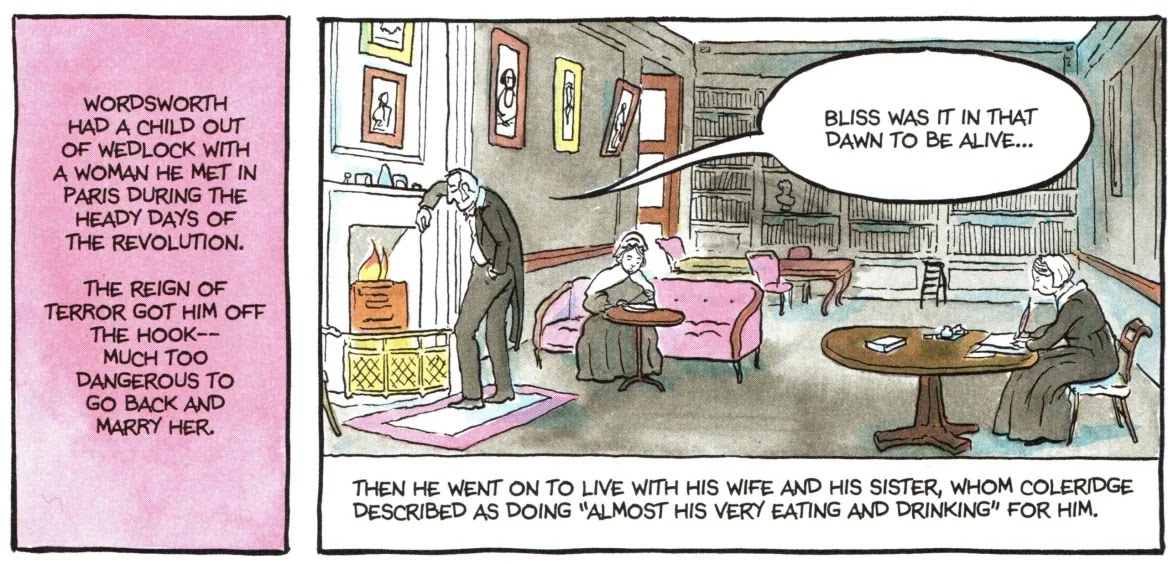
Nor can she have been blind to the fact that her dirty little secret was bound to come out in the end. Just as the illegitimate daughter whose very existence Wordsworth hid from the world was eventually discovered, giving the lie to so many of his more pompous moral pronouncements - but also explaining so much about him and his transformation from youthful rebel to faithful servant of the establishment - so Munro's hateful attitude towards her own daughter must have continued to nag at her as she conducted her minute analyses of the mindsets and actions of provincial Canadians.

We haven't stopped reading him yet, and no doubt the same will apply to Alice Munro. However much we might deplore their actions, this tends to have the paradoxical effect of deepening our interest in their writings, rather than erasing it.


Alison Bechdel: The Secret To Superhuman Strength (2021)


Alice Munro (2006)

Alice Ann Munro (née Laidlaw)
(1931–2024)


Books I own are marked in bold:
    Collections:

  1. Dance of the Happy Shades (1968)
  2. Lives of Girls and Women (1971)
  3. Something I've Been Meaning to Tell You (1974)
  4. Who Do You Think You Are? [aka "The Beggar Maid: Stories of Flo and Rose"] (1978)
  5. The Moons of Jupiter (1982)
  6. The Progress of Love (1986)
  7. Friend of My Youth (1990)
  8. Open Secrets (1994)
  9. The Love of a Good Woman (1998)
  10. Hateship, Friendship, Courtship, Loveship, Marriage [aka "Away from Her"] (2001)
    • Hateship, Friendship, Courtship, Loveship, Marriage: Stories. London: Chatto & Windus, 2001.
  11. Runaway (2004)
    • Runaway: Stories. Introduction by Jonathan Franzen. 2004. Vintage Books. London: Random House, 2005.
  12. The View from Castle Rock (2006)
  13. Too Much Happiness (2009)
  14. Dear Life (2012)

  15. Compilations:

  16. Selected Stories 1968-1994 [aka "A Wilderness Station: Selected Stories, 1968–1994"] (1996)
  17. No Love Lost (2003)
  18. Vintage Munro (2004)
  19. Carried Away: A Selection of Stories [aka "Alice Munro's Best: A Selection of Stories"]. Introduction by Margaret Atwood (2006)
    • Carried Away: A Selection of Stories. Introduction by Margaret Atwood. 2006. Everyman’s Library, 302. New York: Alfred A. Knopf, 2008.
  20. My Best Stories (2009)
  21. New Selected Stories (2011)
  22. Lying Under the Apple Tree. New Selected Stories (2014)
  23. Family Furnishings: Selected Stories 1995–2014 (2014)


Alice Munro & her family:
l-to-r: Jenny, Sheila, Alice & Andrea


Thursday, March 10, 2022

Auden: The Complete Poems (finally!)


W. H. Auden: Poems, 1: 1927-1939 (2022)


Way, way back, in 1997 (it must have been), some 25 years ago, when I was first tentatively trying out Amazon.com as a means of obtaining books I couldn't find in the bookshops here in Auckland, I remember that my initial pre-order was for two books I wanted to see the moment they appeared: the Complete Poems of Herman Melville (in the Northwestern-Newberry Edition), and the Complete Poems of W. H. Auden (in the Princeton University Press edition).

It's been a long wait.

But now, at last, after two volumes of 'dramatic works' (1988 & 1993), and no fewer than six volumes of collected prose (1996-2015), it seems that Princeton's complete edition of Auden's works is about to culminate in two volumes of poems. Here's a rough breakdown of the constituent parts of their edition to date:


W. H. Auden: Plays and Other Dramatic Writings: 1928-1938 (1988)

The Complete Works of W. H. Auden:

  1. [with Christopher Isherwood]. Plays and Other Dramatic Writings: 1928-1938. Ed. Edward Mendelson. London: Faber, 1988.
    Including:
    1. The Dance of Death (1933)
    2. [with Christopher Isherwood] The Dog Beneath the Skin (1935)
    3. [with Christopher Isherwood] The Ascent of F6 (1936)
    4. [with Christopher Isherwood] On the Frontier (1938)


  2. [with Chester Kallman]. Libretti and Other Dramatic Writings: 1939-1973. Ed. Edward Mendelson. Princeton & Oxford: Princeton University Press, 1993.
    Including:
    1. Paul Bunyan. Music by Benjamin Britten. 1941 (1976)
    2. [with Chester Kallman] The Rake's Progress. Music by Igor Stravinsky (1951)
    3. [with Chester Kallman] Elegy for Young Lovers. Music by Hans Werner Henze (1956)
    4. [with Chester Kallman] The Magic Flute, by Emanuel Schikaneder (1956)
    5. [with Chester Kallman] The Bassarids. Music by Hans Werner Henze (1961)
    6. [with Chester Kallman] Love's Labour's Lost. Music by Nicolas Nabokov (1973)


  3. Prose and Travel Books in Verse and Prose. Volume 1: 1926-1938. Ed. Edward Mendelson. London: Faber, 1996.
    Including:
    1. Essays and Reviews, 1926-1938
    2. [with Louis MacNeice] Letters from Iceland (1937)
    3. [with T. C. Worsley] Education: Today - and Tomorrow (1939)
    4. [with Christopher Isherwood] Journey to a War (1939)


  4. Prose. Volume 2: 1939-1948. Ed. Edward Mendelson. Princeton & Oxford: Princeton University Press, 2002.
    Including:
    1. Essays and Reviews, 1939-1948
    2. The Prolific and the Devourer. 1939 (1993)


  5. W. H. Auden: Prose. Volume 2: 1939-1948 (2002)


  6. Prose. Volume 3: 1949-1955. Ed. Edward Mendelson. Princeton & Oxford: Princeton University Press, 2008.
    Including:
    1. Essays and Reviews, 1949-1955
    2. The Enchaféd Flood, or The Romantic Iconography of the Sea (1950)


  7. W. H. Auden: Prose. Volume 3: 1949-1955 (2008)


  8. Prose. Volume 4: 1956-1962. Ed. Edward Mendelson. Princeton & Oxford: Princeton University Press, 2010.
    Including:
    1. Essays and Reviews, 1956-1962
    2. The Dyer's Hand and Other Essays (1962)


  9. W. H. Auden: Prose. Volume 4: 1956-1962 (2010)


  10. Prose. Volume 5: 1963-1968. Ed. Edward Mendelson. Princeton & Oxford: Princeton University Press, 2015. xlii + 562 pp.
    Including:
    1. Essays and Reviews, 1963-1966
    2. Secondary Worlds: The T. S. Eliot Memorial Lectures, Delivered at Eliot College in the University of Kent at Canterbury, October, 1967 (1968)
    3. Essays and Reviews, 1967-1968


  11. W. H. Auden: Prose. Volume 5: 1963-1968 (2015)


  12. Prose. Volume 6: 1969-1973. Ed. Edward Mendelson. Princeton & Oxford: Princeton University Press, 2015. xiv + 790 pp.
    Including:
    1. A Certain World: A Commonplace Book (1970)
    2. Essays and Reviews, 1969-1973
    3. Forewords and Afterwords (1973)


  13. W. H. Auden: Prose. Volume 6: 1969-1973 (2015)


  14. Poems. Volume I: 1927-1939. Ed. Edward Mendelson. Princeton & Oxford: Princeton University Press, 2022. xxx + 808 pp.
    Including:
      Poems 1930-1939:
    1. Poems (1930 / 1933)
    2. Other Poems, 1927-1930
    3. The Orators: An English Study (1932)
    4. Other Poems, 1931-1935
    5. On This Island [aka Look, Stranger!] (1936)
    6. Spain (1937)
    7. Other Poems, 1936-1939
    8. Poems from Letters from Iceland (1937)
    9. Poems from Journey to a War (1939)
    10. Another Time (1940)
    11. Juvenilia: Early Poems 1922-1928:
    12. Poems (1928)
    13. Other Published Poems, 1922-1928
    14. Appendices:
      • Verses for School Magazines, 1933-1939
      • [with Benjamin Britten] Our Hunting Fathers (1936)
      • Poems Abandoned before Publication
      • Songs and Other Musical Pieces Abandoned before Publication


  15. W. H. Auden: Poems, 1: 1927-1939 (2022)


  16. Poems. Volume II: 1940-1973. Ed. Edward Mendelson. Princeton & Oxford: Princeton University Press, 2022. viii + 1106 pp.
    Including:
      Poems 1940-1973:
    1. The Double Man [aka New Year Letter] (1941)
    2. Other Poems, 1940-1944
    3. For the Time Being (1945)
    4. Poems First Collected in The Collected Poetry of W. H. Auden (1945)
    5. The Age of Anxiety: A Baroque Eclogue (1947)
    6. Other Poems, 1945-1950
    7. Nones (1951)
    8. Other Published and Pothumous Poems, 1951-1973
    9. The Shield of Achilles (1955)
    10. Homage to Clio (1960)
    11. About the House (1965)
    12. City Without Walls and Other Poems (1969)
    13. Academic Graffiti (1971)
    14. Epistle to a Godson and Other Poems (1972)
    15. Thank You, Fog: Last Poems (1974)
    16. Appendices:
      • Collected and Selected Editions
      • Auden's Choices for Anthologies
      • Published Recordings
      • Poems Abandoned before Publication
      • A List of Auden's Translations


  17. W. H. Auden: Poems, 2: 1940-1973 (2022)


    W. H. Auden: Poems, 2: 1940-1973 (2022)


  18. Personal Writings: Selected Letters, Journals, and Poems Written for Friends. Ed. Edward Mendelson. Princeton & Oxford: Princeton University Press, tba.
    Including:


And why, exactly, should this be exciting news for anyone except Auden fanatics? Some time ago I outlined a few of my reasons for feeling so enthusiastic about his work in the following post. Is there more to it than that, though? We are, after all, coming up (next year) to the fiftieth anniversary of his death. Shouldn't we give him a bit of a rest?


Peter Davison, ed.: The Complete Works of George Orwell (1997-98)


I'm afraid not. Like his close contemporary (though not really friend) George Orwell, W. H. Auden maintains his relevance for readers today. I guess one reason why is because both grappled directly with the issues of their day, rather than maintaining some kind of careful aesthetic distance from the ugly events of the mid-twentieth century - among mankind's lowest moments in terms of sheer violence and terror.

Another reason is the way that both of them wrote: in clear, straightforward English, immediately comprehensible to most readers. Take, for example, Auden's 'Refugee Blues', written in 1939 as the true horror of Hitler's policies against the Jews became increasingly undeniable:
... Went to a committee; they offered me a chair;
Asked me politely to return next year:
But where shall we go today, my dear, but where shall we go today?

Came to a public meeting; the speaker got up and said:
‘If we let them in, they will steal our daily bread’;
He was talking of you and me, my dear, he was talking of you and me.

Thought I heard the thunder rumbling in the sky;
It was Hitler over Europe, saying: ‘They must die’;
We were in his mind, my dear, we were in his mind.

Saw a poodle in a jacket fastened with a pin,
Saw a door opened and a cat let in:
But they weren’t German Jews, my dear, but they weren’t German Jews.
Is it poetry or propaganda? At the time many thought that Auden was crossing a line in talking so directly about the issues of the day - 'poetry' was for things like daffodils, and broken hearts, and learned disquisitions on history. It's a matter of taste, I suppose, but when I read lines like the ones below, I have to say if that isn't poetry, I don't know what is:
Went down the harbour and stood upon the quay,
Saw the fish swimming as if they were free:
Only ten feet away, my dear, only ten feet away.

Walked through a wood, saw the birds in the trees;
They had no politicians and sang at their ease:
They weren’t the human race, my dear, they weren’t the human race.

Dreamed I saw a building with a thousand floors,
A thousand windows and a thousand doors;
Not one of them was ours, my dear, not one of them was ours.

Stood on a great plain in the falling snow;
Ten thousand soldiers marched to and fro:
Looking for you and me, my dear, looking for you and me.
All I can say is that as Russian tanks roll again in Europe, and refugees stream west before Putler's armies, it's Auden poems I turn to for a bit of light in the darkness. All of a sudden he seems terrifyingly relevant in a way we probably all hoped he would never be again.


Ukrainian refugees (The Guardian: 5-3-2022)


Sunday, July 16, 2017

Orwelliana


The other day a bunch of us were sitting around talking about books (as you do), when someone asked us each to name our favourite author. The answers were pretty interesting - and quite revealing. Bronwyn said 'Tracey Slaughter,' her sister Thérèse said 'Anne Carson,' Martin said 'Salman Rushdie,' I said 'Guillaume Apollinaire,' and my brother-in-law Greg said 'George Orwell.'

I guess on another day any one of us might have mentioned somebody else ('Stephen King' would probably have been more accurate for me, if the truth be told). But Orwell - that was the name that really struck me, and the response I envied most.

I've been reading his books for forty years, I'm astonished to discover. My second-hand copy of the 'Uniform Edition' of Down and Out in Paris and London cost me 20 cents in 1977, I see on the inside flap, and I acquired copies of The Road to Wigan Pier and Homage to Catalonia not much later. I'm sure I'd already read Animal Farm and Nineteen Eighty-Four by then, though it wasn't till I bought the large hardback 'Octopus Books' edition of his complete novels that I read the other ones. Coming Up for Air is probably my favourite book of his, actually.


  • Orwell, George. Down and Out in Paris and London. 1933. Uniform Edition. 1949. London: Martin Secker & Warburg Ltd., 1951.
  • Orwell, George. The Road to Wigan Pier. 1937. Uniform Edition. London: Martin Secker & Warburg Ltd., 1959.
  • Orwell, George. Homage to Catalonia, & Looking Back on the Spanish War. 1938 & 1953. Harmondsworth: Penguin, 1978.
  • Orwell, George. Burmese Days / A Clergyman's Daughter / Keep the Aspidistra Flying / Coming Up for Air / Animal Farm / Nineteen Eighty-Four. 1934, 1935, 1936, 1939, 1945, 1949. London: Martin Secker & Warburg Limited / Octopus Books Limited, 1976.
  • Orwell, George, & Reginald Reynolds, ed. British Pamphleteers. Volume 1: From the 16th Century to the French Revolution. London: Allan Wingate, 1948.

Nine books: 6 novels, 3 books of non-fiction reportage, plus a couple of collections of reprinted essays: that was his life's work. Or all of it that was accessible to us for a long time, that is.

There was all the fuss about him when the year 1984 finally dawned, of course. I dutifully went out and bought the facsimile edition of the manuscript of the novel. More significantly, though, it must have been around then that I discovered the Penguin editions of his Collected Essays, Journalism and Letters:


  • Orwell, George. Nineteen Eighty-Four: The Facsimile of the Extant Manuscript. Ed. Peter Davison. Preface by Daniel G. Siegel. London: Martin Secker & Warburg Limited / Weston, Massachusetts: M & S Press Inc., 1984.
  • Orwell, George. The Collected Essays, Journalism and Letters of George Orwell. Volume 1: An Age Like This, 1920–1940. Ed. Ian Angus & Sonia Brownell. 1968. 4 vols. Harmondsworth: Penguin, 1970.
  • Orwell, George. The Collected Essays, Journalism and Letters of George Orwell. Volume 2: My Country Right or Left, 1940–1943. Ed. Ian Angus & Sonia Brownell. 1968. 4 vols. Harmondsworth: Penguin, 1977.
  • Orwell, George. The Collected Essays, Journalism and Letters of George Orwell. Volume 3: As I Please, 1943–1945. Ed. Ian Angus & Sonia Brownell. 1968. 4 vols. Harmondsworth: Penguin, 1978.
  • Orwell, George. The Collected Essays, Journalism and Letters of George Orwell. Volume 4: In Front of Your Nose, 1945–1950. Ed. Ian Angus & Sonia Brownell. 1968. 4 vols. Harmondsworth: Penguin, 1978.


That was an absolute revelation. For the first time it was possible to get some idea of what it must have felt like to be 'George Orwell' - all the ups and downs of his extraordinary life and times, from the slums of the Depression through the Spanish War through the Second World War and out the other side into postwar austerity. I still think this four-volume collection is a miracle of good taste and good editing.

It did, though, have the effect of making me feel that I now knew the man inside out. I did buy the volumes of hitherto undiscovered War Broadcasts which appeared in 1985, but it was with a certain reluctance. They were - to tell the truth - a little tedious taken out of context, and the great thing about Ian Angus and Sonia Orwell's tapestry had been the discovery that Orwell almost never wrote a boring or superfluous word.

  • Orwell, George. The War Broadcasts. Ed. W. J. West. 1985. Harmondsworth: Penguin, 1987.
  • Orwell, George. The War Commentaries. Ed. W. J. West. 1985. Harmondsworth: Penguin, 1987.

That's where I stopped. For the past thirty years I've refreshed my memory of his work from the collected edition from time to time, but I haven't read each of the successive Orwell biographies, full as each of them has been of hitherto unsuspected 'facts' (that he was an exhibitionist, that he wasn't an exhibitionist, that he calculated his public persona carefully, that he stumbled into his public persona, etc. etc.) I was aware that there was some monstrous multi-volumed beast called the Complete Works, but I assumed that it mostly repeated what I already knew.


  • Buddicom, Jacintha. Eric and Us: A Remembrance of George Orwell. London: Leslie Frewin Publishers Limited, 1974.
  • Stansky, Peter, & William Abrahams. The Unknown Orwell. 1972. A Paladin Book. Frogmore, St. Albans, Herts.: Granada Publishing Limited, 1974.
  • Stansky, Peter, & William Abrahams. Orwell: The Transformation. 1979. A Paladin Book. Frogmore, St. Albans, Herts.: Granada Publishing Limited, 1981.
  • Crick, Bernard. George Orwell: A Life. 1980. Harmondsworth: Penguin, 1982.
  • Coppard, Audrey, & Bernard Crick. Orwell Remembered. Ariel Books. London: British Broadcasting Corporation, 1984.
  • Wadhams, Stephen, ed. Remembering Orwell. Introduction by George Woodcock. Harmondsworth: Penguin, 1984.


That is, until the other day when I ran across a second-hand copy of Orwell's Diaries, edited by a certain Peter Davison (not the Dr. Who actor, in case you were wondering), which claimed on its blurb to be the closest thing to the 'autobiography he never wrote.'

I bought it, of course, and in the process of investigating its introduction and apparatus, chanced on the extraordinary saga of Davison's own forty-year struggle with Orwell's work. (You can read his fascinating 2012 essay "The Troubled History Behind George Orwell's Complete Works" here).


  • Orwell, George. Diaries. Ed. Peter Davison. Harvill Secker. London: Random House, 2009.
  • Orwell, George. A Life in Letters. Ed. Peter Davison. 2010. Penguin Classics. London: Penguin, 2011.


The critical response to Peter Davison's self-imposed task has been, to be honest, a little mixed. Quite a few reviewers have criticised him for his 'boots and all' approach to Orwell's work, preferring the more nuanced approach of Ian Angus and Orwell's second wife Sonia. But when I read in one of these pieces that the latter had attempted pretty systematically to expunge his first wife Eileen O'Shaughnessy (who died in 1945) from the record, I began to think that there might be something to be said for the wholesale approach after all.

And so it has proved. I'm steadily working my way through the eleven volumes of what Davidson describes as "his and his wife Eileen’s letters (some 1,100), 265 articles, 380 reviews, lecture notes and research materials, diaries (apart from one or two still believed to be held in the NKVD Archive in Moscow), his hundreds of BBC broadcasts to India and the arrangements for making those, together with a selection of letters written to him." True, some of the juvenilia is a bit lame, but pretty much from the publication of his first pieces of journalism in Paris, the authentic voice is very much in evidence.

Does anyone deserve to be documented on quite this scale? Well, I'm sure that it would horrify Orwell himself, but if anyone merits it, he does. Even his most hurried reviews are always sensible and interesting - and have the effect of providing a potted history of two decades of English intellectual life, as well as their many other virtues. The letters and diaries are also fascinating. Reading it is really like discovering a whole new Orwell: not the careful craftsman of the nine books, or the more expansive - but still rigorously controlled - journalist of the Ian Angus / Sonia Orwell selection, but a warts-and-all portrait of the artiste engagé.


  • Davison, Peter, with Ian Angus & Sheila Davison, ed. The Complete Works of George Orwell. 10: A Kind of Compulsion: 1903–1936. 1998. London: Secker & Warburg, 2000.
  • Davison, Peter, with Ian Angus & Sheila Davison, ed. The Complete Works of George Orwell. 11: Facing Unpleasant Facts: 1937–1939. 1998. London: Secker & Warburg, 2000.
  • Davison, Peter, with Ian Angus & Sheila Davison, ed. The Complete Works of George Orwell. 12: A Patriot After All: 1940–1941. 1998. London: Secker & Warburg, 2002.
  • Davison, Peter, with Ian Angus & Sheila Davison, ed. The Complete Works of George Orwell. 13: All Propaganda Is Lies: 1941–1942. 1998. London: Secker & Warburg, 2001.
  • Davison, Peter, with Ian Angus & Sheila Davison, ed. The Complete Works of George Orwell. 14: Keeping Our Little Corner Clean: 1942–1943. 1998. London: Secker & Warburg, 2001.
  • Davison, Peter, with Ian Angus & Sheila Davison, ed. The Complete Works of George Orwell. 15: Two Wasted Years: 1943. 1998. London: Secker & Warburg, 2001.
  • Davison, Peter, with Ian Angus & Sheila Davison, ed. The Complete Works of George Orwell. 16: I Have Tried to Tell the Truth: 1943–1944. 1998. London: Secker & Warburg, 2001.
  • Davison, Peter, with Ian Angus & Sheila Davison, ed. The Complete Works of George Orwell. 17: I Belong to the Left: 1945. 1998. London: Secker & Warburg, 2001.
  • Davison, Peter, with Ian Angus & Sheila Davison, ed. The Complete Works of George Orwell. 18: Smothered Under Journalism: 1946. 1998. London: Secker & Warburg, 2001.
  • Davison, Peter, with Ian Angus & Sheila Davison, ed. The Complete Works of George Orwell. 19: It Is What I Think: 1947–1948. 1998. London: Secker & Warburg, 2002.
  • Davison, Peter, with Ian Angus & Sheila Davison, ed. The Complete Works of George Orwell. 20: Our Job Is to Make Life Worth Living: 1949–1950. 1998. London: Secker & Warburg, 2002.
  • Davison, Peter, ed. The Lost Orwell: Being a Supplement to The Complete Works of George Orwell. London: Timewell Press Limited, 2006.


I'm astonished that I didn't think to investigate these 11 volumes (plus supplementary volume) before. In a sense, though, I'm glad. Now I can savour the treat fully, and at my leisure: rather than waiting for each new volume to appear in a fever of impatience.

There is, of course - given Davison's mania for completeness - more to it than that. The first nine volumes of his edition provide critical texts for each of the novels and books of reportage (texts more readily available now through Penguin Modern Classics). He has also edited four volumes of selections from the edition, each focussed on a particular book of Orwell's:


  • Davison, Peter, ed. Orwell and the Dispossessed: Down and Out in Paris and London in the Context of Essays, Reviews and Letters Selected from The Complete Works of George Orwell. Introduction by Peter Clarke. Penguin Modern Classics. London: Penguin, 2001.
  • Davison, Peter, ed. Orwell's England: The Road to Wigan Pier in the Context of Essays, Reviews and Letters Selected from The Complete Works of George Orwell. Introduction by Ben Pimlott. Penguin Modern Classics. London: Penguin, 2001.
  • Davison, Peter, ed. Orwell in Spain: The Full Text of Homage to Catalonia with Associated Articles, Reviews and Letters from The Complete Works of George Orwell. Introduction by Christopher Hitchens. Penguin Modern Classics. London: Penguin, 2001.
  • Davison, Peter, ed. Orwell and Politics: Animal Farm in the Context of Essays, Reviews and Letters Selected from The Complete Works of George Orwell. Introduction by Timothy Garton Ash. Penguin Modern Classics. London: Penguin, 2001.


Simon Schama's classic TV series on the History of Britain concludes with an episode entitled "The Two Winstons," contrasting Orwell's Winston Smith (from 1984) with that other Winston, Winston Churchill, as a way of exploring the UK in the twentieth century.


Simon Schama: A History of Britain (2002)


It works quite well, really. While I demonstrated in my previous post that I have spent quite a lot of time poring over Winston Churchill's literary remains, there is, I'm afraid, no comparison with the interest I feel in Orwell's. He really is one of the greatest writers of the last century, and it's nice to be able to see his work whole and entire at last, thanks to the largely thankless labours of that culture-hero Peter Davison.


George Orwell: Complete Novels (Folio Society, 2001)