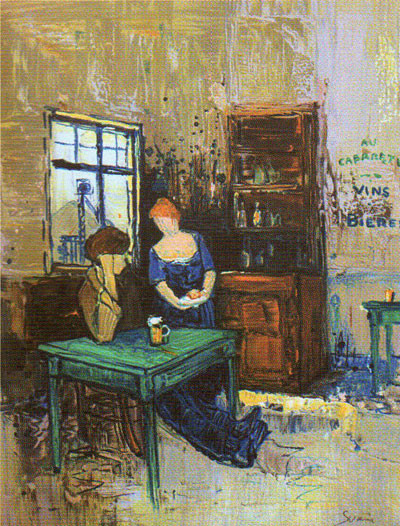
Un soir de demi-brume à LondresMore than a half-century has passed since the manuscript beginning with these lines was fished out of limbo, read and read again, and a dazzled magazine editor called across the room that here, at last, was a first-rate poem. A reader of the [1960s] might find other terms in which to express his approval, though some of Paul Léautaud's are still serviceable: "I read, read twice, three times, was carried away, dazed, delighted, deeply moved. Such melancholy, such evocative tone, such bohemianism, such rangings of the mind, and that faintly gypsy air and the total absence of that abomination of ordinary verse, la rime riche ... "
Un voyou qui ressemblait à
Mon amour vint à ma rencontre
Et le regard qu’il me jeta
Me fit baisser les yeux de honte
- Warren Ramsay, "Foreword" to Alcools. Trans. Anne Hyde Greet (1965)

It seems like a curious coincidence that it's now nearly fifty years since I first read the words above. Here's what I wrote about that discovery in a previous post on this blog:
It's funny when you go snooping around in the ripped old paperbacks in the back of a bookshop (in this case, Jason Books on High Street ...) You see something there which hardly even seems to merit being picked up - a backless wodge of papers with a pasted spine and no title-page - but it turns out to be one of the finds of your life.There was definitely something magical about the experience. Mind you, given it was missing a title-page, I didn't know whose translation it was at the time. It wasn't till years afterwards that I was able to hunt down that information about Anne Hyde Greet and her mid-sixties translation of the whole of Alcools (1913), probably Apollinaire's finest book of poems, which she followed up in 1980 with a similarly complete version of his technically adventurous (and hugely influential) book Calligrammes (1918).
I see from the inscription above that it was on the 5th September, 1979 ..., and the book in question was Apollinaire's Alcools - or, rather, a complete dual-text translation of the same, which some iconoclast had ripped apart and then deposited among the other trash to be pulped. A price of 15 cents hardly seemed exorbitant even at the time, especially when I think of the amount of time I've spent leafing through those pages, reading and rereading those amazing poems: "Zone", "Le Pont Mirabeau" - above all, "La Chanson du Mal-Aimé."
It turns out - from the Santa Barbara Independent obituary I located online - that she passed away just a couple of years ago, in 2023, at the age of 94. They say of her there:
Anne received her B.A. in Greek from Bryn Mawr, her M.A. in English from Columbia and in French from the University of Colorado, as well as her Ph.D. in French. She held a scholarship in Greek at Oxford, a Fulbright grant at the University of Padua, and studied at the Middleburg School of French in Paris as well as the University for Foreigners at Perugia. At the beginning of her career, she taught classics at the Chapin School in New York and French at the University of Colorado. She finished out her career as a professor of poetry and French at the University of California at Santa Barbara, where she was named professor emeritus. The love of languages came from her father and her aunt, both professors of English.
She was soft-spoken, kind, generous and loving, and she will be greatly missed ... From ”Jellyfish” in Anne’s book of poetry Musk Ox:Is there another such dance as mine?
I journey where the currents take me.
My only harbor, death.

I certainly owe Professor Anne Greet a huge debt of gratitude - though perhaps it ought to be shared with the barbarian who ripped off the front and back cover of the book I still own (though it now has a handsome binding created by the crafty and ingenious Bronwyn Lloyd):

How should one English those five lines above, the opening stanza of Apollinaire's long poem of lost love, "La Chanson du Mal-Aimé" [The Song of the Ill-loved]? I did make a brief pass at it in my first novel, Nights with Giordano Bruno (2000):
One night of spindrift fog in London
a boyo who was the dead spit
of my lost leader Shackleton
    came up and took a look at it …

I was 16 when I started reading Apollinaire, and perhaps his insouciant, knowing manner - combined with the huge hurts he was forced to withstand throughout his life - made him the ideal poet for an adolescent. The erotic wildness of much of his work didn't hurt, either. He was Polish by birth, and the appalling frankness of his 1907 novel Les Onze Mille Verges ou les Amours d'un hospodar [translated as "The Debauched Hospodar"] seems to combine reminiscences of his Eastern European heritage with more recent impressions of his adopted homeland France. It's hard to think of a parallel to it outside Sade's Justine or Georges Bataille's Story of the Eye (1928). Apollinaire's friend Picasso allegedly referred to it as his "masterpiece".
It was the poems that appealed to me most, though. My very first book - a tiny chapbook hand-printed on an old press at the University of Edinburgh - was a translation of one of the interpolated songs in "La Chanson du Mal-Aimé," Aubade (1987). It's probably mainly of interest now because it contains an uncollected drawing by novelist and children's book illustrator Mark Haddon, author of The Curious Incident of the Dog in the Night-Time (2003):

Aubade• It’s Spring let’s walk out Alison the woods are lovely though those chooks are cackling in the yard the sun is not ashamed of sex the folded sheets are red with dawn Mars and Venus have returned They’re kissing with open mouths in front of a still-virgin bed of roses where a rout of nymphs and satyrs dances nude Come my love-sickness inspires the flowers that spring at every turn the horned god pipes with antic fire the bullfrogs sing in tune the force of nature is desire
C'est le printemps viens-t'en Pâquette Te promener au bois joli Les poules dans la cour caquètent L'aube au ciel fait de roses plis L'amour chemine à ta conquête Mars et Vénus sont revenus Ils s'embrassent à bouches folles Devant des sites ingénus Où sous les roses qui feuillolent De beaux dieux roses dansent nus Viens ma tendresse est la régente De la floraison qui paraît La nature est belle et touchante Pan sifflote dans la forêt Les grenouilles humides chantent - Guillaume Apollinaire (1913)
- trans. Jack Ross (12/86)

Needless to say, I was in love at the time - with an American exchange student called Alison. Hence the shift from Apollinaire's endearingly named (and possibly allegorical) object of affection "Pâquette" to that much-easier-to-rhyme-with-in-English other name.
I feel, in a sense, as if Apollinaire has been pursuing, or perhaps I should say prompting me ever since. Unlike his predecessor Rimbaud, his poems seem - at least on the surface - approachable and easy to follow. His vocabulary is anything but recondite, and his subject matter clearly that of a turn-of-the-century modernist. In "Zone" (1913), for instance, he lambasts "ce monde ancien" [this old world] in favour of "les livraisons à 25 centimes pleines d’aventures policières" [25-cent pulp paperbacks full of crime stories].
It's probably too long to quote here in full, but here are the opening lines:
À la fin tu es las de ce monde ancien

Bergère ô tour Eiffel le troupeau des ponts bêle ce matin

Tu en as assez de vivre dans l’antiquité grecque et romaine

Ici même les automobiles ont l’air d’être anciennes
La religion seule est restée toute neuve la religion
Est restée simple comme les hangars de Port-Aviation

Seul en Europe tu n’es pas antique ô Christianisme
L’Européen le plus moderne c’est vous Pape Pie X
Et toi que les fenêtres observent la honte te retient
D’entrer dans une église et de t’y confesser ce matin
Tu lis les prospectus les catalogues les affiches qui chantent tout haut

Voilà la poésie ce matin et pour la prose il y a les journaux
Il y a les livraisons à 25 centimes pleines d’aventures policières
Portraits des grands hommes et mille titres divers ...
And here's an extract from Donald Revell's 1995 translation of the whole poem:
At last you’re tired of this elderly world

Shepherdess O Eiffel Tower this morning the bridges are bleating

You’re fed up living with antiquity

Even the automobiles are antiques
Religion alone remains entirely new religion
Remains as simple as an airport hangar

In all Europe only you O Christianism are not old
The most modern European Pope Pius X it’s you
The windows watch and shame has sealed
The confessionals against you this morning
Flyers catalogs hoardings sing aloud
Here’s poetry this morning and for prose you’re reading the tabloids
Disposable paperbacks filled with crimes and police
Biographies of great men a thousand various titles
•
Revell's version is literal enough, but he can't help smoothing out Apollinaire's staccato French into rather less aggressive, more grammatical English. I think it gives you the general idea, though: automobiles, newspapers, the Eiffel Tower - everything throughly modern, in other words.
Where Apollinaire really soars, though, is as a love poet. If you're trying to find the right words to send to your beloved - that necessary fusion of the sentimental and the sensual - his work is unparalled in its power and range. Take this wonderfully intricate antiphonal love poem, for instance:

Il y a• Il y a des petits ponts épatants I There’s a big steel harbour bridge Il y a mon coeur qui bat pour toi crush There’s my heart beating for you Il y a une femme triste sur la route you There’s a woman trundling across the road Il y a un beau petit cottage dans un jardin against There’s a fibrolite bach in a garden Il y a six soldats qui s’amusent comme des fous my There’s six skateboarders crapping out like loons Il y a mes yeux qui cherchent ton image breast There’s my eyes searching for you like There’s a stand of eucalyptus trees on Forrest Hill (& an old campaigner who pisses as we pass) the There’s a poet dreaming about his Chantal There’s a beautiful Chantal in that big Auckland dove There’s a pill-box on a cliff-top There’s a farmer trucking his sheep a There’s my life which belongs to you There’s my black ballpoint scribbling scribbling little There’s a screen of poplars intricate intricate There’s my old life which is definitely over girl There’s narrow streets near K Rd where we’ve loved each other There’s a chick in Freemans Bay who drives her friends INSANE strangles There’s my driver’s licence in my wristbag There’s Mercs and Beamers on the road without There’s love noticing There’s life I adore you
Il y a des petits ponts épatants Il y a mon cœur qui bat pour toi Il y a une femme triste sur la route Il y a un beau petit cottage dans un jardin Il y a six soldats qui s’amusent comme des fous Il y a mes yeux qui cherchent ton image Il y a un petit bois charmant sur la colline Et un vieux territorial pisse quand nous passons Il y a un poète qui rêve au ptit Lou Il y a un ptit Lou exquis dans ce grand Paris Il y a une batterie dans une forêt Il y a un berger qui paît ses moutons Il y a ma vie qui t’appartient Il y a mon porte-plume réservoir qui court, qui court Il y a un rideau de peupliers délicat, délicat Il y a toute ma vie passée qui est bien passée Il y a des rues étroites à Menton où nous nous sommes aimés Il y a une petite fille de Sospel qui fouette ses camarades Il y a mon fouet de conducteur dans mon sac à avoine Il y a des wagons belges sur la voie Il y a mon amour Il y a toute la vie Je t’adore - Guillaume Apollinaire (5 avril 1915)
- trans. Jack Ross (10/3/1999)

I may have taken one or two liberties with the translation - inserting the bit about the little girl from a contiguous piece of writing, for instance, as well as updating a few of the references - but I still feel that my version is reasonably faithful to the spirit of Apollinaire's original.
You'll note that the poem above is addressed to "Lou" - Louise de Coligny-Châtillon - a pioneer aviator, and the subject of some of Apollinaire's most passionate verse, mostly sent home in letters from the trenches, where he was serving in the French artillery.

Sad to say, he was also corresponding, at the same time, equally passionately, with a young schoolteacher named Madeleine Pagès. Here's a characteristic sample:

As for you, I adore you. I take you naked as a pearl and devour you with kisses all over from your feet to your head, so swoon from love, my darling love, I eat your mouth and your fine breasts which belong to me and which swollen with voluptuousness thrill me with endless delight.

Not only that, but sometimes virtually the same poem was sent to both women (with a few necessary adjustments to names).
It was difficult to find time and space to write at the front, and Apollinaire accordingly evolved a new approach to poetry. His "Calligrammes" - concrete poems composed in various shapes and sizes - had a revolutionary effect on post-war writing, whether it be Dadaist, Futurist, or Surrealist. Here's one striking example, sent to Lou in 1915:

Reconnais-toi	                              Recognise yourself
cette adorable personne c’est toi    this adorable person is you
sous le grand chapeau caroline	      under the big Carolina hat
oeil	                                                     eye
nez	                                                    nose
la bouche	                                           mouth
voici l’ovale de la figure	   here is the oval of your face
ton cou	                                               your neck
et puis	                                                and then
un peu plus bas	                                a bit lower down
c’est ton coeur qui bat	              there’s your beating heart
ni	                                                     nor
ci confus	                           should we mix with it
l’impure	                                      the impure
par le mirage	                              through the mirage
de ton buste adoré	                    of your loved breast
un comma	                                         a comma
à travers un nuage	                         through a cloud

- Guillaume Apollinaire (9 février 1915)
- trans. Jack Ross (2012)

In 1916 Apollinaire requested a transfer to the infantry, in quest (he claimed) of more action. He got his wish. In 1916 "he received a serious shrapnel wound to the temple, from which he would never fully recover." It's no accident that the last portraits his artist friends made of him - by Cocteau (above), and Picasso (below) - all show a bandage wrapped around his head.
It's hard, in retrospect, not to see something prophetic in some of the verses he wrote just before the outbreak of war. These from the longer poem "L'assassin," for instance:

from L'assassin• Sea’s edge summer’s end gulls fly waves leave behind glass blobs of jellyfish ships pass on the horizon wind dies in the pines sun sinks behind the islands foam bruises the sand the sea darkens to purple you fool naked alone shout your fear into the storm
Je suis au bord de l’océan sur une plage Fin d’été : je vois fuir les oiseaux de passage. Les flots en s’en allant ont laissé des lingots : Les méduses d’argent. Il passe des cargos Sur l’horizon lointain et je cherche ces rimes Tandis que le vent meurt dans le pins maritimes. Je pense à Villequier « arbres profonds et verts » La Seine non pareille aux spectacles divers L’Eglise des tombeaux et l’hôtel des pilotes Où flotte le parfum des brunes matelotes. Les noirceurs de mon âme ont bien plus de saveur. Et le soleil décline avec un air rêveur Une vague meurtrie a pâli sur le sable Ainsi mon sang se brise en mon cœur misérable Y déposant auprès des souvenirs noyés L’échouage vivant de mes amours choyés. L’océan a jeté son manteau bleu de roi Il est sauvage et nu maintenant dans l’effroi De ce qui vit. Mais lui défie à la tempête Qui chante et chante et chante ainsi qu’un grande poète. - Guillaume Apollinaire (23 juillet 1913)
- trans. Jack Ross (21/6-12/8/15)

Severely weakened by his wounds, Apollinaire fell victim to the great Spanish 'flu epidemic at the end of the war:
As he lay dying in his hospital bed, he could hear the crowds outside chanting: "À bas Guillaume" - Down with Guillaume. They meant Kaiser Wilhelm, who was on the point of abdicating just before the German surrender, but to the poet himself, it seemed the final irony. It was 9 November, 1918. He died just two days before the Armistice was signed.

As I mentioned above, Apollinaire was a pioneer in his association with painters. His interest in modern art, chronicled in endless columns and newspaper articles, included virtually all the major modernists, who saw him as perhaps the only writer who understood what they were getting at.
And, of course, in the end, he transformed himself into a visual artist in his own right, in the half-drawn, half-written calligrammes, collected in book-form in 1918.
In fact, it wasn't really until the poets of the New York School - John Ashbery, Frank O'Hara, Kenneth Koch - began to emerge in the 1950s that so close a relationship between art and writing developed again. And there's little doubt that their model in this (as in so many other things) was Apollinaire.
Let's go back in time a little, then, to one of the best-known (and most frequently translated) poems from his first book, Alcools:

-
Le Pont Mirabeau
- Le Pont Mirabeau
- The Pont Mirabeau
- Mirabeau Bridge
- Mirabeau Bridge
- Mirabeau Bridge
- Mirabeau Bridge
- Le pont Mirabeau
- Guillaume Apollinaire (1912)
Sous le pont Mirabeau coule la Seine
           Et nos amours
     Faut-il qu'il m'en souvienne
La joie venait toujours après la peine

           Vienne la nuit sonne l'heure
           Les jours s'en vont je demeure

Les mains dans les mains restons face à face
           Tandis que sous
     Le pont de nos bras passe
Des éternels regards l'onde si lasse

           Vienne la nuit sonne l'heure
           Les jours s'en vont je demeure

L'amour s'en va comme cette eau courante
           L'amour s'en va
     Comme la vie est lente
Et comme l'Espérance est violente

           Vienne la nuit sonne l'heure
           Les jours s'en vont je demeure

Passent les jours et passent les semaines
           Ni temps passé
     Ni les amours reviennent
Sous le pont Mirabeau coule la Seine

           Vienne la nuit sonne l'heure
           Les jours s'en vont je demeure

- trans. Roger Shattuck (1948)
Under the pont Mirabeau flows the Seine
        Our loves flow too
    Must it recall them so
Joy came to us always after pain

        May night come and the hours ring
        The days go by and I remain

Facing each other hand in hand
        Thus we will stand
    While under our arms' bridge
Our longing looks pass in a weary band

        May night come and the hours ring
        The days go by and I remain

Love leaves us like this flowing stream
        Love flows away
    How slow life is and mild
And oh how hope can suddenly run wild

        May night come and the hours ring
        The days go by and I remain

May the long days and the weeks go by
        Neither the past
    Nor former loves return
Under the pont Mirabeau flows the Seine

        May night come and the hours ring
        The days go by and I remain

- trans. Oliver Bernard (1965)
Under the Pont Mirabeau the Seine
        Flows with our loves
      Must I recall again?
Joy always used to follow after pain

    Let the night come: strike the hour
    The days go past while I stand here

Hands holding hands let us stay face to face
        While under this
      Bridge our arms make slow race
Long looks in a tired wave at a wave's pace

    Let the night come: strike the hour
    The days go past while I stand here

Love runs away like running water flows
        Love flows away
      But oh how slow life goes
How violent hope is nobody knows

    Let the night come: strike the hour
    The days go past while I stand here

The days pass and the weeks pass but in vain
        Neither time past
      Nor love comes back again
Under the Pont Mirabeau flows the Seine

    Let the night come: strike the hour
    The days go past while I stand here

- trans. Anne Hyde Greet (1965)
Past Mirabeau Bridge flows the Seine
        And our love
    Must I remember
Joy followed always after pain

        Let night come    sound the hour
        Time draws in     I remain

Hand in hand let us stay face to face
        While past the
    Bridge of our embrace
Flows one long look's weary wave

        Let night come    sound the hour
        Time draws in     I remain

Love creeps by like the flowing tide
        Love slips by
    How slow is life
And expectation how violent

        Let night come    sound the hour
        Time draws in     I remain

Days creep by and the weeks creep by
        Neither past
    Time nor loves return
Past Mirabeau Bridge flows the Seine

        Let night come    sound the hour
        Time draws in     I remain

- trans. Richard Wilbur (1987)
Under the Mirabeau Bridge there flows the Seine
          Must I recall
     Our loves recall how then
After each sorrow joy came back again

    Let night come on bells end the day
    The days go by me still I stay

Hands joined and face to face let's stay just so
          While underneath
     The bridge of our arms shall go
Weary of endless looks the river's flow

    Let night come on bells end the day
    The days go by me still I stay

All love goes by as water to the sea
          All love goes by
     How slow life seems to me
How violent the hope of love can be

    Let night come on bells end the day
    The days go by me still I stay

The days the weeks pass by beyond our ken
          Neither time past
     Nor love comes back again
Under the Mirabeau Bridge there flows the Seine

    Let night come on bells end the day
    The days go by me still I stay

- trans. James Kirkup (1989)
(tanka sequence with haiku refrain)
The Seine keeps flowing
under the Mirabeau Bridge -
and our loves also -
I need to remember that
joy always follows sorrow.

And when night's bell tolls
the days take their departure -
I alone remain

Holding hand in hand,
let us sit face to face while
underneath the bridge
of our arms pass eternal
gazings on such weary waves.

And when night's bell tolls
the days take their departuure -
I alone remain

Love is flowing fast
away, just as these flowing
waters flow away
slow as life itself flows by -
how violent Hope becomes.

And when the night's bell tolls
the days take their departure -
I alone remain

The days passing by,
the weeks passing by - and yet
neither our past time
nor our loves return - under
Mirabeau Bridee flows the Seine -

And when night's bell tolls
the days take their departure -
I alone remain

- trans. Donald Revell (1995)
Under Mirabeau Bridge the river slips away
       And lovers
     Must I be reminded
Joy came always after pain

       The night is a clock chiming
       The days go by not I

We’re face to face and hand in hand
       While under the bridges
     Of embrace expire
Eternal tired tidal eyes

       The night is a clock chiming
       The days go by not I

Love elapses like the river
       Love goes by
     Poor life is indolent
And expectation always violent

       The night is a clock chiming
       The days go by not I

The days and equally the weeks elapse
       The past remains the past
     Love remains lost
Under Mirabeau Bridge the river slips away

       The night is a clock chiming
       The days go by not I

- trans. Charles Bernstein (2013)
Under the Mirabeau bridge flows the Seine
           And our love
     Comes back to memory again
Where always joy came after pain

        Comes night, the hours sound
        Days go round in which to drown

Hand in hand, face to face
          While underneath
     The bridge of our embrace
Eternal gazes, weary waves

        Comes night, the hours sound
        Days go round in which to drown

Love goes away like the water flows
          Love goes away
     Like life is slow
And like Hopefulness is violent

        Comes night, the hours sound
        Days go round in which to drown

Pass the days, pass the nights
          Neither time past
     Nor love comes back
Under the Mirabeau bridge flows the Seine

        Comes night, the hours sound
        Days go round in which to drown

A little bit of online exploration will provide numerous other versions, many of them reprinted on the page dedicated to the subject on the UPenn website. The translators in question include Peter Dean, the indefatigable A. S. Kline, Philip Nikolayev, and William A. Sigler.
However, I suspect that a sample set of seven is quite enough to be going along with.
At first sight, the poem looks easy enough to translate. The French is not difficult - the sentence structures straightforward. But that refrain has a nursery rhyme insistence about it which turns out to be quite difficult to reproduce in English:
[Comes the night - or perhaps: let the night come - sounds the hour / The days go by I remain - or: I'm stuck here].Vienne la nuit sonne l'heure Les jours s'en vont je demeure
This is what our various poets do with it:
Roger Shattuck:
Oliver Bernard:May night come and the hours ring The days go by and I remain
Anne Hyde Greet:Let the night come: strike the hour The days go past while I stand here
Richard Wilbur:Let night come sound the hour Time draws in I remain
James Kirkup:Let night come on bells end the day The days go by me still I stay
Donald Revell:And when night's bell tolls the days take their departure - I alone remain
Charles Bernstein:The night is a clock chiming The days go by not I
Each of them struggles to come up with something as pithy as the original. I guess Anne Hyde Greet's still sounds best to me. It's accurate, as well as giving something of the feeling of the original. James Kirkup's haiku version is also strangely effective.Comes night, the hours sound Days go round in which to drown
Perhaps the most original is Charles Bernstein's. I'm not quite sure I'm on board with that final phrase "in which to drown," but the rest is bang on. And of course I can see his point: the water is moving but not the poet. He's "drowning" in the tedious passage of time.
To be honest, I'm not sure that any of them give me quite the same feeling as Apollinaire's poem, so obviously reminiscent of the classic French folksong "Sur le pont d'Avignon / On y danse tous en rond." The equally antique rhyme "London Bridge is Falling Down" would probably be the closest thing to that in English, but it doesn't have quite the same air of lost felicity about it.
All in all, I'd say that virtually all of our poets - both the literalists (Oliver Bernard, Anne Greet) and the experimentalists (Charles Bernstein, James Kirkup) - have done a good job, in their distinct but various manners. They do tend to draw you back to the original, though.
Whether that's what poetic translation is meant to do is beside the point. Apollinaire seems to me to be one of the poets whose effects can genuinely cross the language barrier. You can read him in any mood - or idiom - and still get a pretty clear idea of what he's on about. I see that as a strength in him. It's certainly an advantage. He's a poet, I'd say, whom you either fall in love with or determine to avoid completely.
There's really no middle ground. I guess it's fairly obvious which school of thought I belong to.

•
 Henri Rousseau: The Muse Inspiring the Poet: Apollinaire & Marie Laurencin (1909)
Wilhelm Albert Włodzimierz Apolinary Kostrowicki
[Guillaume Apollinaire]
(1880-1918)
Books I own are marked in bold:
-
Poetry:
- Le Bestiaire ou Cortège d'Orphée (1911)
- Included in: Alcools: suivi de Le Béstiaire illustré par Raoul Dufy et suivi de Vitam impendere amori. 1920. Collection Poésie. Paris: Gallimard, 1972.
- Alcools (1913)
- Included in: Alcools: suivi de Le Béstiaire illustré par Raoul Dufy et suivi de Vitam impendere amori. 1920. Collection Poésie. Paris: Gallimard, 1972.
- Alcools: Poems 1898–1913. Trans. Walter Meredith. New York: Doubleday, 1964.
- Alcools. 1913. Trans. Anne Hyde Greet. Foreword by Warren Ramsey. Berkeley & Los Angeles: University of California Press, 1965.
- Alcools: Poems. Trans. Donald Revell. Middletown, CT: Wesleyan University Press, 1995.
- Vitam impendere amori (1917)
- Included in: Alcools: suivi de Le Béstiaire illustré par Raoul Dufy et suivi de Vitam impendere amori. 1920. Collection Poésie. Paris: Gallimard, 1972.
- Calligrammes, poèmes de la paix et de la guerre 1913–1916 (1918)
- Calligrammes: Poèmes de la paix et de la guerre (1913-1916). 1918. Préface de Michel Butor. 1966. Collection Poésie. Paris: Gallimard, 1971.
- Calligrammes: Poems of Peace and War (1913-1916): A Bilingual Edition. 1918. Introduction by S. I. Lockerbie. Trans. Anne Hyde Greet. 1980. Berkeley & Los Angeles: University of California Press, 2004.
- Calligrammaire, les calligrammes de Guillaume Apollinaire / Kalligrammatika, Guillaume Apollinaire kalligrammái [Bilingual French–Hungarian edition] (2025)
- Il y a ... (1925)
- Included in: Poèmes à Lou, Précédé de Il y a. Préface de Michel Décaudin. 1969. Collection Poésie. Paris: Gallimard, 1988.
- Julie ou la rose (1927)
- Ombre de mon amour [Poems for Louise de Coligny-Châtillon] (1947)
- Poèmes secrets à Madeleine (1949)
- Le Guetteur mélancolique (1952)
- Included in: Le Guetteur mélancolique, suivi de Poèmes retrouvés. 1952 & 1956. Notice de Michel Décaudin. 1970. Collection Poésie. Paris: Gallimard, 1989.
- Poèmes à Lou (1955)
- Included in: Poèmes à Lou, Précédé de Il y a. Préface de Michel Décaudin. 1969. Collection Poésie. Paris: Gallimard, 1988.
- Poèmes retrouvés (1956)
- Included in: Le Guetteur mélancolique, suivi de Poèmes retrouvés. 1952 & 1956. Notice de Michel Décaudin. 1970. Collection Poésie. Paris: Gallimard, 1989.
- Soldes (1985)
- Et moi aussi je suis peintre [Album of drawings for Calligrammes] (2006)
- Mirely ou le Petit Trou pas cher [unpublished] (1900)
- Que faire ? (1900)
- Les Onze Mille Verges ou les Amours d'un hospodar (1907)
- Les onze mille verges, ou les amours d’un hospodar. Préface de Michel Décaudin. Paris: Editions J’ai lu, 1989.
- Included in: Debauched Hospodar and Memoirs of a Young Rakehell. Los Angeles, California: Holloway House, 1967.
- Included in: Flesh Unlimited: Three Erotic / Surrealist Novellas, by Guillaume Apollinaire & Louis Aragon. Trans. Alexis Lykiard. Creation Classics. London: Creation Books, 2000.
- L'enchanteur pourrissant (1909)
- Les Exploits d'un jeune Don Juan (1911)
- Les exploits d’un jeune Don Juan. Préface de Michel Décaudin. Paris: Editions J’ai lu, 1978.
- Included in: Classiques de la littérature amoureuse. [Crébillon fils: Le Sopha; John Cleland: Fanny Hill; Vivant Denon: Point de lendemain; Sade: Les Infortunes de la vertu; Pierre Louÿs: La Femme et le Pantin; Octave Mirbeau: Le Journal d’une femme de chambre; Hugues Rebell: Les Nuits chaudes du Cap français; Guillaume Apollinaire: Les Exploits d’un jeune Don Juan]. Ed. Claude Aziza. Paris: Omnibus, 1996.
- Included in: Debauched Hospodar and Memoirs of a Young Rakehell. Los Angeles, California: Holloway House, 1967.
- Included in: Flesh Unlimited: Three Erotic / Surrealist Novellas, by Guillaume Apollinaire & Louis Aragon. Trans. Alexis Lykiard. Creation Classics. London: Creation Books, 2000.
- La Rome des Borgia (1914)
- La Fin de Babylone (1914)
- Les Trois Don Juan (1915)
- La Femme assise (1920)
- L'Hérèsiarque et Cie (1910)
- The Heresiarch and Co. [aka "The Wandering Jew and Other Stories" (1967)]. Trans. Rémy Inglis Hall (1965)
- Le Poète assassiné (1916)
- The Poet Assassinated. Trans. Matthew Josephson (1923)
- The Poet Assassinated and Other Stories. 1916. Trans. Ron Padgett. 1984. Grafton Books. London: Collins Publishing Group, 1988.
- Les Épingles (1928)
- Les Mamelles de Tirésias (1917)
- [with André Billy] La Bréhatine [screenplay] (1917)
- Couleurs du temps (1918)
- Casanova (1952)
- Le Théâtre italien (1910)
- La Vie anecdotique : Chroniques dans Le Mercure de France (1911–1918)
- Pages d'histoire : Chronique des grands siècles de France (1912)
- Les Peintres Cubistes : Méditations Esthétiques (1913)
- La Peinture moderne (1913)
- L'Antitradition futuriste, manifeste synthèse (1913)
- Case d'Armons (1915)
- L'esprit nouveau et les poètes (1918)
- Le Flâneur des Deux Rives (1918)
- Oeuvres poétiques. Bibliothèque de la Pléiade (1956)
- Oeuvres poétiques. Ed. Marcel Adéma & Michel Décaudin. Préface d’André Billy. 1956. Bibliothèque de la Pléiade, 121. Paris: Éditions Gallimard, 1966.
- Oeuvres poétiques. Ed. Marcel Adéma & Michel Décaudin. Préface d'André Billy. Bibliothèque de la Pléiade, 121. 1956. Paris: Gallimard, 1990.
- Le Bestiaire
- Alcools
- Vitam impendere amori
- Calligrammes
- Il y a
- Poèmes à Lou
- Le Guetteur mélancolique
- Poèmes à Madeleine
- Poèmes à la marraine
- Poèmes retrouvés
- Poèmes épistolaires
- Poèmes inédits Théâtre
- Les Mamelles de Tirésias
- Couleur du temps
- Casanova
- Oeuvres en prose complètes I. Bibliothèque de la Pléiade (1977)
- Oeuvres en prose complètes I. Ed. Michel Décaudin. Bibliothèque de la Pléiade, 267. 1977. Paris: Gallimard, 1988.
-
Contes et récits
- L'Enchanteur pourrissant
- L'Hérésiarque et Cie
- Le Poète assassiné
- Contes écartés du «Poète assassiné»
- La Femme assise
- Contes retrouvés
- La Fin de Babylone
- Les Trois Don Juan
- La Femme blanche des Hohenzollern Théâtre
- La Température
- Le marchand d'anchois
- Jean-Jacques
- La colombelle
- Fragments divers Cinéma
- La Bréhatine
- C'est un oiseau qui vient de France
- Oeuvres en prose complètes I. Ed. Michel Décaudin. Bibliothèque de la Pléiade, 267. 1977. Paris: Gallimard, 1988.
- Oeuvres en prose complètes II. Bibliothèque de la Pléiade (1991)
- Oeuvres en prose complètes II. Ed. Pierre Caizergues & Michel Décaudin. Bibliothèque de la Pléiade, 382. Paris: Gallimard, 1991.
-
Écrits sur l'art
- Méditations esthétiques
- Les Peintres cubistes
- Fragonard et l'Amérique
- Chroniques et paroles sur l'art Critique littéraire
- La Phalange nouvelle
- Les Poèmes de l'année
- Les Poètes d'aujourd'hui
- [Sur la littérature féminine]
- L'Antitradition futuriste
- L'Esprit nouveau et les Poètes Chroniques et articles
- Théories et polémiques
- Portraits et silhouettes
- Critique
- Variétés Échos sur les lettres et les arts
- Oeuvres en prose complètes II. Ed. Pierre Caizergues & Michel Décaudin. Bibliothèque de la Pléiade, 382. Paris: Gallimard, 1991.
- Oeuvres en prose complètes III. Bibliothèque de la Pléiade (1993)
- Oeuvres en prose complètes III. Ed. Pierre Caizergues & Michel Décaudin. Bibliothèque de la Pléiade, 399. Paris: Gallimard, 1993.
- Le Flâneur des deux rives
- La Vie anecdotique
- Les Diables amoureux Appendices
- Essai sur la littérature sotadique au XIXᵉ siècle
- L'Arétin et son temps
- [Les Fleurs du Mal]
- Lettre à Louis Chadourne Textes érotiques
- Les Onze Mille Verges
- Les Exploits d'un jeune don Juan Compléments : théâtre
- Un buveau d'absinthe qui a lu Victor Hugo
- À la cloche de bois. Pièce en un acte
- Revue de l'année : la Vérité sur la vie et le théâtre Compléments : contes
- [Projet de contes]
- Un vol à la cour de Prusse
- Le Roi Lune
- Héloïse ou Dieu même Chroniques et échos
- Oeuvres en prose complètes III. Ed. Pierre Caizergues & Michel Décaudin. Bibliothèque de la Pléiade, 399. Paris: Gallimard, 1993.
- Lettres à Lou. Ed. Michel Décaudin (1969).
- Lettres à Lou. Ed. Michel Décaudin. 1969. Collection L’Imaginaire. Paris: Éditions Gallimard, 1990.
- Lettres à Madeleine : Tendre comme le souvenir. 1952. Ed. Laurence Campa (2005)
- Letters to Madeleine: Tender as Memory. Ed. Laurence Campa. 2005. Trans. Donald Nicholson-Smith. The French List. London: Seagull Books, 2010.
- Selected Writings. Trans. Roger Shattuck. New York: New Directions Press, 1948.
- Selected Poems. Trans. Oliver Bernard (1965)
- Selected Poems. Trans. Oliver Bernard. Penguin Modern European Poets. Harmondsworth: Penguin, 1965.
- Apollinaire on Art: Essays and Reviews, 1902–1918. Ed. LeRoy C. Breunig. Trans. Susan Suleiman. New York: The Viking Press, 1972.
- Zone. Trans. Samuel Beckett. Dublin: Dolmen Press, 1972.
- The Self-Dismembered Man: Selected Later Poems. Trans. Donald Revell. Middletown, CT: Wesleyan University Press, 2004.
- The Little Auto. Trans. Beverley Bie Brahic. UK: CB editions, 2012.
- Zone: Selected Poems. Trans. Ron Padgett. New York: New York Review Books, 2015.
- Selected Poems. Trans. Martin Sorrell. Oxford: Oxford University Press, 2015.
- Steegmuller, Francis. Apollinaire: Poet among the Painters. 1963. Penguin Literary Biographies. Harmondsworth: Penguin, 1986.
Novels:
Short story collections:
Plays:
Non-fiction:
Bibliothèque de la Pléiade:
Letters:
Translations:
Secondary:

•
 William Roberts: The Vorticists at the Restaurant de la Tour Eiffel (1961-62)
Modern Poets in English
- C. P. Cavafy (1863-1933)
- Anna Akhmatova (1889-1966)
- Osip Mandelstam (1891-1938)
- Arthur Rimbaud (1854-1891)
- Guillaume Apollinaire (1880-1918)
- Rainer Maria Rilke (1875-1926)
- Paul Celan (1920-1970)
- Eugenio Montale (1896-1981)
- Salvatore Quasimodo (1901-1968)
- Federico García Lorca (1898-1938)
- Pablo Neruda (1904-1973)
- Fernando Pessoa (1888-1935)
•


![Louise de Coligny-Châtillon ["Lou"]](https://commons.wikimedia.org/wiki/File:Lou_Louise_de_Coligny_Chatillon.jpg)