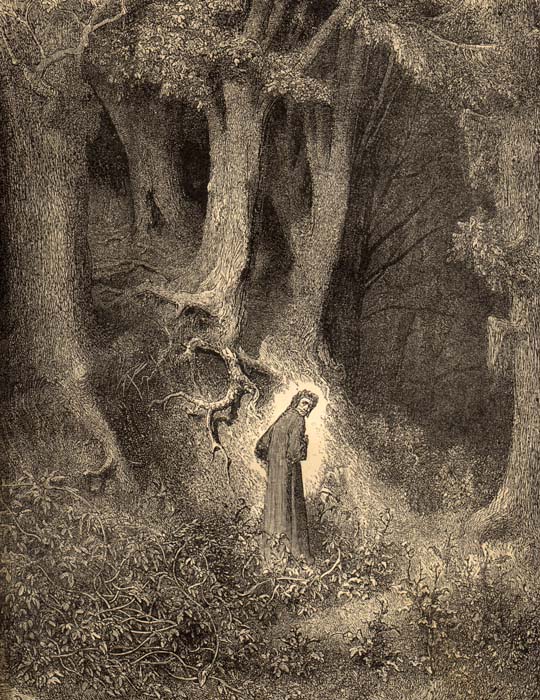
Recently I put up a post called "Top Bards", exploring the idea that every language - or even nation-state - needs some kind of designated superstar writer. England has Shakespeare; Germany has Goethe; Greece has Homer; Spain has Cervantes - and Italy has Dante.
As you can see from the list above, this top bard doesn't have to be a poet - nor (despite appearances) does it have to be a guy: Japan's greatest writer, Lady Murasaki, reigns supreme as the inventor of the psychological novel.
Miguel de Cervantes was an indifferent versifier and playwright, who also wrote one indisputable masterpiece, Don Quixote. Homer (if he ever existed) wrote epics, but no other considerable work by him has come down to us - the attribution to him of the serio-comic Batrachomyomachia, or Battle of Frogs and Mice, has long since been exploded. Goethe wrote a little of everything: novels, epics, dramas, philosophical and scientific treatises - his preeminence doesn't rest solely on Faust. William Shakespeare was, admittedly, one of the greatest of all dramatic poets, but his other poems - the Sonnets alone excepted - are of far more variable quality.
 Giorgio Vasari: Six Tuscan Poets (1544)
[l-to-r: Guittone d'Arezzo, Cino da Pistoia, Petrarch, Giovanni Boccaccio, Dante Alighieri, and Guido Cavalcanti]
Dante, by contrast, was all poet. True, he also wrote prose essays and polemics, but they're only read now for the light they cast on his greatest work, La Commedia [The Divine Comedy]. But it would be possible to argue that his love poetry - La Vita Nuova in particular - has had an even greater influence on European literature.
All this translates into a massive anxiety of influence resting on the back of any poet who wants to break out of the mould of mellifluous smoothness which has dominated Italian verse since the late Middle Ages. Petrarch, Ariosto, Tasso, even Leopardi - all have been forced to live and work under the colossal shadow of Dante.
Until Eugenio Montale came along.

Does that sound unnecessarily melodramatic? I'm sure Montale would think so. But the fact remains that the publication of his first book Ossi di seppia [Cuttlefish Bones] in 1925 was at least as important an event in Italian poetry as the appearance of Eliot's The Waste Land (1922) was for poetry in English.
There's a reason why Montale nearly made it to the distinguished ranks of the Penguin Poets in Translation, with Dante and Petrarch and the other great poets of antiquity. How to explain the nature of his work? There's a famous word-pairing in the opening lines of the Commedia: "aspra e forte".
Nel mezzo del cammin di nostra vita mi ritrovai per una selva oscura, ché la diritta via era smarrita. Ahi quanto a dir qual era è cosa dura esta selva selvaggia e aspra e forte che nel pensier rinova la paura!• In the middle of the path of our life I found myself in a dark wood because the straight way was lost Oh how hard it is to say how it was that wild wood - bitter and strong - that it renews the fear in my thoughts
- literal version by Jack Ross (9/12/2012)

Aspra e forte - bitter (the same word is at the root of our word "asperity") and strong (as in "fortitude"): that was the essence of Montale's verse. Unlike his great predecessors, he never even tried to be sweet and simple. Jonathan Gharraie's rather tongue-in-cheek Paris Review article "Eugenio Montale Comes to New York" sums up his achievement as follows:
Montale belongs with W. H. Auden, Constantine P. Cavafy, and Anna Akhmatova in a fellowship of poets who never have to await rediscovery or critical rehabilitation. Unlike many of their contemporaries, they didn’t willfully capsize their reputations by embracing extremist politics or writing vast, unintelligible tracts of self-justificatory nonsense. Montale quietly championed an uncompromised aesthetic: without making any claims for the amorality of art, he was a wary craftsman for whom inspiration conferred responsibilities, instead of granting license ...Gharraie's affectations of ignorance - of the Italian language, not to mention Montale's specific contributions to it - can't conceal the acuteness with which he quizzes the various pundits invoked in his article:
Much the same could be said of Montale’s own practice as a poet and critic, which manages to be genuinely cosmopolitan while drawing upon the regionally specific landscape and culture of his native Ligurian coast. Before the reading, Professor Viale had stressed the fine discriminations by which Montale’s distinctive view was shaped. We learned that he linked morality to decency in everyday life; that he opposed the positivism of the nineteenth century by affirming the role of chance in his writing; that he was sufficiently affected by the tragedy of the Holocaust to declare that “if it were possible to be Jewish without knowing it, such is my case.”
[At the conference the next day], I would find myself scratching my head as the discussions among the scholarly congregation would frequently revert to Italian. But I would also discover more about Montale’s appeal to American poets and translators, such as Robert Lowell, and about the balance he sought between innovation and tradition. Talking to [Jonathan] Galassi, who edited and translated the Collected Poems in 1998, I learned that Montale “wasn’t a radical, a Marinetti, but he was trying to make it new. He called his work a novelette — it was disjunctive but not fragmented.”Montale, then, was more of an Eliot than a Pound. But he lacked Eliot's frigid, reactionary poetics and politics. Also, his undying devotion to Liguria, the region he grew up in, enabled him to sidestep the pervasive Tuscan flavour of formal Italian.
What does all this mean in practice, though - and how much of it is apparent in translation? Let's take a look. Here's a characteristic poem from his second major collection, Le Occasioni [The Occasions] (1939) - though it was written long before that, at the beginning of the 1930s.

La casa dei doganieri Tu non ricordi la casa dei doganieri sul rialzo a strapiombo sulla scogliera: desolata t'attende dalla sera in cui v'entrò lo sciame dei tuoi pensieri e vi sostò irrequieto. Libeccio sferza da anni le vecchie mura e il suono del tuo riso non è più lieto: la bussola va impazzita all'avventura. e il calcolo dei dadi più non torna Tu non ricordi; altro tempo frastorna la tua memoria; un filo s'addipana. Ne tengo ancora un capo; ma s'allontana la casa e in cima al tetto la banderuola affumicata gira senza pietà. Ne tengo un capo; ma tu resti sola né qui respiri nell'oscurità. Oh l'orizzonte in fuga, dove s'accende rara la luce della petroliera! Il varco è qui? (Ripullula il frangente ancora sulla balza che scoscende ...) Tu non ricordi la casa di questa mia sera. Ed io non so chi va e chi resta. - Eugenio Montale (1930)• You won’t remember the tidewaiters’ house perched on the cliff’s overbearing rock: it has waited for you desolated since the evening your moiling thoughts made their way in to stay put without ever quieting. Sou’westers have whipped round those old walls for years and the sound of your laugh is no longer lighthearted: the compass runs mad, it’s all over the place, your hunch how the dice will roll doesn’t pay off. You don’t remember; some other time gets in the way of remembering; a thread is wound. I still hold one end, but the house pulls back and on top of the roof the smoke-blackened vane spins without pity. I hold an end; you remain alone, you couldn’t breathe here in this dark. Oh the horizon withdraws, where only rarely a tanker’s lights start up. The point to cross over is here? (Breakers seethe as before at the foot of the cliff which is coming apart ...) You won’t remember the house of this, my evening. I don’t know who goes or who stays.
- trans. Kendrick Smithyman (1993)

This is, admittedly, a poet-to-poet translation, by New Zealand polymath Kendrick Smithyman - I'll have more to say about his versions from Italian in my post on Montale's great contemporary Salvatore Quasimodo. But I think enough of the original comes through in Smithyman's text to show that this poem has an impenetrable heart, however straightforward the memories it preserves may seem to be on the surface.
Who is remembering what, for instance? The speaker begins by saying that whomever he's addressing won't remember the Customs Officers’ House. Perhaps because she never visited it? It's one of many poems addressed to an absent lover - but in this case it's stressing the fragility and impermanence of memory - and thus of the experiences which can only be preserved in this way.
Or could it be an actual house where they shared some kind of tryst? Guidebooks to Liguria will tell you the precise location of this hut, but Montale may also have intended a reference to Monet's famous series of paintings - at different times, from different angles - of a similar cottage on the Normandy coast. What exactly is the significance of these Customs Officers and their house? We'll never know. Time moves on. "Ed io non so chi va e chi resta" [I don't know who goes or who stays].
I think that should show you just how much Montale can pack into one short lyric poem. And, whatever it sounds like, it certainly doesn't sound like Dante.
Which brings us to one of his most celebrated anthology pieces, "The Eel".

L’anguilla L’anguilla, la sirena dei mari freddi che lascia il Baltico per giungere ai nostri mari, ai nostri estuarî, ai fiumi che risale in profondo, sotto la piena avversa, di ramo in ramo e poi di capello in capello, assottigliati, sempre piú addentro, sempre piú nel cuore del macigno, filtrando tra gorielli di melma finché un giorno una luce scoccata dai castagni ne accende il guizzo in pozze d’acquamorta, nei fossi che declinano dai balzi d’Appennino alla Romagna; l’anguilla, torcia, frusta, freccia d’Amore in terra che solo i nostri botri o i disseccati ruscelli pirenaici riconducono a paradisi di fecondazione; l’anima verde che cerca vita là dove solo morde l’arsura e la desolazione, la scintilla che dice tutto comincia quando tutto pare incarbonirsi, bronco seppellito; l’iride breve, gemella di quella che incastonano i tuoi cigli e fai brillare intatta in mezzo ai figli dell’uomo, immersi nel tuo fango, puoi tu non crederla sorella? - Eugenio Montale (1948)• The eel, siren of the cold seas that quits the Baltic to come to our seas, to our estuaries, to the rivers rising from the deep, under the downstream surge, from branch to branch and then from capillary to capillary, slimming itself down, increasingly more inside, increasingly into the heart of rock, infiltrating between rills of mud until one day a light glancing off the chestnuts lights her fuse in stagnant puddles, in ravines cascading down from the flanks of the Apennines to Romagna; eel, flashlight, birch, arrow of Love on earth that only our gullies or dried Pyrenean streams lead back to a paradise of insemination; the soul that seeks green life there where only drought and desolation bite, the spark that says everything begins when everything seems burnt to charcoal, a buried stump; brief iris, twin to the one your lashes frame which makes you shine intact in the midst of the sons of man, immersed in your mud, can you not believe her sister?
- literal version by Jack Ross (29/4/2008)

In his fascinating 2009 anthology Corno inglese: An anthology of Eugenio Montale's poetry in English translation, New Zealand-based Academic and poet Marco Sonzogni included a large section devoted solely to the more than fifty English-language versions (to date) of "The Eel".
My own - reprinted here - was one of them. Here's another, by Irish poet Paul Muldoon, from his book Moy Sand and Gravel:

The selfsame, the siren
of icy waters, shrugging off as she does the Baltic
to hang out in our seas,
our inlets, the rivers
through which she climbs, bed-hugger, who keeps going against
the flow, from branch to branch, then
from capillary to snagged capillary,
farther and farther in, deeper and deeper into the heart
of the rock, straining
through mud runnels, till one day
a flash of light from the chestnut trees
sends a fizzle through a standing well,
through a drain that goes
by dips and darts from the Apennines to the Romagna —
the selfsame eel, a firebrand now, a scourge,
the arrow shaft of Love on earth
which only the gulches or dried-out
gullies of the Pyrenees might fetch and ferry back
to some green and pleasant spawning ground,
a green soul scouting and scanning
for life where only
drought and desolation have hitherto clamped down,
the spark announcing
that all sets forth when all that’s set forth
is a charred thing, a buried stump,
this short-lived rainbow, its twin met
in what’s set there between your eyelashes,
you who keep glowing as you do, undiminished, among the sons
of man, faces glistening with your slime, can’t you take in
her being your next-of-kin?
- trans. Paul Muldoon (2002)

According to the notes in Jonathan Galassi's translation of Montale's Collected Poems 1920-1954 (2000):
[William] Arrowsmith [in his dual-text version of La Bufera ed altra, 1985] emphasizes that the eel should not be read as essentially phallic, but that it incorporates both sexes, incarnating an "undifferentiated 'life force' akin to Bergson's elan vital" ... 'The Eel,' then, should be viewed as a cosmic love-poem, an account of the phylogeny of the human spirit as well as a dithyramb to the woman who inspired it, or as [Gilberto] Lonardi ... puts it, "the anabasis of the Anima, in the Jungian sense, of its author".

Paul Muldoon's version is particularly interesting to examine in this respect because of the long discussion of Robert Lowell's strange 1961 translation / adaptation of "The Eel" included in his collection of Oxford lectures on poetry, The End of the Poem. Lowell, it would appear, ended up running this poem into the one which happened to be printed next to it in the Penguin Book of Italian Verse, as he didn't realise that the page divide was also the end of the poem ... And yet, as Muldoon remarks:
I want to go further than Lowell and propose (1) that the “poetic translation” is itself an “original poem,” (2) that the “original poem” on which it’s based is itself a “translation” and (3) that both “original poem” and “poetic translation” are manifestations of some ur-poem. I shy away from this last idea, of course, since it smacks of a Platonism I can’t quite stomach.It is an idea to shy away from, but also a strangely compelling one: one which echoes Walter Benjamin's famous dictum - from his 1923 essay "The Task of the Translator" - that "the question of the translatability of certain works would remain open even if they were untranslatable for man". As George Steiner paraphrased this notion in After Babel:
Walter Benjamin’s view of the translator [was as] one who elicits, who conjures up by virtue of unplanned echo a language nearer to the primal unity of speech than is either the original text or the tongue into which he is translating.


What is it about Montale that takes people down such esoteric highways and byways? Whether or not the translator - as Walter Benjamin posits - is the one who can repair the ancient rift of Babel, and see a work between languages, in its pure Platonic essence, for a precious instant of time, is not really a question of much use to us when it comes to judging the quality and accuracy of particular translations.
It seems best, for that particular exercise, to go back to the beginning, and look at Montale's "Sunflower", included in Ossi di Seppia, and translated innumerable times since then. I discussed the merits and demerits of three of these versions in a Poetry NZ essay on "Poetic Translation" in 2001, but I've added a few more to my repertoire since then:
- The Sunflower
- Bring Me the Sunflower
- The Sunflower
- The Sunflower
- The Sunflower
- The Sunflower
- Sunflowers

Portami il girasole
- Eugenio Montale (1925)
Portami il girasole ch’io lo trapianti
nel mio terreno bruciato dal salino,
e mostri tutto il giorno agli azzurri specchianti
del cielo l’ansietà del suo volto giallino.

Tendono alla chiarità le cose oscure,
si esauriscono i corpi in un fluire
di tinte: queste in musiche. Svanire
è dunque la ventura delle venture.

Portami tu la pianta che conduce
dove sorgono bionde trasparenze
e vapora la vita quale essenza;
portami il girasole impazzito di luce.

- trans. George Kay (1964)
Bring me the sunflower for me to transplant
to my own ground burnt by the spray of sea,
and show all day to the imaging blues
of sky that golden-faced anxiety.

Things hid in darkness lean towards the clear,
bodies consume themselves in a flowing
of shades: and they in varied music – showing
the chance of chances is to disappear.

So bring me the plant that takes you right
where the blond hazes shimmering rise
and life fumes to air as spirit does;
bring me the sunflower crazy with the light.

- trans. Charles Wright (1978)
Bring me the sunflower so I can transplant it
here in my own field burned by salt-spray,
so it can show all day to the blue reflection of the sky
the anxiety of its golden face.

Darker things yearn for a clarity,
bodies fade and exhaust themselves in a flood
of colors, as colors do in music. To vanish,
therefore, is the best of all good luck.

Bring me the plant that leads us
where blond transparencies rise up
and life evaporates like an essence;
bring me the sunflower sent mad with light.

- trans. Jeremy Reed (1990)
Bring me the sunflower and I'll transplant
it in my garden's burnt salinity.
All day its heliocentric gold face
will turn towards the blue of sky and sea.

Things out of darkness incline to the light,
colours flow into music and ascend,
and in that act consume themselves, to burn
is both a revelation and an end.

Bring me that flower whose one aspiration
is to salute the blond shimmering height
where all matter's transformed into essence,
its radial clockface feeding on the light.

- trans. William Arrowsmith (1992)
Bring me the sunflower, I’ll plant it here
in my patch of ground scorched by salt spume,
where all day long it will lift the craving
of its golden face to the mirroring blue.

Dark things are drawn to brighter,
bodies languish in a flowing
of colors, colors in musics. To vanish,
then, is the venture of ventures.

Bring me the flower that leads us out
where blond transparencies rise
and life evaporates as essence.
Bring me the sunflower crazed with light.

- trans. Kendrick Smithyman (1993)
Bring me the sunflower so I can plant it
in my ground burnt as may be with sea salt,
that all day it display to the blue mirror-
wise sky anxious concern of its yellow face.

Obscure things are impelled towards clarity,
bodies exhaust themselves in fluent change
of shades; these, in music. To disappear
is then the chanciest of chances.

Bring me the plant which may lead us
where the fair rise and are translucent,
where life delivers itself into finest spirit:
bring me the sunflower crazed with light.

- trans. Jonathan Galassi (1998)
Bring me the sunflower, let me plant it
in my field parched by the salt sea wind,
and let it show the blue reflecting sky
the yearning of its yellow face all day.

Dark things tend to brightness, bodies
fade out in a flood of colors,
colors in music. So disappearing is
the destiny of destinies.

Bring me the plant that leads the way
to where blond transparencies
rise, and life as essence turns to haze;
bring me the sunflower crazed with light.

- trans. Jack Ross (2001)
Bring me the sunflower so that I can transplant it
in my soil burnt by salt air,
and show all day to the mirroring blues
of the sky the anxiety of its yellow face.

Dark things tend towards clarity,
bodies consume themselves in a flowing
of colours: these in music. Vanishing
is thus the chance of chances.

Bring me the plant that leads
where blonde transparencies rise
and life evaporates like spirit;
bring me the sunflower crazed with the light.

As I once said in some lecture notes intended for my First Year Creative Writing students:
One important test for the writer is the test of translation. This cuts both ways, of course. Some poetry is almost impossible to translate because it relies on properties, such as puns or wordplay, exclusive to its own language. Poetry which is more imagistic or anecdotal can often translate very successfully, though.Can you do all those things simultaneously, in fact? Here's what I had to say on the matter in the 2001 essay mentioned above. Let's begin with George Kay:
For the translator, then, the challenge of being faithful to a poem’s meaning without losing its music and precision is a daunting one.
The first thing to note is that Kay tries to preserve the rhyme scheme of the original in all but the first stanza, which explains some of his infelicities of syntax: “spray of sea” in l.2. is not really acceptable under that old Poundian rule (“nothing that you couldn’t, … in the stress of some emotion, actually say”). There are also too many lines like l.5: “Things hid in darkness lean towards the clear.” A more idiomatic English would insist on using “hidden” and “clarity” here, just as it would refuse to admit “takes you right / where” in ll.9-10 – a redundant expression supplied purely for the rhyme.Moving on, then, to Kendrick Smithyman, whose knowledge of Italian came solely from cribs:
The second consideration concerns the actual meaning of the poem – what is it about? Montale seems to be saying that the “anxiety” of the sunflower’s face mirrors a general tendency in things to seek non-existence: “Svanire / è dunque la ventura di venture.” Kay’s poem says that dark things seek to expose themselves to “the clear,” bodies to turn into shades, shades into music – a series of Ovidian metamorphoses which remind one more of photosynthesis than non-entity. Generally, it’s a more cheerful piece, without the unsettling sense of instability which undermines the original.
It was a wise choice to ignore the rhymes, I think. Certainly the diction here is far less strained and distorted. Oddities and departures may therefore be examined on their own merits: “burnt as may be by sea salt” – in the original it is burnt; there is no doubt about the fact. Ah, but of course the mirroring is conditional upon its being transplanted, so perhaps Kendrick means to bring in that conditional tense a little early. Certainly the relentless enjambment of the lines makes us a little “anxious” about their ability to resolve the syntactic pattern.And finally to a translation by the doyen of English-language Montale scholars, William Arrowsmith:
What else? “To disappear / is then the chanciest of chances.” This is a crux: if we read it “chance of chances” (like Kay), we are seeing it as good luck; if we read it as “venture of ventures” (like Arrowsmith below) we are seeing it as a thrilling enterprise; if (like Kendrick) we read it “chanciest of chances,” we are seeing it as a terrible risk. And so the flower, for him, becomes something which may lead us – not does lead us – to that happy land where “the fair rise and are translucent.” This may not be Montale’s poem exactly, but it is a poem: an edgy, anxious poem, a little dubious about its quest for clarity and, ultimately, disappearance (non-being, even).
“To die must be an awfully big adventure.” This is Montale as Peter Pan. The sunflower’s face is now “craving,” not made anxious by, the blue sky, and “to vanish” is the “venture of ventures.” You’ve always wanted to meet a nice, transparent blond? Well, just follow the yellow crazed flower.I can't promise to keep up this minute level of analysis - nor, I think, would you thank me for doing so - but I think you get the general idea. Verbal choices have ideological implications, and the entire tenor of a poem can be shifted off base, or even reversed, by decisions made for the sake of balance or euphony.
Yes, I know that sarcasm is the lowest form of wit, and I do see that Arrowsmith’s is a nice clean translation, with fewer awkwardnesses of diction or syntax than either of his two predecessors, but it seems to me profoundly false to the spirit of Montale’s poem. There’s no “anxiety,” no problems left – the salt-sown garden now seems positively fertilised by “spume,” and the “mirroring blue” has become a goal, not a threat.
But then, the same could be said of any poem. Paul Muldoon, at any rate, seems unwilling to acknowledge any great difference between a poem and a poetic translation. Leaving my own literal crib to one side, we're left with Charles Wright, Jeremy Reed, and Jonathan Galassi.
Wright's seems sound to me, albeit a little short on word-music (perhaps the best thing to scant on). Reed's is very free. His attempt to preserve some of the original rhymes has led to some curiously polysyllabic neologisms. I like it as a poem, though I'm not sure I recognise very much of Montale in it. Galassi's is almost a xerox copy of the phrasing of the original. Making that work in English is not as easy as it might appear, so I have to salute him for that. Essentially, it's a version meant for dual-text presentation - ideal for those with some Italian, but not enough to tease out the intricacies of Montale's original on their own.

But that's not really where I want to leave the subject. There's another Montale as well. After the three great canonical collections, Cuttlefish Bones (1925), The Occasions (1939), and The Storm and Other Things (1956) - the ones included in Galassi's Collected Poems - the old man refused to retire and rest on his laurels.
Instead, he started to compose some simpler, less hermetic - journalistic, even - verses about the events of his daily life. The result was a set of late books entitled Satires (1971), Diary of 71-72 (1973), and Four Years of Notebooks (1977).
The critics were outraged. This was not the Montale they knew, the consummate lyricist and metaphysical visionary - some of them even questioned whether such colloquial snippets could be called poems at all!
But if you stop reinventing yourself creatively you die, and Montale had no intention of clocking out before his time. These last verses are harsh, ironic, and not particularly lovely. But isn't that what modern poetry is all about? In Celan's famous dictum: "La poésie ne s’impose plus, elle s’expose" [Poetry no longer imposes itself, it exposes itself].
At times Montale seemed to be taking aim at his own earlier self, as in this late poem "The Fleas" - a riposte, perhaps, to his bravura piece "The Eel"?

Le Pulci Non hai mai avuto una pulce che mescolando il suo sangue col tuo abbia composto un frappé che ci assicuri l’immortalità? Così avvenne nell’aureo Seicento. Ma oggi nell’età del tempo pieno si è immortali per meno anche se il tempo si raccorcia e i secoli non sono che piume al vento. - Eugenio Montale (1971)• Did you ever have a flea that combined its blood with yours and mixed up a milkshake to guarantee us immortality? That’s what happened in the Golden Age of the sixteen hundreds, but today in the age of full-time professionals it takes less to get immortalized, even if time contracts and the centuries are nothing but feathers on the wind.
- trans. George Bradley (2024)


Books I own are marked in bold:
-
Poetry:
- Ossi di seppia (1925)
- Cuttlefish Bones (1920-1927). 1925 & 1928. Trans. William Arrowsmith. New York: W. W. Norton, 1992.
- La casa dei doganieri e altre poesie [chapbook] (1932)
- Poesie (1938)
- Le occasioni (1939)
- The Occasions. 1939. Trans. William Arrowsmith. New York: W. W. Norton, 1987.
- Finisterre. Versi del 1940-42 [chapbook] (1943)
- La bufera e altro (1956)
- The Storm & Other Poems. Trans. Charles Wright. Ohio: Oberlin College Press, 1978.
- The Storm and Other Things. 1956 & 1957. Trans. William Arrowsmith. New York: W. W. Norton, 1985.
- Satura (1962)
- Accordi e pastelli [chapbook] (1962)
- Il colpevole [chapbook] (1966)
- Xenia. 1964-1966 [poems in memory of Mosca] [chapbook] (1966)
- Satura. 1962–1970 (1971)
- Satura 1962-1970. 1971. Trans. William Arrowsmith. Preface by Claire de C. L. Huffman. Ed. Rosanna Warren. New York: W. W. Norton, 1998.
- Diario del '71 e del '72 (1973)
- New Poems (Satura & Diario del ’71 e del ’72). 1971 & 1973. Trans. G. Singh. Introduction by F. R. Leavis. London: Chatto & Windus, 1976.
- Trentadue variazioni [chapbook] (1973)
- Quaderno di quattro anni (1977)
- It Depends: A Poet’s Notebook (Quaderno di Quattro anni). 1977. Trans. G. Singh. New York: New Directions, 1980.
- Tutte le poesie (1977)
- Mottetti. Ed. Dante Isella (1980)
- L'opera in versi, edizione critica. Ed. Rosanna Bettarini e Gianfranco Contini (1980)
- Altri versi e poesie disperse. Ed. Giorgio Zampa (1981)
- Tutte le poesie. Ed. Giorgio Zampa (1991)
- Tutte le Poesie. Ed. Giorgio Zampa. Grandi Classici. 1984. Milano: Arnoldo Mondadori Editore, 1991.
- Diario postumo. Prima parte: 30 poesie. Ed. Annalisa Cima, with Rosanna Bettarini (1991)
- Diario postumo. 66 poesie e altre. Ed. Annalisa Cima, with Rosanna Bettarini,. Preface by Angelo Marchese (1996)
- Posthunous Diary / Diario postumo. Trans. Jonathan Galassi (2001)
- Poesia travestita. Ed. Maria Corti & Maria Antonietta Terzoli (1999)
- La casa di Olgiate e altre poesie. Ed. Renzo Cremante & Gianfranca Lavezzi. With drawings by Montale (2006)
- La fiera letteraria [criticism] (1948)
- Farfalla di Dinard [stories] (1956)
- Auto da fé: Cronache in due tempi [cultural criticism] (1966)
- Fuori di casa [collected travel writing] (1969)
- La poesia non esiste [criticism] (1971)
- Nel nostro tempo (1972)
- Sulla poesia (1976)
- Autografi di Montale. Curated by Maria Corti & Maria Antonietta Grignani (1976)
- Prime alla Scala [music criticism]. Ed. Gianfranca Lavezzi (1981)
- The Second Life of Art: Selected Essays. Trans. Jonathan Galassi (1982)
- The Second Life of Art: Selected Essays of Eugenio Montale. Trans. Jonathan Galassi. New York: The Ecco Press, 1982.
- Prose e racconti. Ed. Marco Forti & Luisa Previtera (1995)
- Prose e racconti. Ed. Marco Forti & Luisa Previtera. I Meridiani. Milano: Arnoldo Mondadori Editore, 1995.
- Il secondo mestiere. Ed. Giorgio Zampa (1996)
- Prose 1929–79
- Arte, musica, società
- L'arte di leggere. Una conversazione svizzera. Ed. Claudio Origoni & Maria Grazia Rabiola (1998)
- [with others] Le amiche dei gatti (2014)
- La botanica. Cronache coniugali (2018)
- L'oscura primavera di Sottoripa. Scritti su Genova e Riviere. Ed. Stefano Verdino & Collana Evoè (2018)
- Verdi alla Scala (1955-1966) e altri scritti. Ed. Stefano Verdino & Paolo Senna (2020)
- Opera completa. 6 vols (1996)
- Eugenio Montale. Immagini di una vita. Ed. Franco Contorbia. Introduction by Gianfranco Contini (1996)
- Le carte di Eugenio Montale negli archivi italiani. Ed. Gianfranca Lavezzi (2021)
- John Steinbeck, La battaglia [In Dubious Battle] (1940)
- Herman Melville, Billy Budd (1942)
- John Steinbeck, Al dio sconosciuto [To a God Unknown] (1946)
- T. S. Eliot tradotto da Montale (1958)
- Jorge Guillen tradotto da Montale (1958)
- Montale traduce Shakespeare: Amleto. 1949 (1971)
- Quaderno di traduzioni. 1948 (1975 / 2018 / 2021)
- William Henry Hudson, La vita della foresta [Green Mansions]. Ed. with an afterword by Maria Antonietta Grignani (1987)
- William Shakespeare, Giulio Cesare nella traduzione di Eugenio Montale. Ed. Luca Carlo Rossi (2023)
- Interviste a Eugenio Montale (1931-1981). Ed. Francesca Castellano (2020)
- Quaderno genovese. [Journal from 1917]. Ed. Laura Barile (1983)
- E. Montale e Italo Svevo, Lettere, con gli scritti di Montale su Svevo. Ed. Giorgio Zampa (1966)
- Lettere a Quasimodo. Ed. Sebastiano Grasso (1981)
- Il carteggio Einaudi-Montale per «Le occasioni» (1938-1939). Ed. Carla Sacchi (1988)
- Lettere e poesie a Bianca e Francesco Messina. Ed. Laura Barile (1995)
- E. Montale e Sandro Penna, Lettere e minute 1932-1938. Ed. Roberto Deidier (1995)
- E. Montale, Gianfranco Contini, Eusebio e Trabucco. Carteggio. Ed. Dante Isella (1997)
- Giorni di libeccio. Lettere ad Angelo Barile (1920-1957). Ed. Domenico Astengo & Giampiero Costa (2002)
- "Le sono grato". Lettere di Eugenio Montale e Angelo Marchese (1973-1979). Ed. Stefano Verdino (2002)
- Caro maestro e amico. Lettere a Valéry Larbaud (1926-1937). Ed. Marco Sonzogni (2003)
- Lettere a Clizia. Ed. Rosanna Bettarini, Gloria Manghetti & Franco Zabagli (2006)
- Moscerilla diletta, cara Gina. Lettere inedite (2017)
- Divinità in incognito. Lettere a Margherita Dalmati (1956-1974). Ed. Alessandra Cenni (2021)
- E. Montale e Sergio Solmi, Ciò che è nostro non ci sarà mai tolto. Carteggio 1918-1980. Ed. Francesca D'Alessandro, Appendice di prose inedite e ritrovate ed. Letizia Rossi (2021)
- Caro Charlie. Eugenio Montale a Carlo Bo. Ed. Stefano Verdino (2023)
- Selected Poems. Trans. George Kay (1964)
- Selected Poems. Trans. George Kay. 1964. Penguin Modern European Poets. Harmondsworth: Penguin, 1969.
- The Coastguard's House / La casa dei doganieri: Selected Poems. Trans. Jeremy Reed (1990)
- Collected Poems. Trans. Jonathan Galassi (1999)
- Collected Poems 1920-1954: Ossi di Seppia / Cuttlefish Bones; Le Occasioni / Occasions; La Bufera e Altro / The Storm, etc. Revised Edition. Trans. Jonathan Galassi. 1998. New York: Farrar, Straus and Giroux, 2000.
- Eugenio Montale: Poems. Ed. Harry Thomas (2002)
- Montale in English. Ed. Harry Thomas. 2002. Handsel Books. New York: Other Press, 2005.
- Selected Poems. Trans. Jonathan Galassi, Charles Wright, & David Young (2004)
- Corno inglese: An anthology of Eugenio Montale's poetry in English translation (2009)
- Corno inglese: An anthology of Eugenio Montale's poetry in English translation. Ed. Marco Sonzogni. Novi Ligure: Edizioni Joker, 2009.
- The Collected Poems Of Eugenio Montale: 1925-1977. Trans. William Arrowsmith (2012)
- The Collected Poems Of Eugenio Montale: 1925-1977. Trans. William Arrowsmith. Ed. Rosanna Warren. New York: W. W. Norton, 2012.
- Xenia [Bilingual version]. Trans. Mario Petrucci (2016)
- Montale's Essential: The Poems of Eugenio Montale in English. Trans. Alessandro Baruffi (2017)
- Late Montale. Trans. George Bradley (2024)
- Giulio Nascimbeni, Giulio. Montale, biografia di un poeta (1986)
Prose:
Collected Works:
Miscellaneous:
Translated:
Interviews:
Diary:
Letters:
Translations:
Secondary:

•
 William Roberts: The Vorticists at the Restaurant de la Tour Eiffel (1961-62)
Modern Poets in English
- C. P. Cavafy (1863-1933)
- Anna Akhmatova (1889-1966)
- Osip Mandelstam (1891-1938)
- Arthur Rimbaud (1854-1891)
- Guillaume Apollinaire (1880-1918)
- Rainer Maria Rilke (1875-1926)
- Paul Celan (1920-1970)
- Eugenio Montale (1896-1981)
- Salvatore Quasimodo (1901-1968)
- Federico García Lorca (1898-1936)
- Pablo Neruda (1904-1973)
- Fernando Pessoa (1888-1935)